
“John William Waterhouse’s painting captures Diogenes of Sinope, the most infamous of the ancient Greek Cynic philosophers. True to historical legend, he is depicted living inside a pithos – a massive ceramic jar (often referred to as his tub) in a public Athens marketplace.”
1 pithos
As the first tendril of light reached into the pithos1, it softly tickled the haggard face within, and the Dog heeded the call of Hallios,and with him Diogenes stirred, yawned and shed the last of the night’s uneasy dreams of his errant youth, for Diogenes was none other than the Dog incarnate, a philosopher in rags, a seeker of truth in a world of pretense and an exile from Sinope censured by his native city.
The Agora was already stirring. Shopkeepers raised their awnings, carts rattled over the stones, and a bevy of rebellious young sightseers observed the famous ascetic philosopher’s scandalous domestic arrangements from a safe distance.
The Dog was thirsty and all the water in Athens would not suffice for he craved a stronger draught, preferably of a vintage blessed by Dionysus2.
2 the greek god of wine
Diogenes, now a pauper, had been born the son of a banker and was blessed to a long life of austerity while cursed with the refined tastes of an aristocrat, and to exacerbate matters of late his patrons, had grown less generous, complaining how this Dog invariably bit any hand that dared to feed it.
To which Diogenes retorted, “other dogs bite their enemies, but I bite my friends to save them.”

In this image, the Flemish Baroque master Peter Paul Rubens depicts a chaotic, joyful celebration of the Bacchanalia, where the god of wine and fertility Bacchus (Dionysus), his elderly tutor Silenus, bacchantes (female followers), and goat-legged satyrs are reveling in the pleasures of wine, music, and dance.
By noon the Agora was thick with carts, merchants, magistrates and respectable men.

Tischbein’s portrayal captures Diogenes in his characteristic search for an honest man, lamp in hand, amidst the bustling Agora. The artist emphasizes the philosopher’s eccentricity and the contrast between his austere lifestyle and the wealth surrounding him.
Diogenes lit his lamp.
“An honest man!” he cried. “Has anyone seen an honest man?”
Prospero, an intrepid sea captain and wine merchant, stopped before him.
“You’ve been searching for this honest man for years.”
“With diminishing expectations.”
“Then prove there isn’t one.”
Diogenes lowered his lamp and looked at Prospero.
Prospero looked sheepishly back.
Have they had done this sort of thing before?
“Very well.”
Diogenes suddenly turned away from him.
“PROSPERO ASKS HOW ONE MAY RECOGNIZE AN HONEST MAN!”
His voice carried halfway across the Agora. Heads turned.
Prospero scratched his beard.
“I was about to ask how.”
“As I said.”
A few merchants laughed.
Prospero’s emporium imported wine for every purse and constitution. There was rough Attic rum for sailors, students and philosophers without patrons; Miranda, the house vintage named after his wife from his family’s vineyard; Mendaean and Lesbian wines; fine Thasian; pale wines brought from the black pumice beaches of Thera; and, behind the counter, Chian bottles whose prices caused sober men to reconsider drinking.
Prospero continued playing the dunce.
“And how shall we nominate this man?”
“Bring me someone who knowingly sacrificed profit rather than speak falsely. Tell me what the truth cost him.”
“And what must the nominator stake?”
“Wine.”
“Any wine?”
Diogenes looked at him sharply.
Prospero’s face remained admirably vacant.
The Dog smiled.
He stepped upon one of Prospero’s empty crates.
The transformation was remarkable.
The stooped, sunburnt vagrant seemed to gain more than the three feet Prospero’s crate afforded him. His back straightened. The lamp became almost a thunderbolt in his raised hand. His rags fell about him like the imperfect disguise of Zeus visiting mortals to investigate their wickedness. His voice, ordinarily a rasp designed to injure the citizen nearest him, rolled across the Agora.
“A MAN’S WAGER SHALL MEASURE HIS CONFIDENCE!”
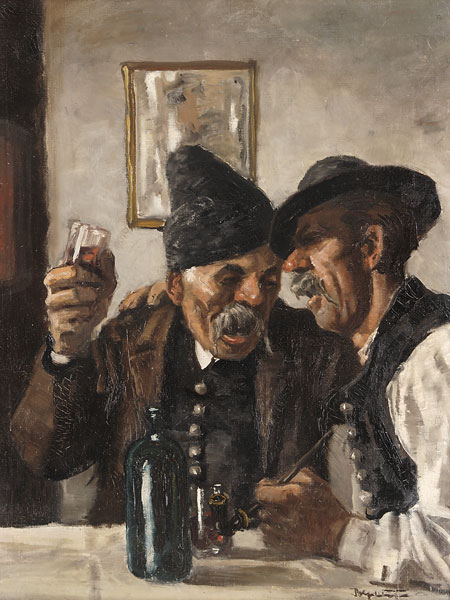
In vino veritas” translates to “in wine, there is truth,” reflecting the ancient idea that alcohol lowers inhibitions and prompts people to speak their unguarded minds. In the context of the painting In vino veritas by Hungarian artist Tibor Pólya (1886–1937), this theme intersects elegantly with the classical philosophical pursuit of “finding an honest man.”
The Agora quieted.
“Bring swill and you proclaim a scoundrel. Bring Miranda and I shall hear you respectfully. Bring Thasian and I may even believe you.”
Prospero raised one finger.
“And Chian?”
Diogenes waited.
He knew how long.
“Then you had better have brought Socrates.”
The applause began before he lowered his hand.
The Dog had found his stage.

Prospero nominated Cephalus, the wealthy old gentleman known for paying his debts and sleeping soundly thereafter.
He put down a flask of Miranda.
Diogenes listened with grave attention.
“How much did his honesty cost him?”
Prospero named the sum.
Diogenes looked at Cephalus. Then at the wine. Then at the crowd.
He let the silence ripen.
“Honesty is inexpensive when one is rich enough to afford it.”
Applause.
A citizen named Lysias nominated Nicias and accompanied the claim with a respectable Lesbian vintage. Nicias had once surrendered an advantage rather than violate an oath.
“Who knew of the oath?”
“Half Athens.”
“Then the other half would have heard by supper.”
Laughter.
Chaerephon came next carrying an ugly little flask.
“Anytus!”
The crowd jeered before Diogenes could speak.
Diogenes tasted the offering and spat magnificently over the side of the crate.
Prospero sniffed it.

Exekias the pootter “Dionysos Cup” depicts Dionysos, reclining in a relaxed pose, in a small sailing ship surrounded by dolphins as it passes under vines heavily laden with grapes.
“Cheap Attic. They’ve strengthened it with boiled must.”
Diogenes handed it back.
“One dishonest thing at a time.”
The Agora roared.
The nominations continued.
So did the wine.
A curious market developed. Miranda accompanied respectable citizens. Mendaean announced confidence. Thasian caused murmuring before the candidate was even named. Prospero, who understood markets better than philosophers did, began arranging the bottles by quality without being asked.
Diogenes’ answers grew more dramatic with the crowd.
Yet he did not merely insult. He listened.
When an argument was poor, the Dog sometimes became unnervingly still. He let the speaker build it, embellish it, defend it and finally grow confident in it.
Then he bit.
The crowd learned to recognize the silence before the teeth.
By midafternoon the affair had become fashionable.
Wealthy spectators arrived under parasols. Slaves stood behind them working fans. One matron had servants scatter fragrant petals and potpourri whenever the breeze blew from Diogenes toward her party.
Diogenes stopped in the middle of an argument and sniffed himself.
“Flowers?”
“For the heat,” said the matron.
“Naturally.”
More applause.
Two Sophists appeared at the edge of the Agora, each accompanied by a prosperous train of paying students.
Protagoras noticed Diogenes.
Gorgias noticed the crowd.
Both discovered urgent business in another direction.
Nobody dared call after them.

Antisthenes. Roman copy after a Hellenistic original.
At the edge of the gathering, Antisthenes found Socrates drinking water.
The older philosopher watched his former pupil for a while before speaking.
“He worries me.”
Socrates followed his gaze to Diogenes.
“That is one of his accomplishments.”
“I taught him that virtue requires very little.”
“Apparently he learned it.”
“Too well. A man may throw away his possessions more easily than his passions.”
Diogenes’ voice thundered across the Agora, followed by another burst of laughter.
Antisthenes frowned.
“Sometimes I cannot tell whether he commands the Dog or the Dog commands him.”
Socrates drank.
“Perhaps neither can he.”
A commotion behind them announced Alcibiades.
Socrates sighed before turning around.
Alcibiades was seldom far from Socrates, partly because Socrates loved the brilliant young man and partly because leaving Alcibiades unsupervised for long periods had repeatedly proved unwise.
He arrived carrying an expensive Chian bottle. A small dog trotted beside him.
Diogenes saw the bottle from his crate.
The performance stopped.
He knew Alcibiades particularly well. Three years earlier the youth had smashed his pithos during a nocturnal adventure whose details Alcibiades disputed and Athens improved with every retelling. A replacement had appeared only the previous year after a debate in the Agora over whether providing Diogenes with another home constituted charity, civic improvement or encouragement.
Alcibiades placed the Chian before the crate.
The crowd murmured.
“Who?” asked Diogenes.
“Gorgias.”
Silence.
Diogenes looked at the bottle.
Then at Alcibiades.
Then toward the disappearing Sophist.
“You don’t believe that.”
Alcibiades smiled.
Diogenes picked up the Chian.
“Smart Alec.”
The name stuck.
Alcibiades produced another bottle, a fine pale wine from Thera.
“A peace offering.”
“For my pithos?”
“For Socrates. I nominate him.”
This produced a different murmur.
Diogenes examined the Theran carefully.
Only then did he notice Alcibiades’ companion.
“You own a dog?”
“Aye.”
Diogenes looked at the little animal. Then at Alcibiades.
“A dog owning a dog.” He appeared to contemplate the problem, then quipped, “Athens has perfected democracy.”
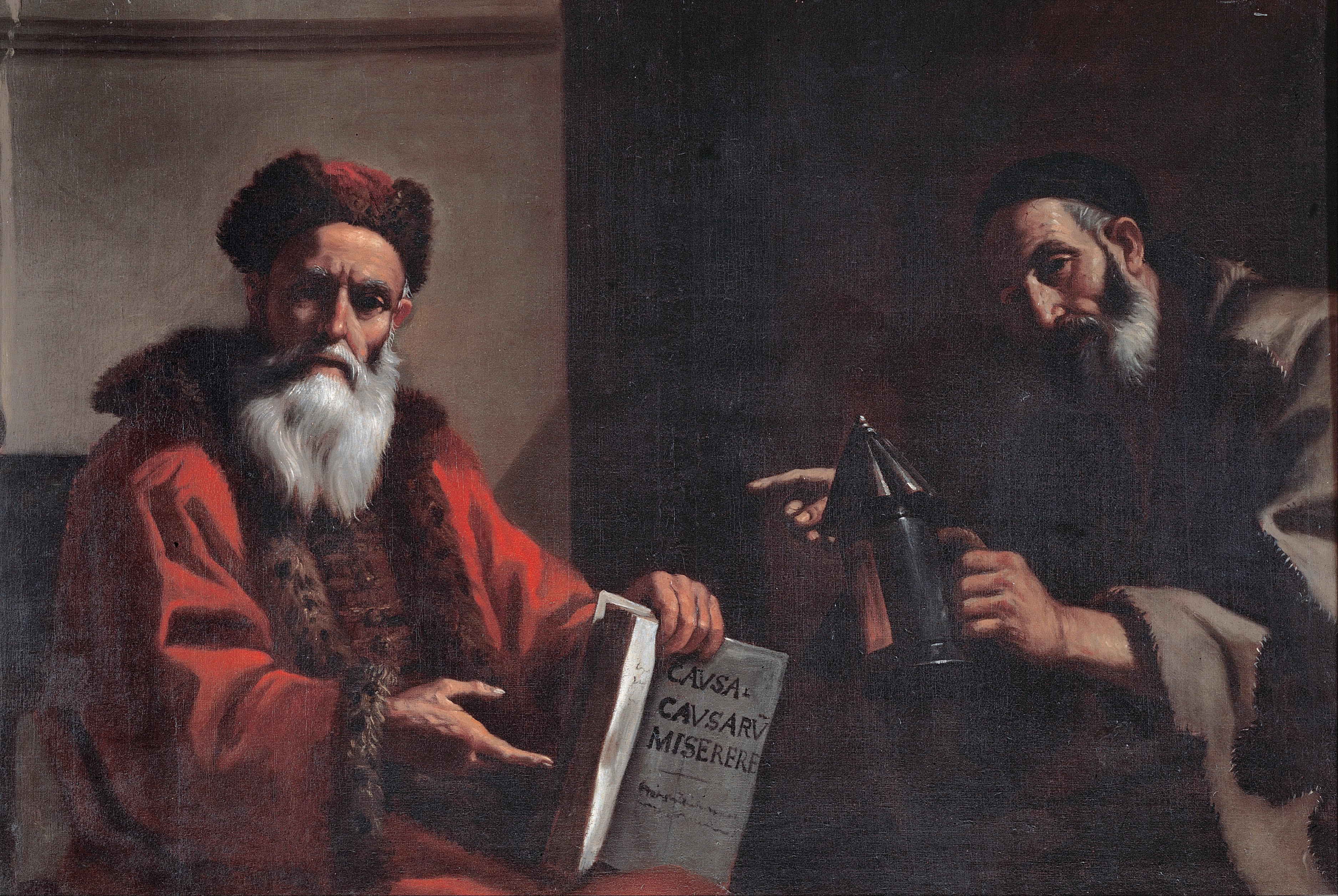
Preti’s portrayal captures the encounter between Diogenes and Plato, emphasizing the contrast between Diogenes’ asceticism and Plato’s philosophical demeanor. The composition highlights the tension and dialogue between the two figures.
The crowd had begun calling for Socrates.
Alcibiades returned to his teacher.
“They want you.”
Socrates accepted another cup of water.
“What does Plato call him?” Socrates asked.
Alcibiades grinned.
“A mad sort of Socrates.”
Plato had heard him.
“Let the Dog’s story be a caution to you, Alcibiades. He began rather more like you than you might find comfortable.”
“Handsome?”
“Promising.”
“Ah.”
“The son of a banker. Money, position, intelligence—and therefore no shortage of Sophists willing to cultivate him at considerable expense.”
Socrates raised an eyebrow.
“Cultivate?”
“Feed,” said Plato. “They fed the clever part of him and the vain part together until neither could distinguish itself from the other.”
Alcibiades glanced toward Diogenes.
“They don’t appear to have fed him recently.”
“Not his stomach. The Dog. Every clever answer was rewarded with a cleverer one. Every appetite acquired an argument. Every act of insolence became independence of mind.”
Socrates looked at Alcibiades.
Alcibiades noticed.
“Why are you looking at me?”
“No reason.”
Plato continued.
“Then he consulted the oracle. ‘Deface the currency,’ he was told—or believed he was told. He followed Apollo’s advice with the judgment one might expect of a young man whose teachers had taught him to justify anything.”
“There was a scandal,” said Alcibiades.
“There was exile. His fortune disappeared. He may never return to Sinope. He may never again own anything of substantial value.”
They looked toward the pithos.
“Nothing anyone can confiscate,” said Socrates.
Plato gave him a look.
“That is exactly the sort of encouragement he does not need.”
Socrates smiled.
“So he came to Athens,” Plato continued, “and sought Antisthenes—a pupil of Socrates and, presumably, a teacher who might finally teach the man to muzzle the Dog.”
“And did he?”
“He tried to drive him away with a stick.”
Alcibiades laughed.
“What did Diogenes do?”
“Offered him his head and told him he would find no stick hard enough to drive him away if Antisthenes had something worth teaching.”
Socrates nodded appreciatively.
“So the Dog found his master.”
“Or Antisthenes discovered his burden.”
Alcibiades looked from Plato to Diogenes.
“A mad sort of Socrates.”
“Indeed,” said Socrates. “And you may yet learn something from him. There is method in that madness.”
“A mad sort of Socrates.”
“Watch him,” said Socrates. “See when he masters it—and when it masters him.”
The speaker finally finished.
Diogenes asked one question.
The argument collapsed.
The crowd erupted.
Alcibiades looked thoughtful.
Alcibiades frowned.
“You’re comparing me to him again.”
“No,” said Plato. “We are trying to prevent the comparison from becoming exact.”
“That wasn’t your position when you persuaded the Assembly to replace his pithos.”
Socrates groaned.
“That pithos again.”
Three years earlier Alcibiades and several companions had smashed Diogenes’ home during a nocturnal expedition which they maintained had begun as philosophy and which everyone else remembered differently.
The following year the question of replacing it had somehow reached public debate.
Some called replacement charity.
Others called it compensation.
One magistrate called it an invitation to further vandalism.
Diogenes called the entire proceeding evidence that Athens possessed too many magistrates.
It had been Socrates and Plato who finally swayed the vote: replace the pithos, they argued, but don’t merely punish the young men. Reform them.
The Assembly had agreed enthusiastically.
It had then appointed Socrates and Plato responsible for doing so.
Alcibiades smiled.
“You won.”
“Yes,” said Socrates. “I’ve been more careful about winning arguments ever since.”
“What about Plato?”
Socrates smiled.
“Plato knows my arguments. Let us see whether he can make his own.”
As if summoned, Diogenes raised his lamp.
“SOCRATES!”
The crowd took it up.
“Socrates! Socrates!”
Plato appeared considerably less amused than his teacher.
“Socrates, Diogenes has been working the crowd, and Alcibiades has played into his hand. They’re calling for you.”
“I’m not worried about the Dog. His bite is no worse than his bark.”
The chanting grew louder.
“Go ahead, Plato. See whether you can pacify them. You’re very fine in the Academy, but you can yet improve your thinking on your feet. Go a round or two with the Dog. I’ll watch Alcibiades and Aristotle.”
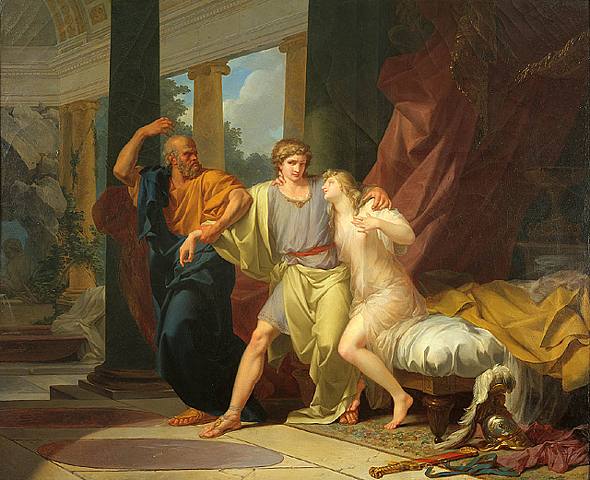
In Jean-Baptiste Regnault we see Socrates dragging Alcibiades from the Embrace of Sensual Pleasure. The sword and helm indicating his future as a General.
Alcibiades pretended to be offended.
“You make us sound like children.”
Socrates looked at Aristotle.
“One of you is.”
“The pithos was replaced. The vandals remain a work in progress.” said Plato.
“Students,” said Alcibiades.
“Terms imposed by the court are not improved by vocabulary.”
Then the crowd calls:
“SOCRATES!”
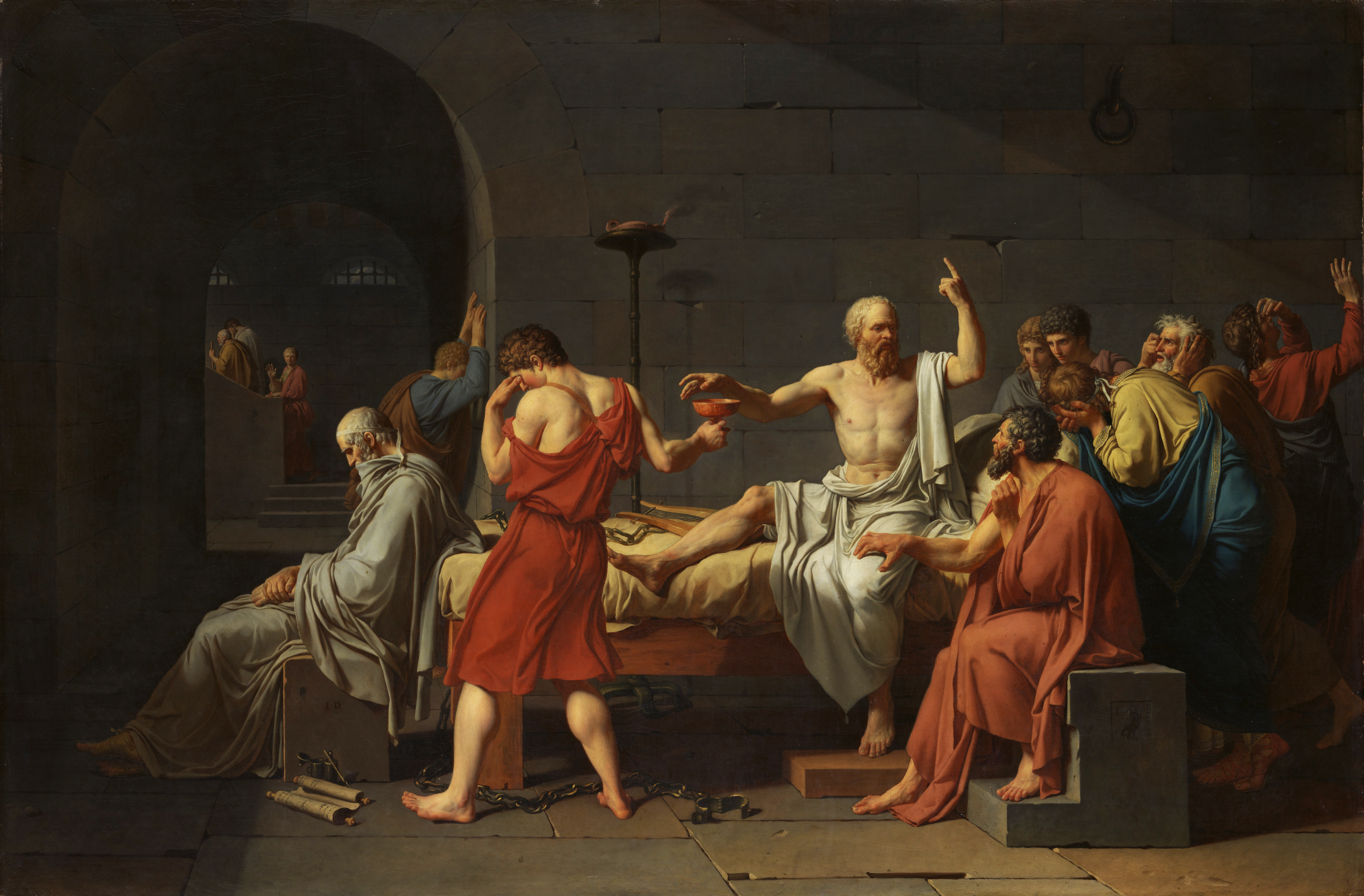
In Jacques-Louis David’s painting “The Death of Socrates”, Socrates is depicted in the moment of his final discourse, reaching for the cup of hemlock with calm resolve, surrounded by his distraught disciples. But in this tale no philosophers were hurt – and the great Socrates imbibed only whine and water.
And Alcibiades can say:
“They want you.”
Socrates drinks his water.
“Let them want.”
Plato entered the circle.
Diogenes did not pounce.
That surprised everyone.
“What precisely,” Plato began, “do you mean by profit?”
“Profit.”
“That is repetition, not definition.”
A few people laughed.
This time at Diogenes.
The Dog’s eyes brightened.
“Proceed.”
“Suppose a man refuses a hundred drachmae rather than tell a lie. You say he has sacrificed a hundred drachmae.”
“I might.”
“But suppose he values justice more highly than the money.”
“Then?”
“Then your accounting fails. You measure the visible thing surrendered and ignore the good retained.”
Diogenes said nothing.
Plato gained confidence.
“A just man need not experience honesty as sacrifice at all. The harmonious man chooses according to what he judges good. You seek virtue by measuring pain, as though the man who suffers most must therefore be best.”
Some of Plato’s pupils applauded.
Diogenes scratched his beard.
“Finished?”
“For the moment.”
The Dog pounced.
“You have hidden the rabbit in the hat.”
Plato frowned.
“You call your man just because he values justice. Then, when I ask how you know he is just, you tell me he values justice.”
“That is not my argument.”
“Good. Then make a better one.”
The crowd laughed.
Plato held his ground.
“You confuse explanation with proof. A physician’s preference for health does not prove that health exists, but neither does it make his treatment circular. Character determines what a man chooses.”
“And how shall I see this character of yours?”
“Through his choices.”
“So I inspect the act.”
“Among other things.”
“And when the act profits him?”
“We determine what he believed he was choosing.”
Diogenes smiled.
“And now, to discover whether his action was honest, I must ask the accused what was inside his soul.”
Plato hesitated.
The Dog waited.
“Prospero!” Diogenes called.
The merchant looked up.
“Your wine is unnecessary. Plato has invented a test in which every man supplies his own witness.”
The crowd broke.
Even Socrates laughed.
Plato flushed, but remained in the ring.
“You’ve shown that my account requires knowledge we may not possess. You have not shown it false.”
Diogenes’ smile disappeared.
For the first time he nodded to Plato.
“A bite returned.”
At the edge of the crowd Alcibiades made a mark on his tablet.
Socrates noticed.
“What did you see?”
“He waited.”
Socrates said nothing.
“He could have mocked Plato before Plato finished. He waited until there was an argument worth attacking.”
Socrates smiled.
“Keep taking notes.”
A younger voice interrupted.
“But Plato is right about one thing.”
Diogenes turned.
Aristotle had been standing behind his teacher, watching the wine with considerable suspicion.
“What?”
“You aren’t testing whether men are honest. You’re testing the price of honest acts.”
The Agora became unexpectedly quiet.
Diogenes stared at the boy.
Then at Plato.
“Whose?”
“Mine.”

Jusepe de Ribera depicts and older yet wiser Aristotle.
“Promising.”
Diogenes poured a cup.
Plato shook his head.
Aristotle looked at Plato, then at Diogenes, then warily at the wine.
He swallowed it in one determined gulp.
Diogenes raised an eyebrow.
Ten minutes later the boy was asleep against Prospero’s crate.
Diogenes pointed.
“Graduated.”
By now the Dog had everything the Dog wanted.
Someone had brought bread and olives. Prospero’s nomination economy had produced enough wine for a minor festival. The autumn sun was warm without being cruel. Diogenes had eaten his fill and could reasonably expect the day’s notoriety to provide tomorrow’s breakfast as well.
He could have stretched out beside his pithos and counted himself ahead of the game.
Instead he was arguing about the nature of justice.
Socrates finally approached.
He looked at the remains of the meal.
“You have eaten.”
Diogenes ignored him.
“You have wine.”
The Dog scratched himself.
“You have your sun.”
“Get to the point.”
“I thought I had.”
Plato opened his mouth.
Diogenes immediately turned on him.
Socrates laughed.
“The dog that bites the hand that feeds him eventually goes hungry.”
Diogenes looked back.
“The horse that swats the gadfly eventually grows fat and stupid.”
Socrates accepted this with a nod.
Diogenes reached behind him for Alcibiades’ Theran.
“Wine?”
“Xanthippe allows none at home unless I provide it.”
“Your wife is a saint.”
“Perhaps. But you don’t have to live with her.”
Diogenes poured generously.
Undiluted.
Alcibiades made another mark.
Socrates drank.
The argument continued.
Plato still did most of the talking. Socrates listened, occasionally asking a small question that somehow required everyone else to reconsider the previous five minutes.
Diogenes refilled his cup.
Ordinary pupils received Miranda drowned in water.
One protested.
“I study philosophy.”
“Precisely.”
Diogenes moved the Theran farther away.
Another cup for Socrates.
Diogenes eventually gestured toward Plato and the assembled pupils.
“How long have you had these?”
“Students are not livestock,” Plato said.
“When do they graduate?”
“One does not graduate from philosophy.”
Diogenes stared at him.
“And you accuse the Sophists of running a racket.”
Socrates laughed into his wine.
Another candidate came forward. Diogenes listened, questioned him and finally dismissed the nomination.
“Next!”
Socrates raised his cup.
“When does a man graduate from your test?”
Diogenes turned slowly.
“That’s my line.”
Socrates held out the cup.
Diogenes filled it.
Alcibiades made another mark.
The sun descended.
The ordinary pupils had become noisy. Aristotle remained asleep. Plato had become better on his feet and consequently more troublesome. The good wine was disappearing at an alarming rate.
Socrates, however, seemed unchanged.
Diogenes tried another cup.
Alcibiades marked his tablet.
Diogenes noticed.
“How many?”
“Seven.”
“And?”
“No change.”
Diogenes poured an eighth.
Alcibiades studied Socrates.
“I sometimes wonder whether he’s half satyr.”
Diogenes looked at Socrates draining the cup.
“Only half?”
At last Diogenes thought he saw his opening.
“You’ve contradicted yourself.”
Alcibiades consulted his notes.
“No.”
Diogenes glared at him.
“Third cup, same position. Fifth, same position. Seventh, unnecessarily longer version of the same position.”
“Give me that tablet.”
Alcibiades moved it beyond his reach.
At sunset the Dog appeared to have won.
Diogenes climbed once more onto Prospero’s crate.
Again the transformation came over him. In the dying light the filthy old man seemed taller, younger, almost Olympian. He raised the lamp like stolen fire.
The Agora quieted.
“You brought me your merchants!”
Laughter.
“Your generals!”
Cheers.
“Your politicians!”
Louder still.
“Even your philosophers!”
Plato folded his arms.
“Every virtue arrived magnificently dressed.”
Diogenes paused.
“Scratch it—”
The Dog showed his teeth.
“—and underneath we found the price.”
The Agora erupted.
Diogenes stood above them, penniless and filthy and magnificent, the greatest name in Athens for one autumn afternoon.
Then Socrates spoke.
Quietly.
“You forgot one.”
The applause faltered.
Diogenes looked down.
“Don’t.”
Plato looked from Socrates to Diogenes.
Then he understood.
“Socrates,” he said.
No one laughed.
Diogenes descended from the crate.
The thunder left his voice with the height.
He approached Socrates and raised the lamp until its little flame stood between their faces.
“Are you an honest man, Socrates?”
“I try to be.”
“That wasn’t the question.”
“No.”
The Dog’s eyes narrowed.
“No?”
“No. I don’t know.”
The crowd waited.
Diogenes could have bitten.
Alcibiades’ stylus hovered over his tablet.
Nothing came.
Prospero finally broke the silence.
“Then you’ve found him.”
Diogenes did not look away from Socrates.
“Have I?”
“He won’t even lie to claim the title.”
“Perhaps.”
“So Socrates is your honest man?”
The lamp remained between them.
One philosopher had spent the day demanding certainty.
The other refused to counterfeit it.
Diogenes lowered the lamp.
“I don’t know.”
Alcibiades slowly lowered his stylus.
There was no applause.
 In Gerome’s depiction of Diogenes, the artist captures the philosopher in his characteristic pose, reclining in his pithos with a contemplative expression. The painting emphasizes Diogenes’ ascetic lifestyle and his philosophical defiance of societal norms. As the day ends he is now at peace with his surroundings, far from the maddening crowds of onlookers and surrounded only by fellowers of the canine persuasions
After a while Socrates looked at the flame.
“So what do we do now?”
Diogenes looked around the Agora: Prospero among his bottles, Plato bruised but still thinking, Aristotle asleep beneath the crate, Alcibiades unusually silent, Antisthenes watching from the edge of the crowd.
Then he looked back at Socrates.
He raised the lamp once more.
“The best our generation can do is keep the search for truth alive.”
Socrates smiled. “I believe, that is my line.”
Citation
@online{bochman2026,
  author = {Bochman, Oren},
  title = {An {Honest} {Man} Is {Hard} {To} {Find}},
  date = {2026-09-10},
  url = {https://orenbochman.github.io/posts/2026/09-10-dio/},
  langid = {en}
}