151.1 Lesson map
This lesson proves the first three lemmas from the extension roadmap.
- 0:12 — Recap: extending P from a field \mathcal{F}_0 to \mathcal{F}=\sigma(\mathcal{F}_0).
- 2:50 — Recall the outer measure P^*.
- 4:18 — Important warning: do not use that P^* is a probability measure yet.
- 4:36 — Recall the definition of \mathcal{M}.
- 6:31 — Lemma 1: \mathcal{M} is a field.
- 17:54 — Lemma 2: P^* is countably additive on disjoint sets in \mathcal{M}.
- 26:41 — Lemma 3: \mathcal{M} is a \sigma-field.
151.2 Recap: the extension problem
We start with a non-empty set \Omega, a field \mathcal{F}_0 on \Omega, and a probability measure
P:\mathcal{F}_0\to[0,1].
Let
\mathcal{F}=\sigma(\mathcal{F}_0)
be the \sigma-field generated by \mathcal{F}_0.
The goal is to extend P to a probability measure on \mathcal{F}, while preserving the old values:
P^*(A)=P(A) \qquad \text{for all } A\in\mathcal{F}_0.
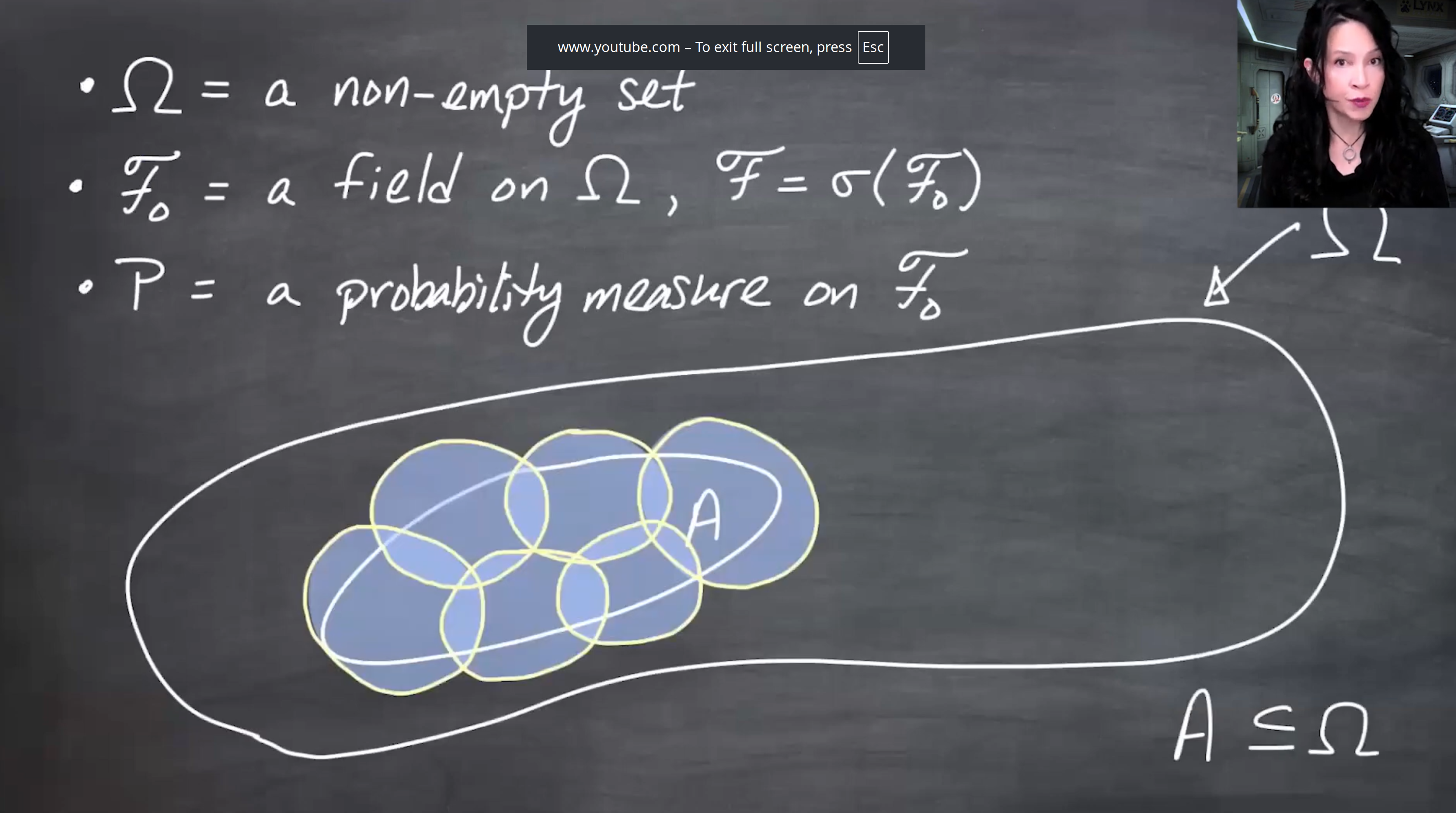
The previous lesson gave the roadmap using six lemmas. This lesson proves Lemmas 1–3.
151.3 Recall the outer measure P^*
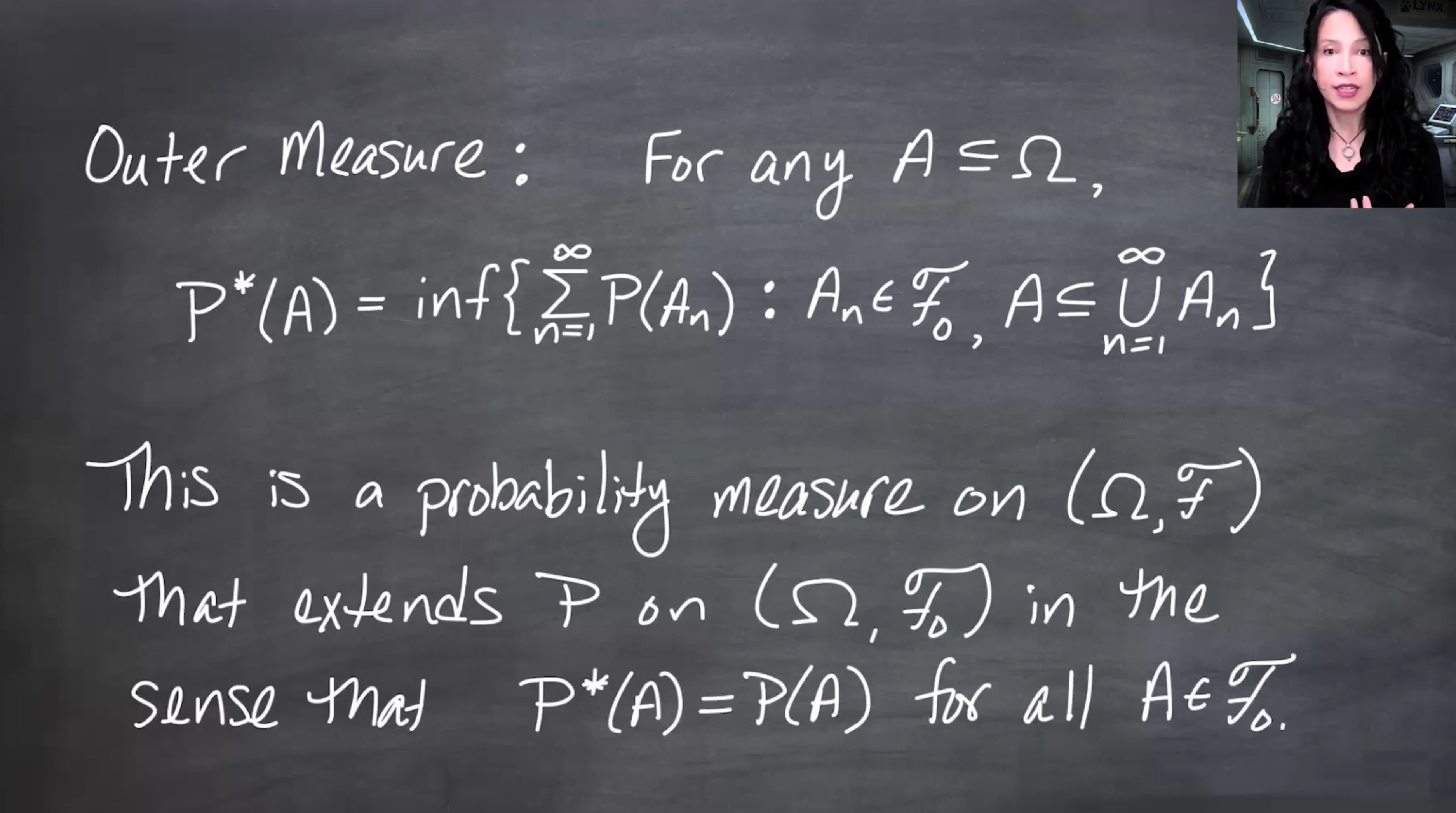
For every subset A\subseteq\Omega, define
P^*(A) = \inf \left\{ \sum_{n=1}^{\infty}P(A_n) : A_n\in\mathcal{F}_0 \text{ and } A\subseteq\bigcup_{n=1}^{\infty}A_n \right\}.
This measures A from the outside by covering it with countably many sets from \mathcal{F}_0.
151.4 Recall the class \mathcal{M}
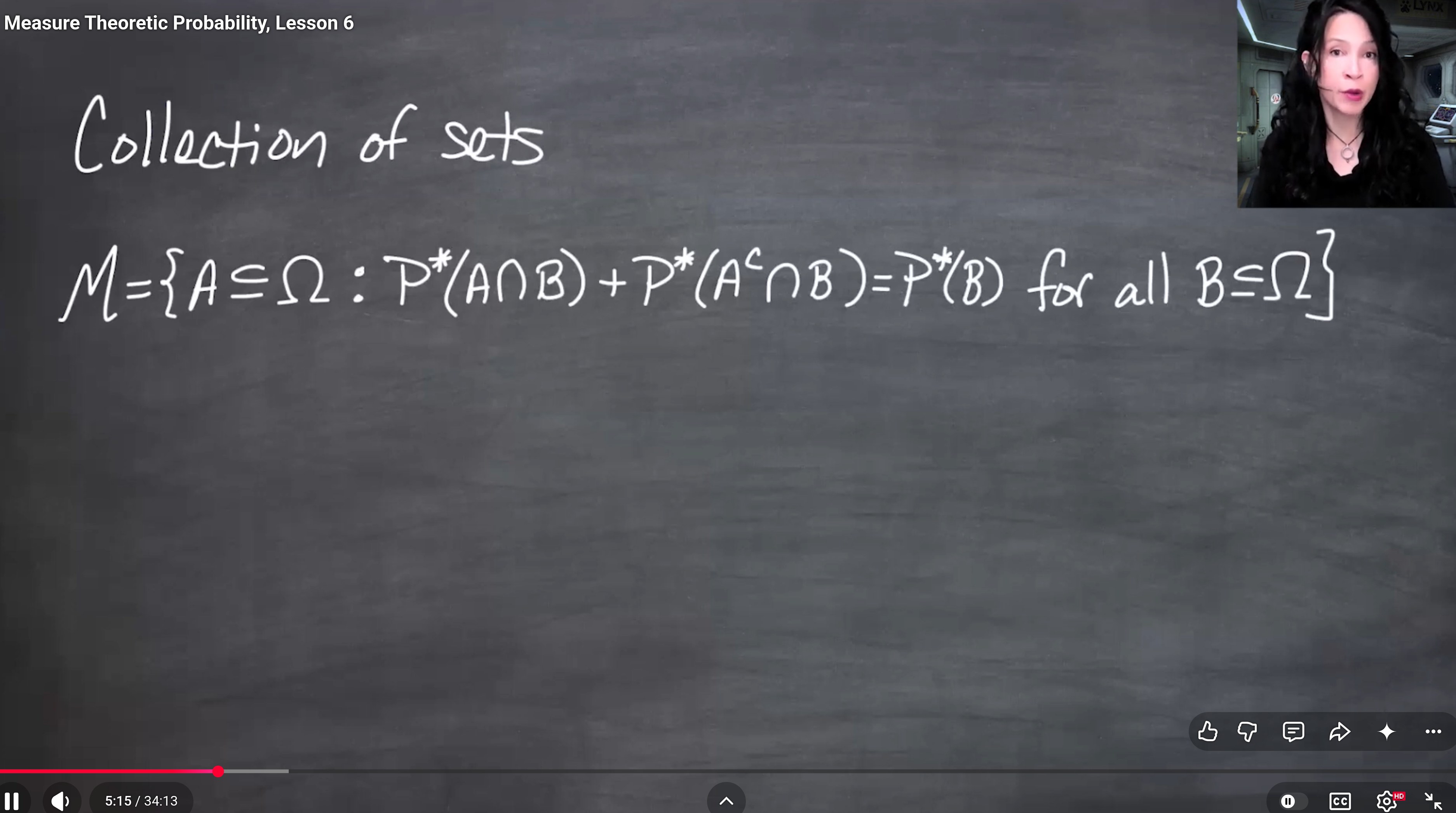
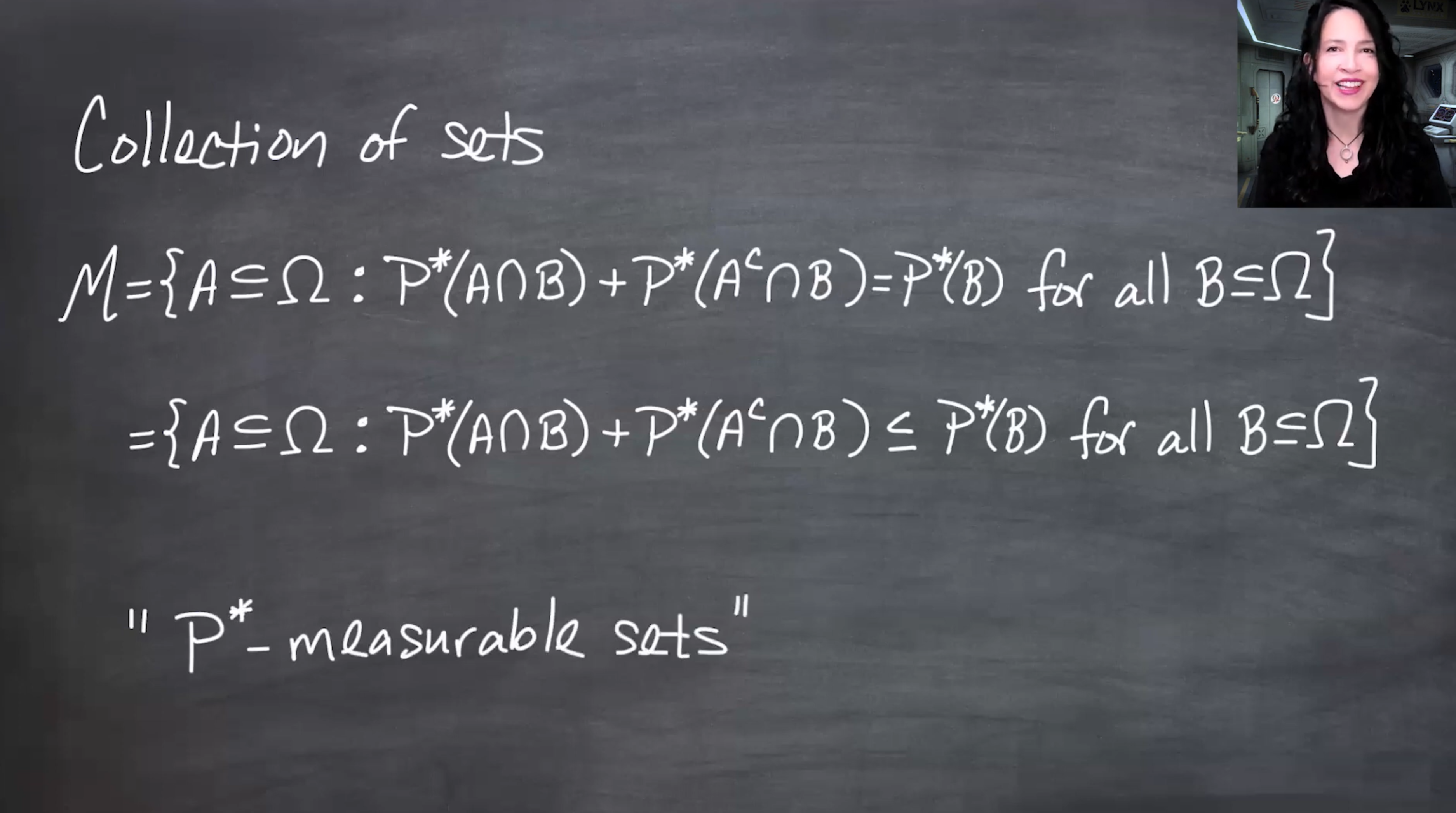
Define \mathcal{M} as the class of subsets A\subseteq\Omega that split every subset B\subseteq\Omega additively:
\mathcal{M} = \left\{ A\subseteq\Omega: P^*(A\cap B)+P^*(A^c\cap B)=P^*(B) \text{ for all } B\subseteq\Omega \right\}.
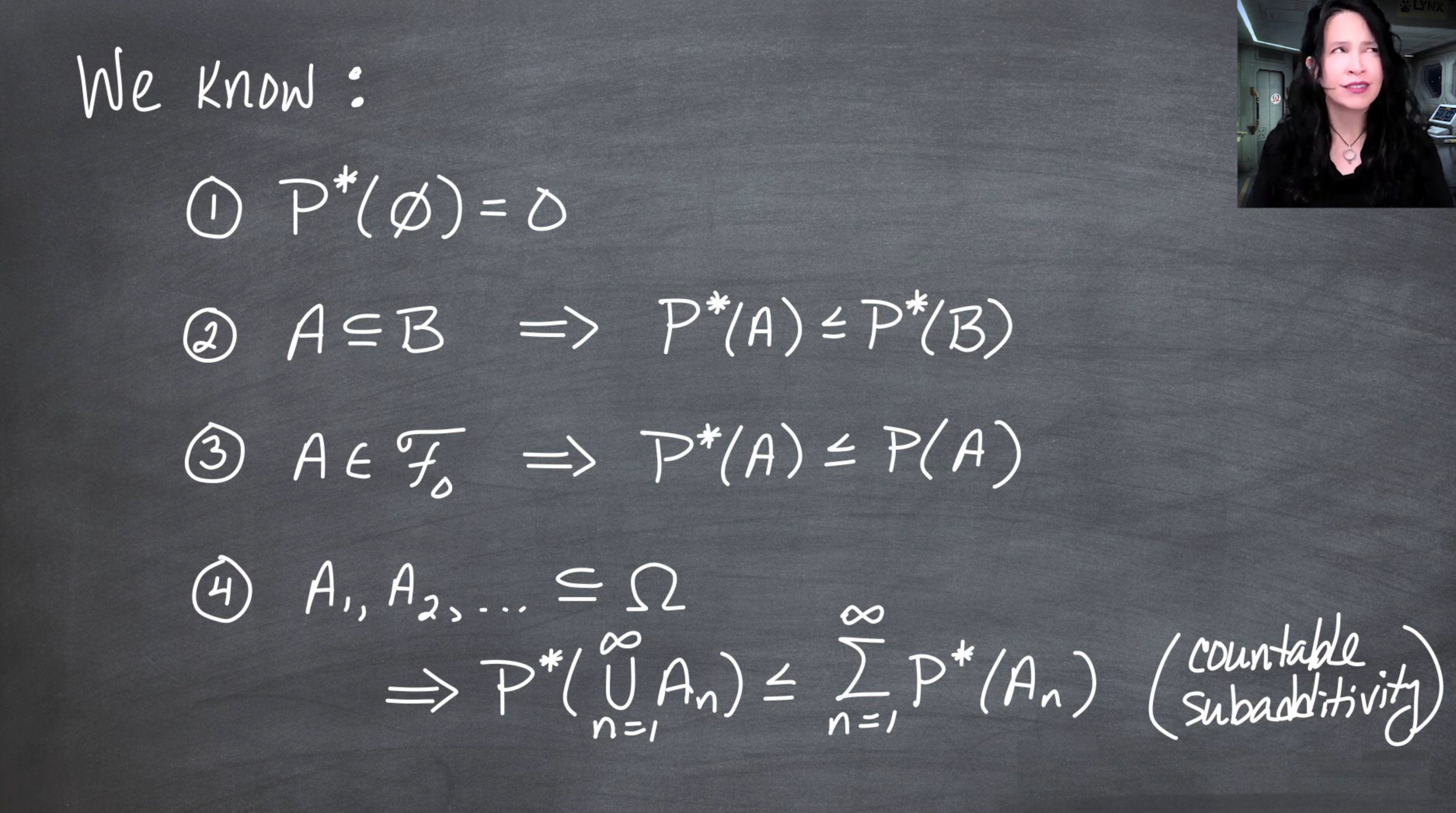
Because P^* is countably subadditive, we always have
P^*(B) \leq P^*(A\cap B)+P^*(A^c\cap B).
So to show A\in\mathcal{M}, it is enough to prove the reverse inequality:
P^*(A\cap B)+P^*(A^c\cap B) \leq P^*(B) \qquad \text{for all } B\subseteq\Omega.
The sets in \mathcal{M} are sometimes called P^*-measurable sets.
151.5 Lemma 1: \mathcal{M} is a field
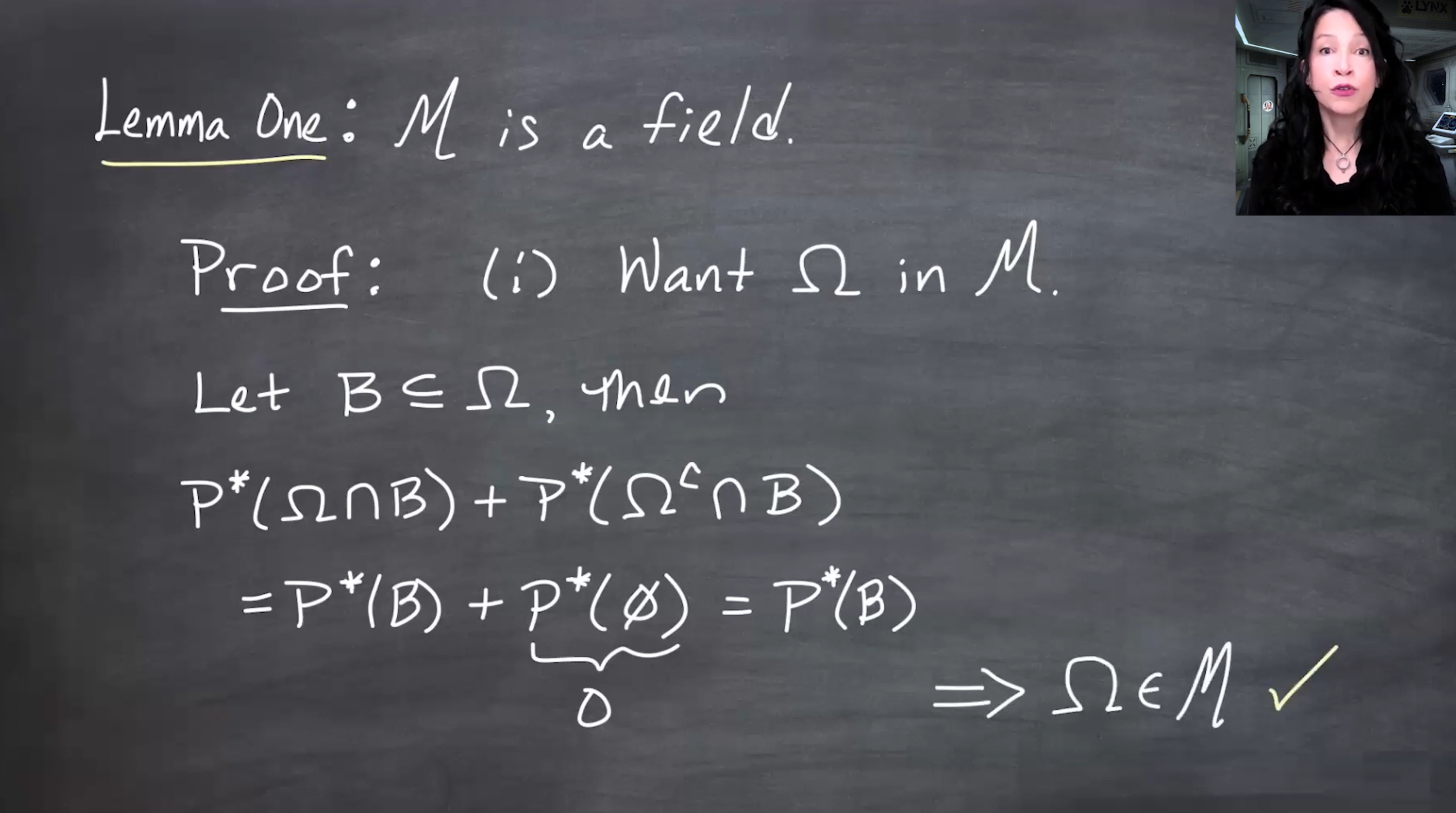
Lemma 151.1 (Lemma 1) The collection \mathcal{M} is a field.
To prove this, show:
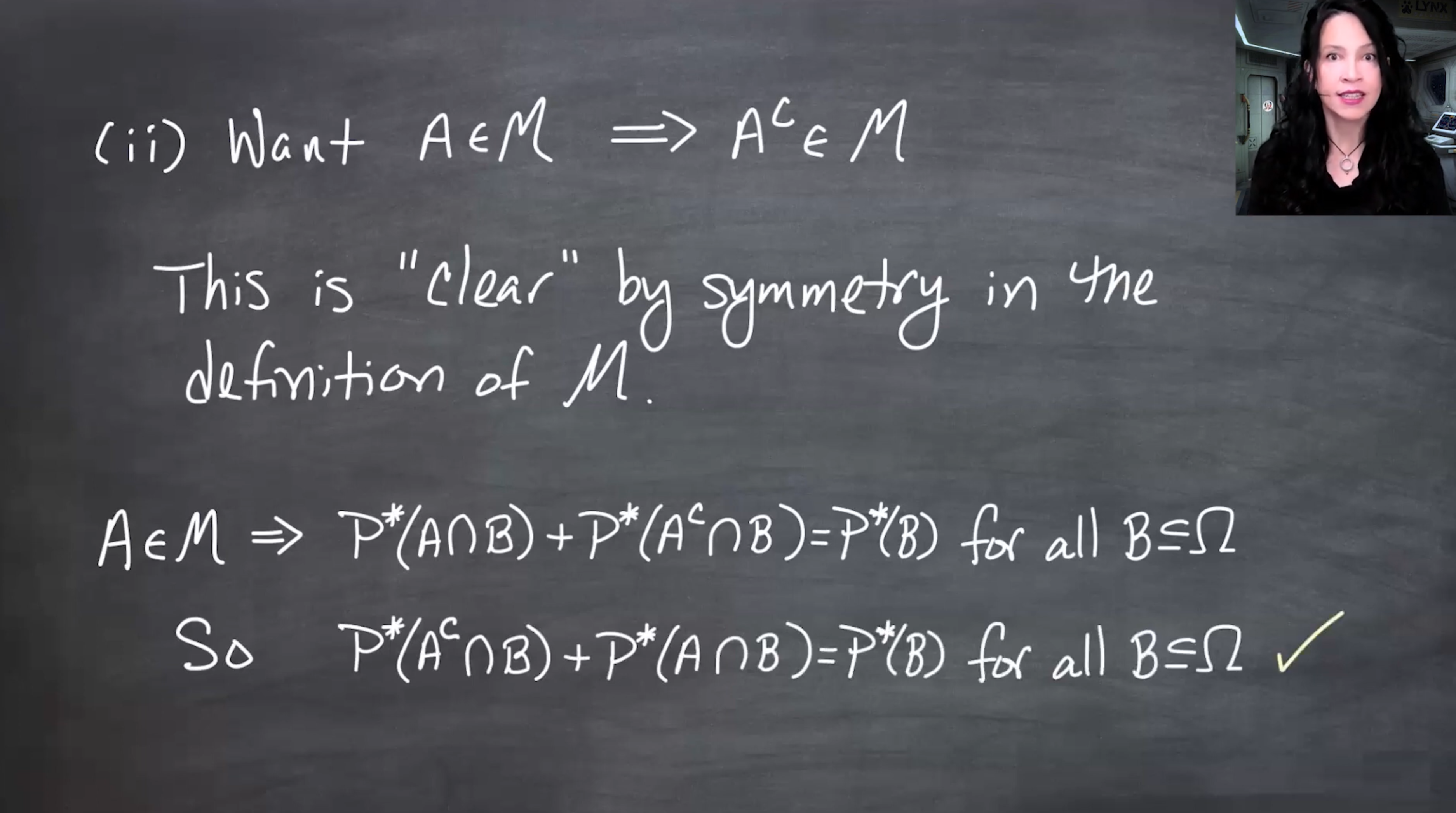
- \Omega\in\mathcal{M};
- if A\in\mathcal{M}, then A^c\in\mathcal{M};
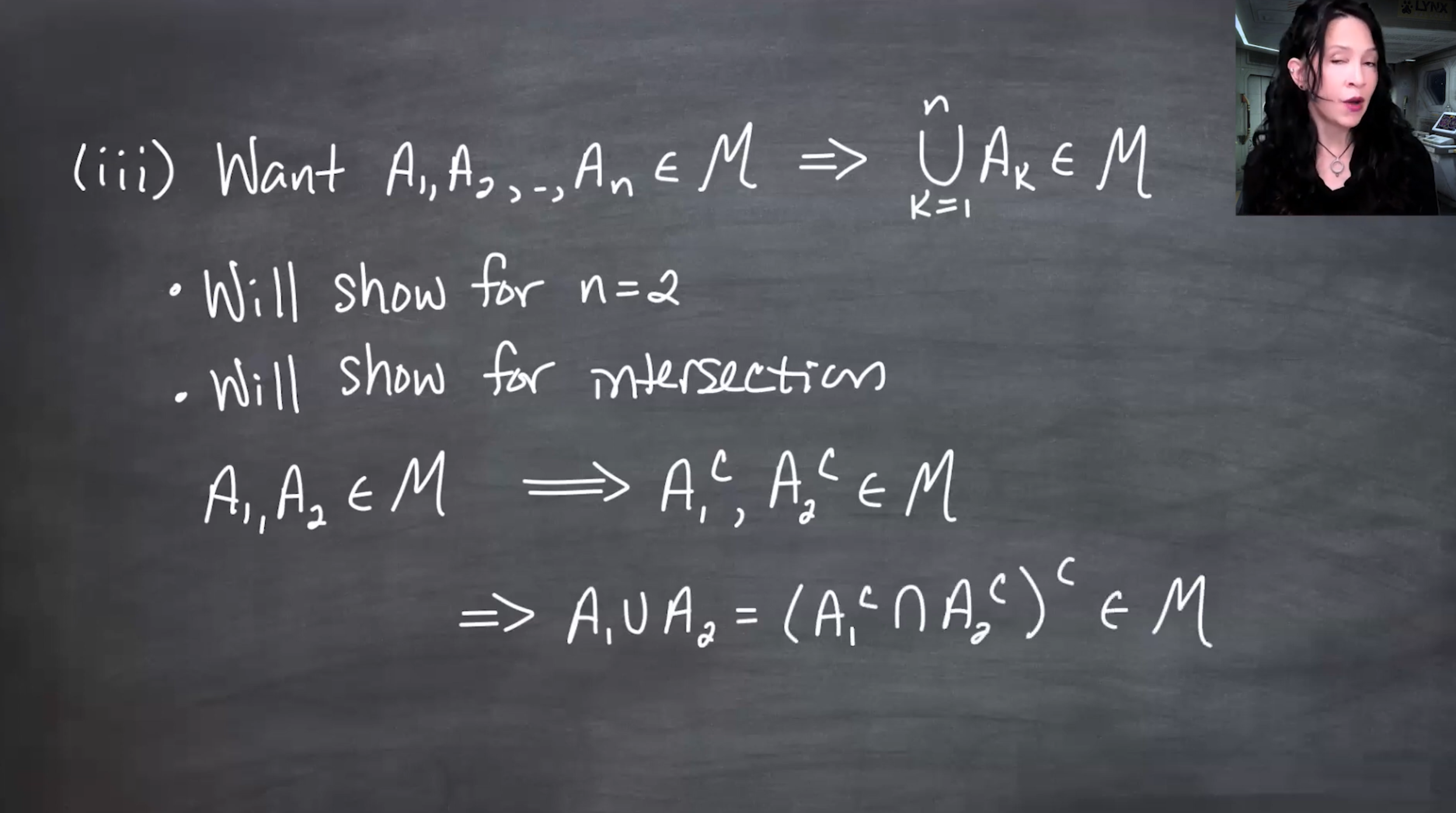
- if A_1,A_2\in\mathcal{M}, then A_1\cup A_2\in\mathcal{M}.
Finite unions then follow by induction.
151.5.1 Step 1: \Omega\in\mathcal{M}
For any B\subseteq\Omega,
P^*(\Omega\cap B)+P^*(\Omega^c\cap B) = P^*(B)+P^*(\emptyset) = P^*(B).
Since P^*(\emptyset)=0, this proves \Omega\in\mathcal{M}.
151.5.2 Step 2: closure under complements
If A\in\mathcal{M}, then for every B\subseteq\Omega,
P^*(A\cap B)+P^*(A^c\cap B) = P^*(B).
But the two summands can be swapped:
P^*(A^c\cap B)+P^*((A^c)^c\cap B) = P^*(B).
Thus A^c\in\mathcal{M}.
151.5.3 Step 3: closure under finite unions
It is easier to prove closure under finite intersections first. Then De Morgan’s law gives closure under finite unions.
If A_1,A_2\in\mathcal{M}, we will prove
A_1\cap A_2\in\mathcal{M}.
Then
A_1\cup A_2 = (A_1^c\cap A_2^c)^c
belongs to \mathcal{M} because \mathcal{M} is closed under complements and finite intersections.
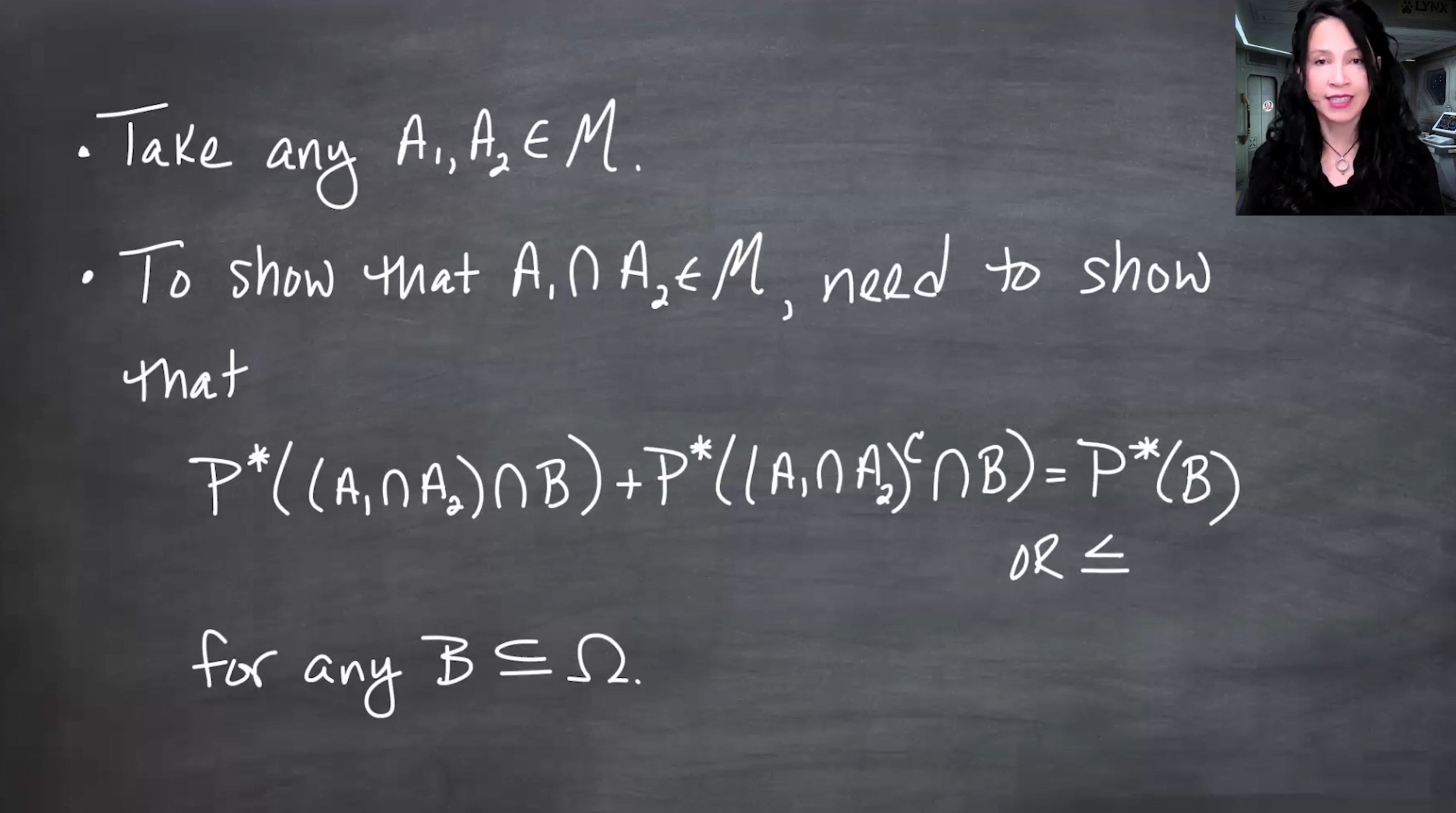
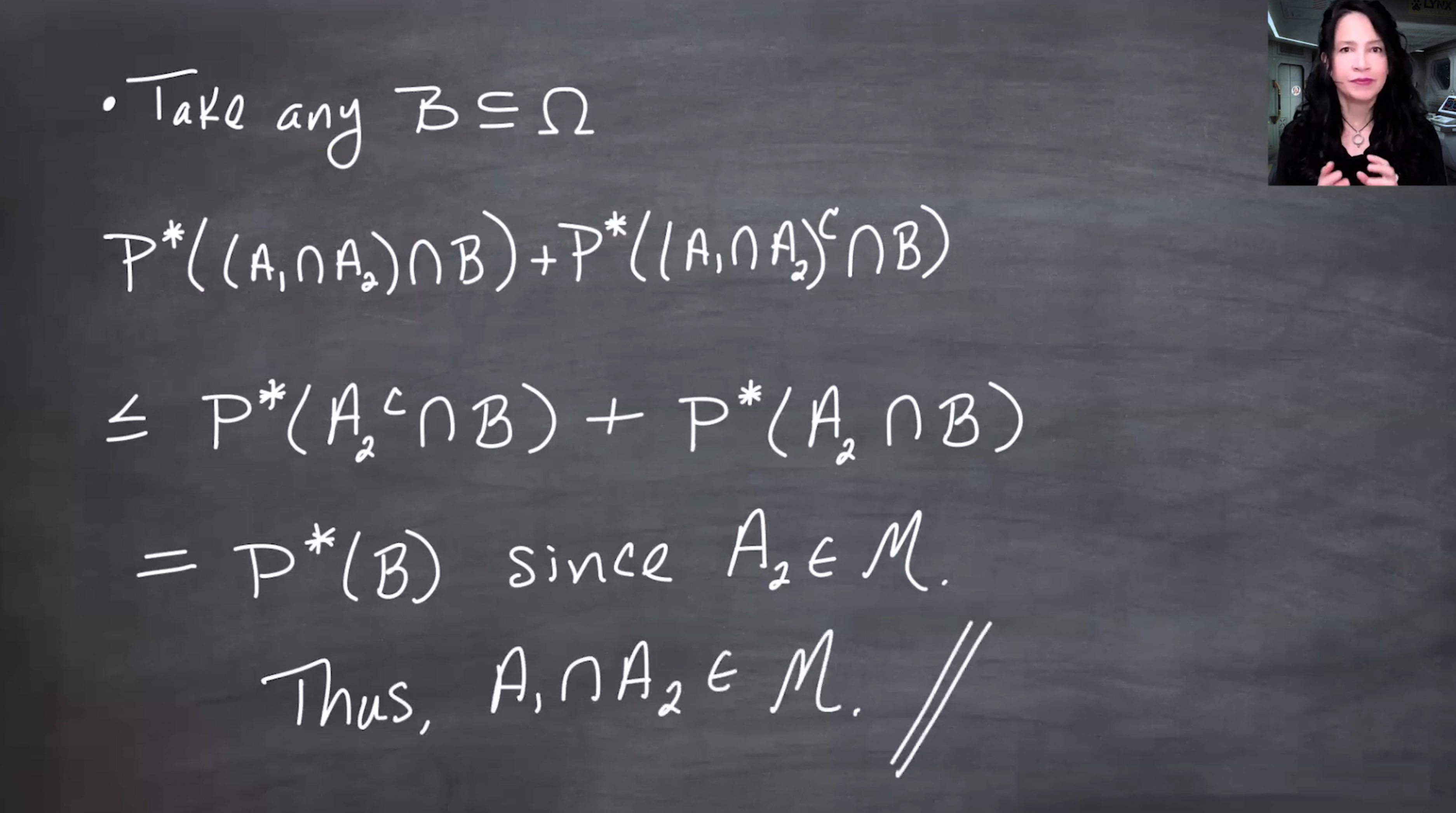
To show A_1\cap A_2\in\mathcal{M}, take any B\subseteq\Omega. We need to show
P^*((A_1\cap A_2)\cap B) + P^*((A_1\cap A_2)^c\cap B) \leq P^*(B).
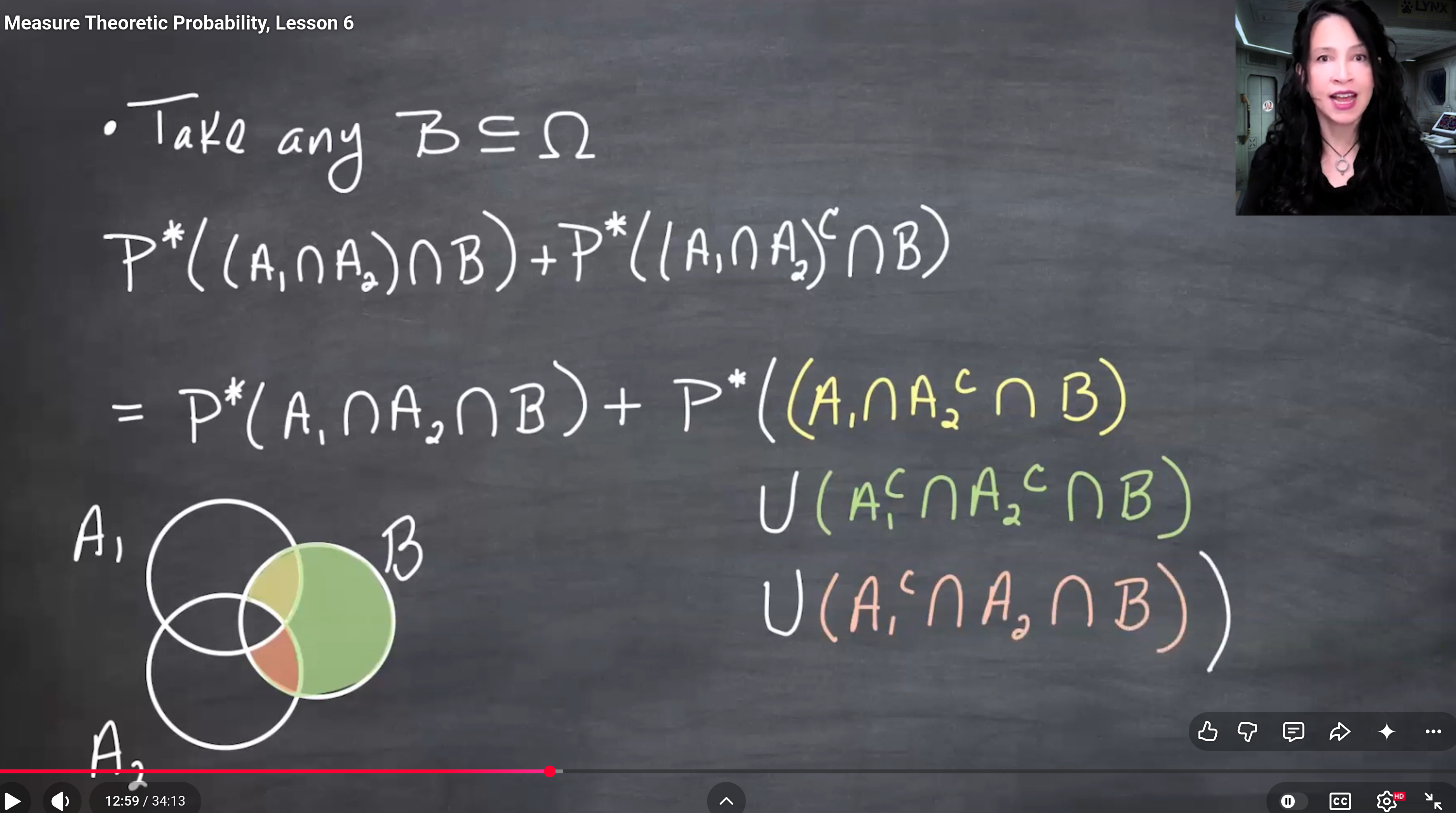
The second set is the part of B outside A_1\cap A_2.
The set outside A_1\cap A_2 but inside B can be decomposed into three regions:
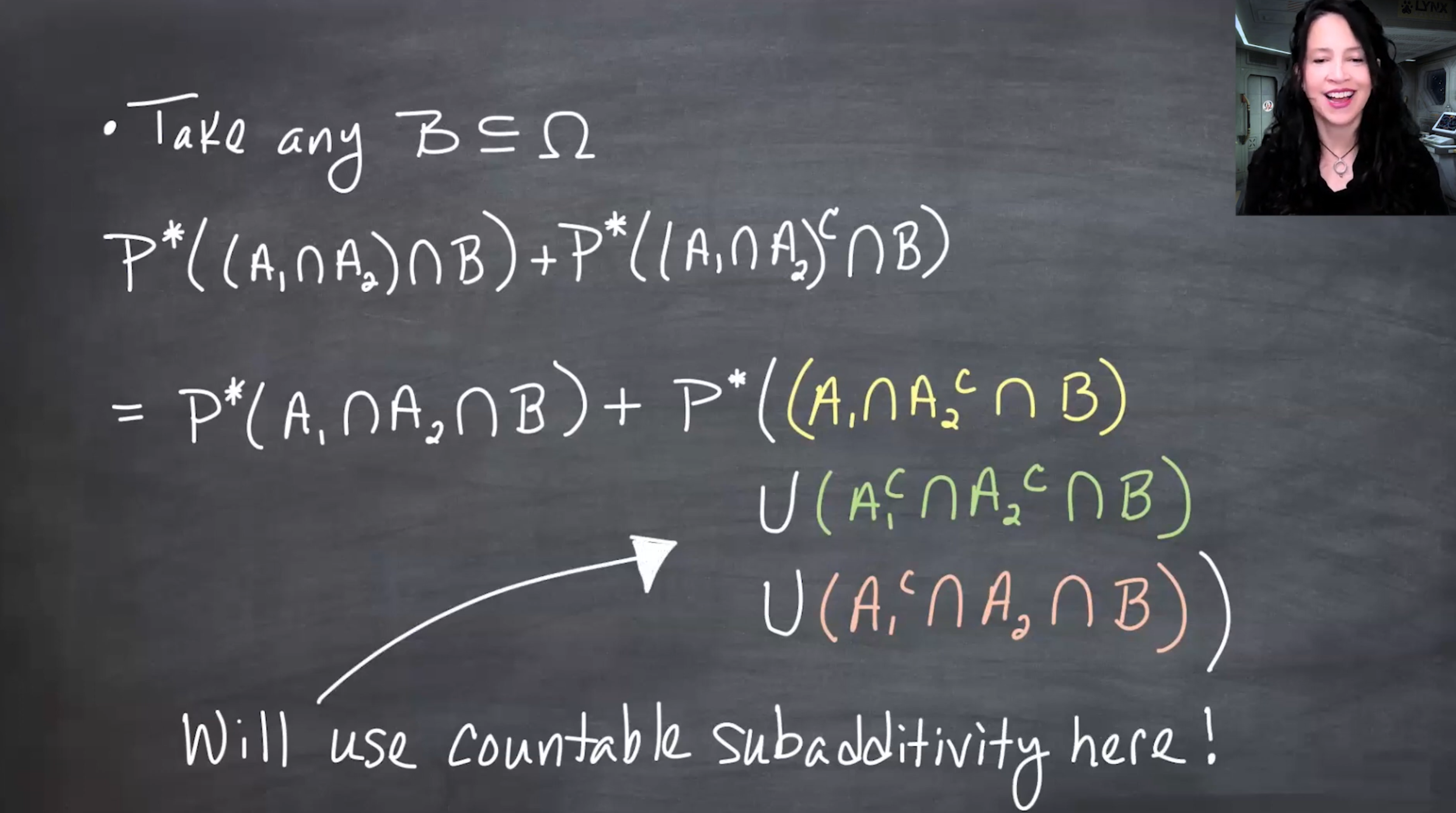
(A_1\cap A_2)^c\cap B = (A_1\cap A_2^c\cap B) \cup (A_1^c\cap A_2^c\cap B) \cup (A_1^c\cap A_2\cap B).
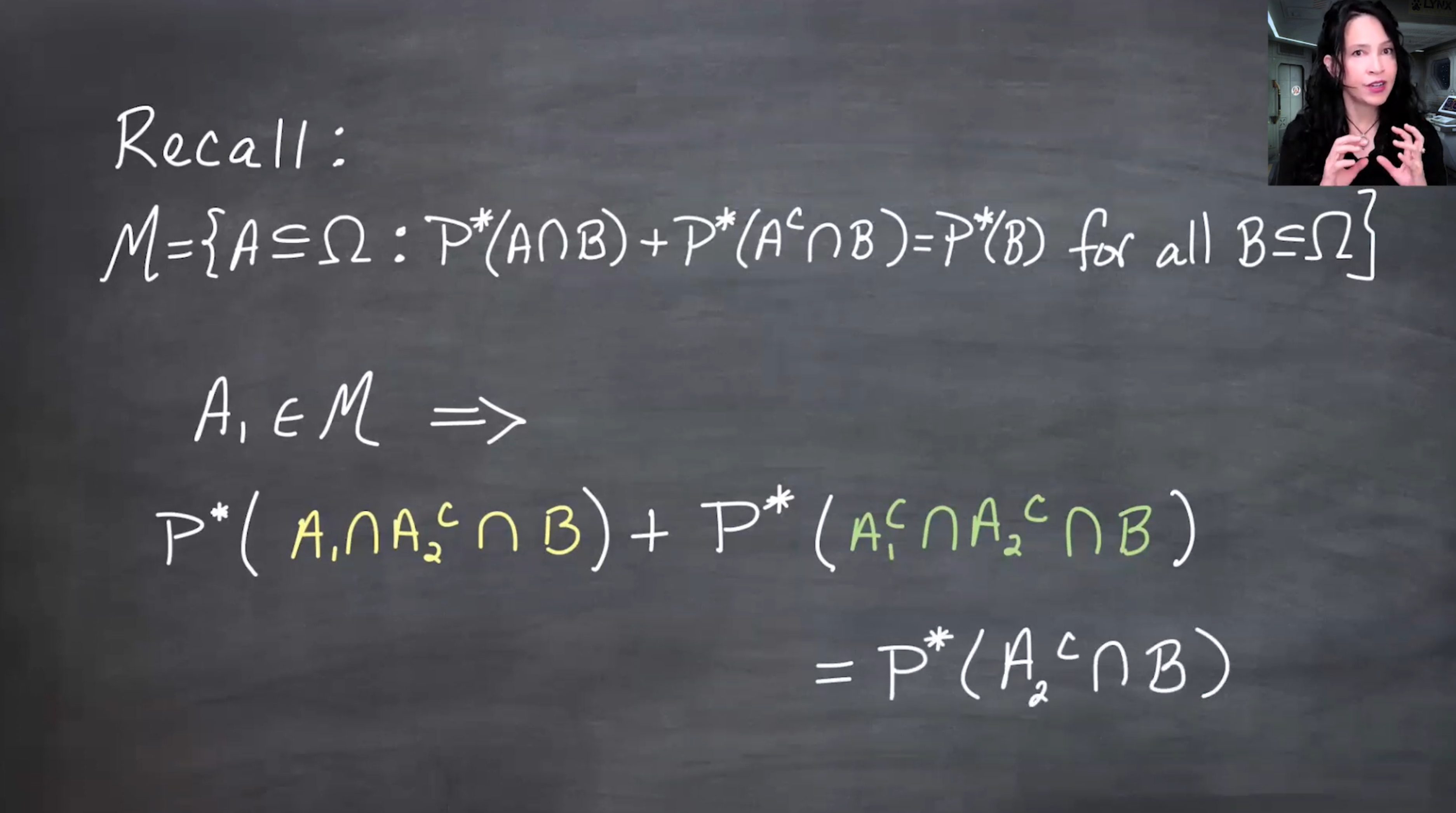
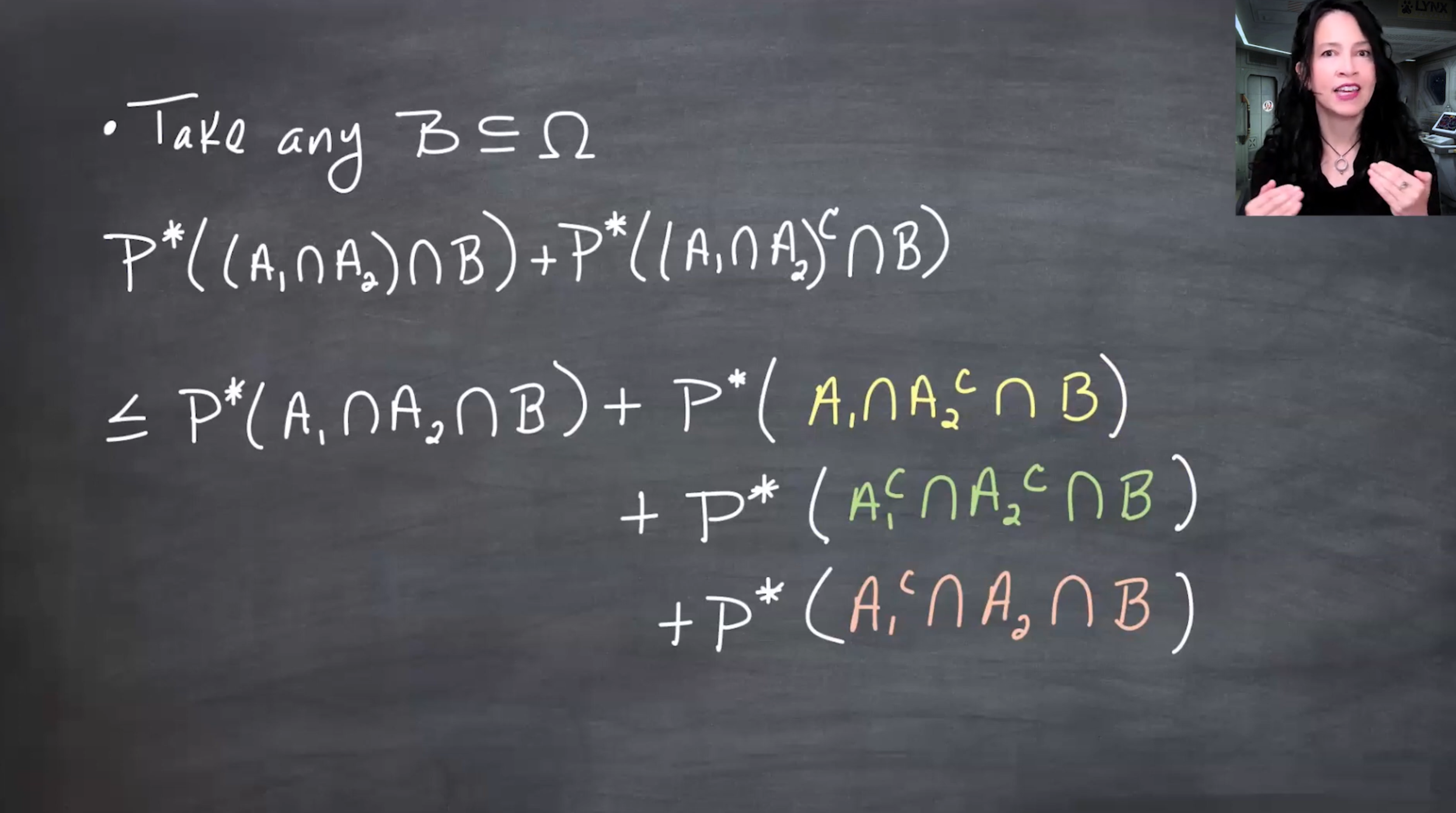
By countable subadditivity of P^*, the P^* of this union is bounded above by the sum of the three P^* values.
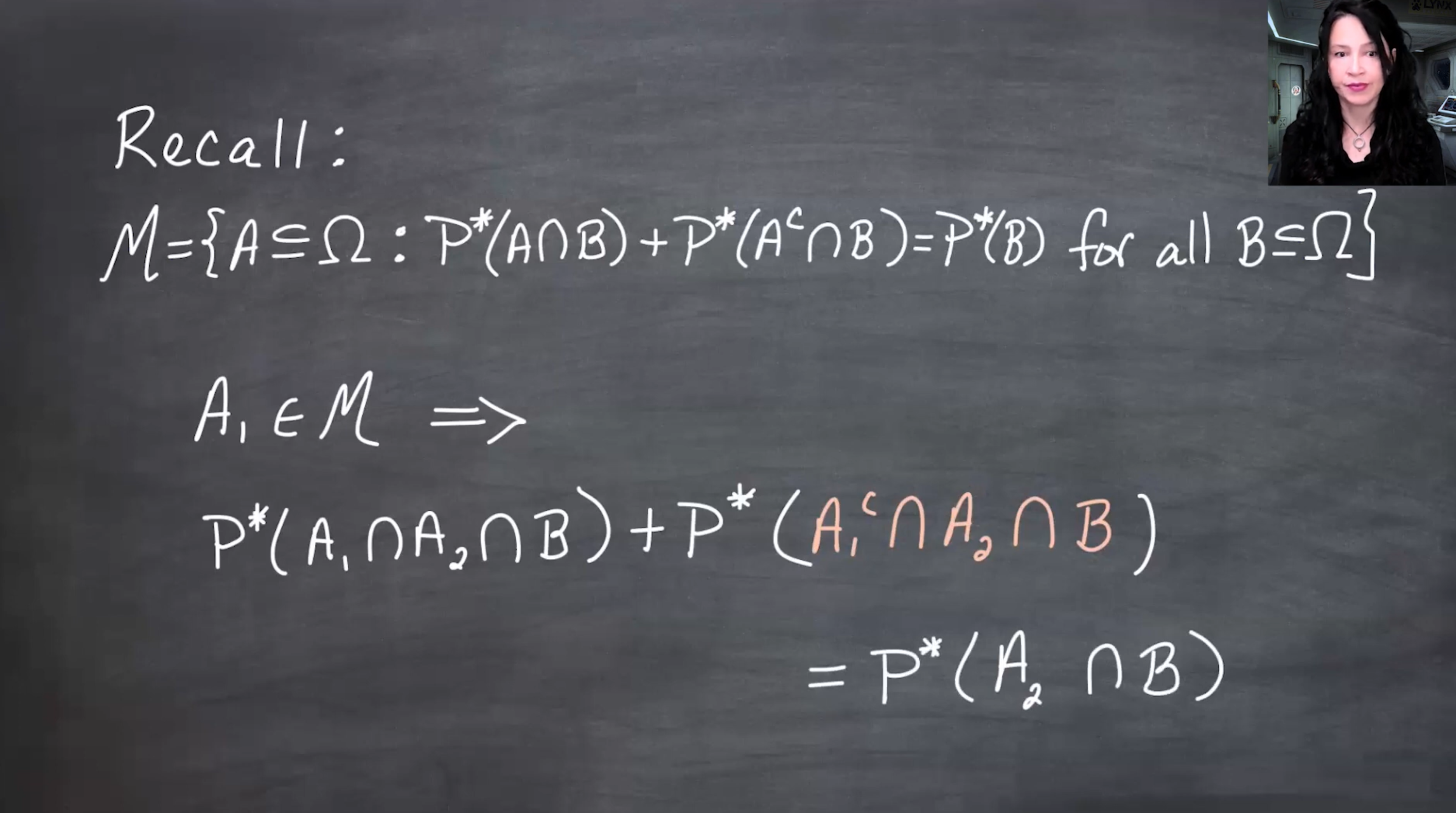
Now group the terms using the defining property of A_1\in\mathcal{M}.
For example,
P^*(A_1\cap A_2^c\cap B) + P^*(A_1^c\cap A_2^c\cap B) = P^*(A_2^c\cap B),
because this is the \mathcal{M} splitting property for A_1 applied to the test set A_2^c\cap B.
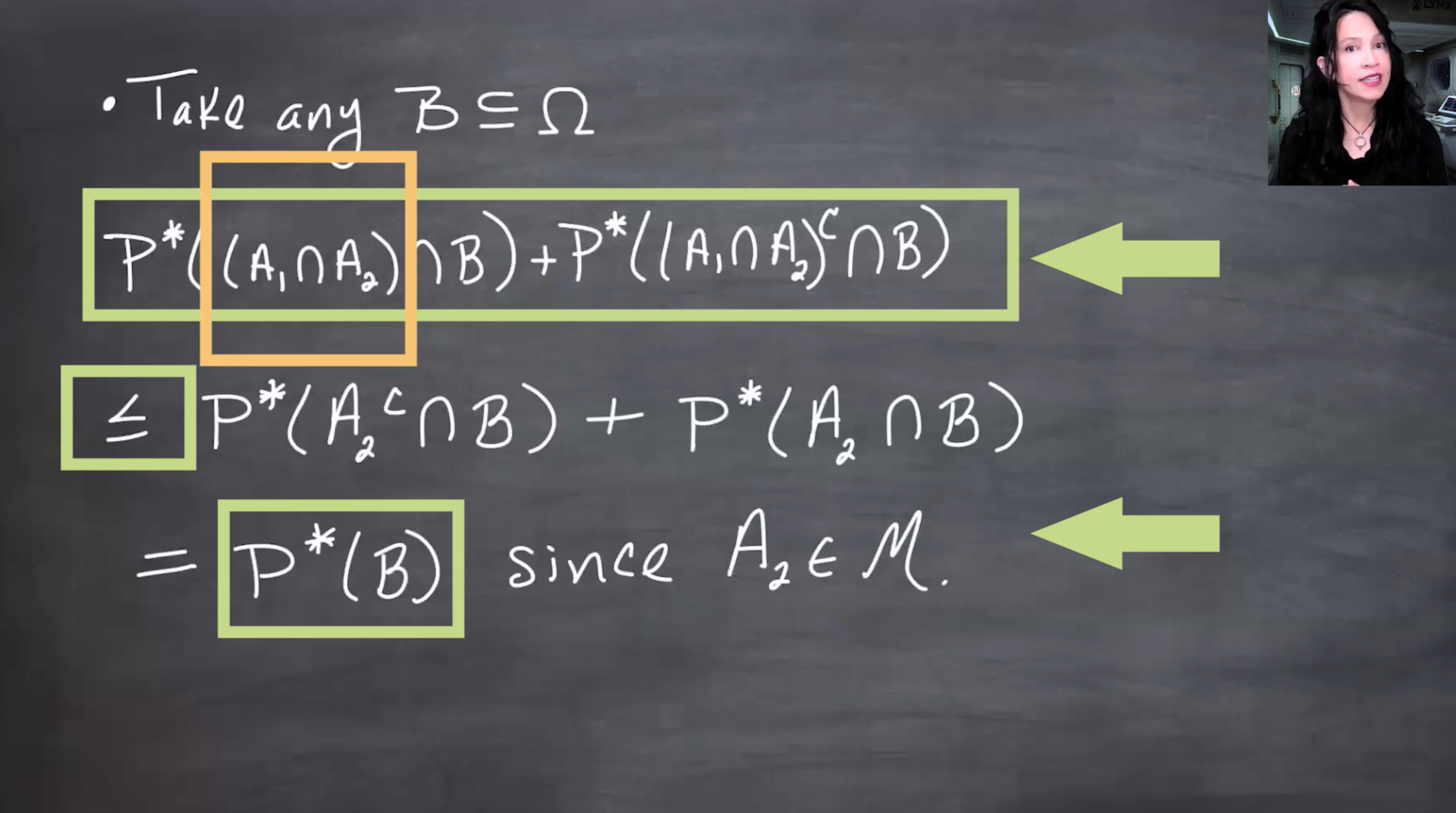
After grouping, the expression becomes
P^*(A_2\cap B)+P^*(A_2^c\cap B).
Since A_2\in\mathcal{M}, this equals P^*(B).
Finite union closure for more than two sets follows by induction: once the union of two \mathcal{M}-sets is in \mathcal{M}, repeatedly union one more set.
Thus Lemma 1 is proved: \mathcal{M} is a field.
151.6 Lemma 2: countable additivity on \mathcal{M}
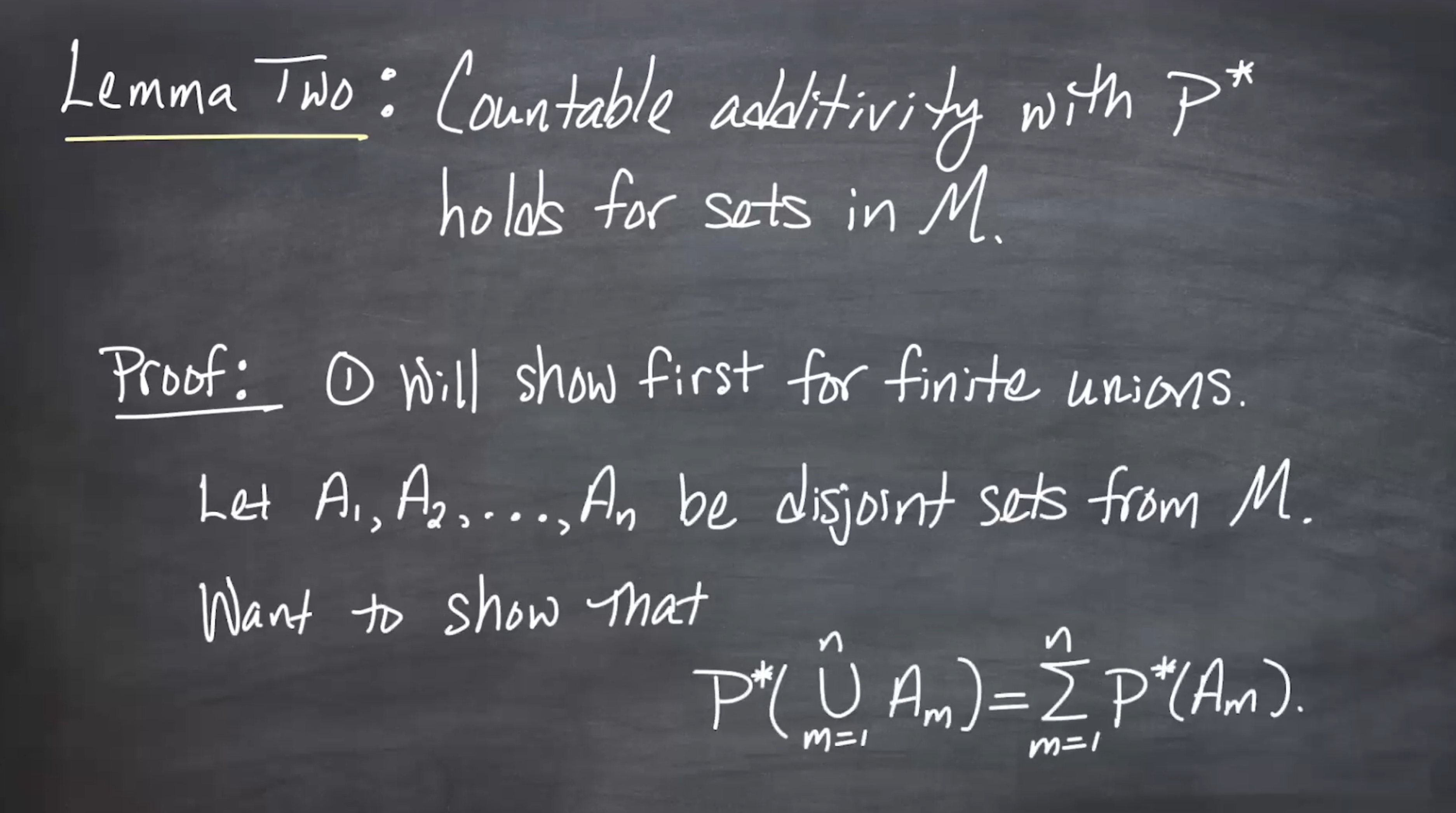
Lemma 151.2 (Lemma 2) If A_1,A_2,\ldots\in\mathcal{M} are disjoint, then
P^*\left(\bigcup_{n=1}^{\infty}A_n\right) = \sum_{n=1}^{\infty}P^*(A_n).
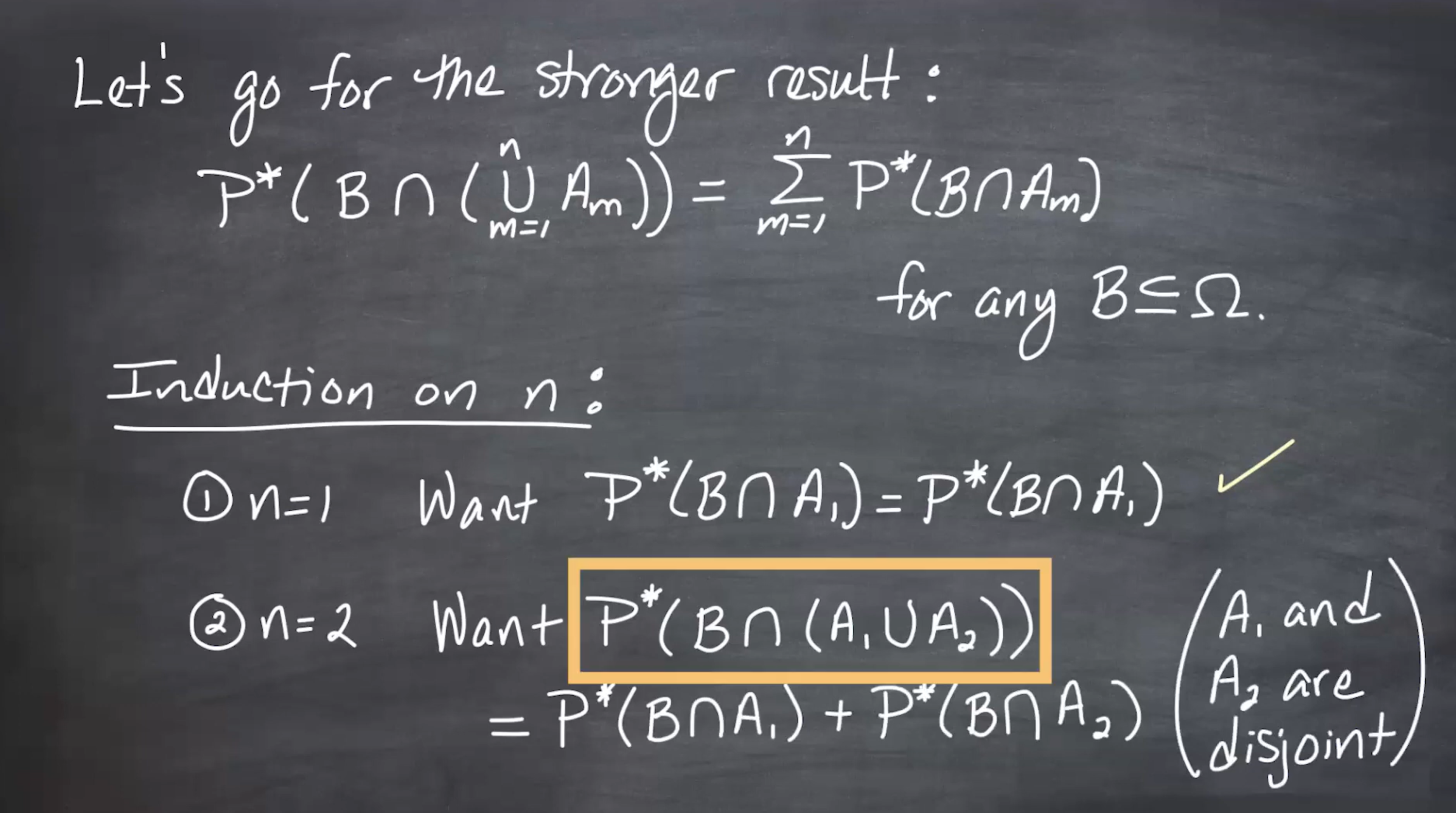
The proof first establishes a stronger finite version involving an arbitrary test set B\subseteq\Omega:
P^*\left(B\cap\bigcup_{i=1}^{n}A_i\right) = \sum_{i=1}^{n}P^*(B\cap A_i),
for disjoint A_1,\ldots,A_n\in\mathcal{M}.
151.6.1 Finite case
For n=1, the identity is trivial.
For n=2, take disjoint A_1,A_2\in\mathcal{M}. Then
B\cap(A_1\cup A_2)
splits into the part inside A_1 and the part inside A_2.
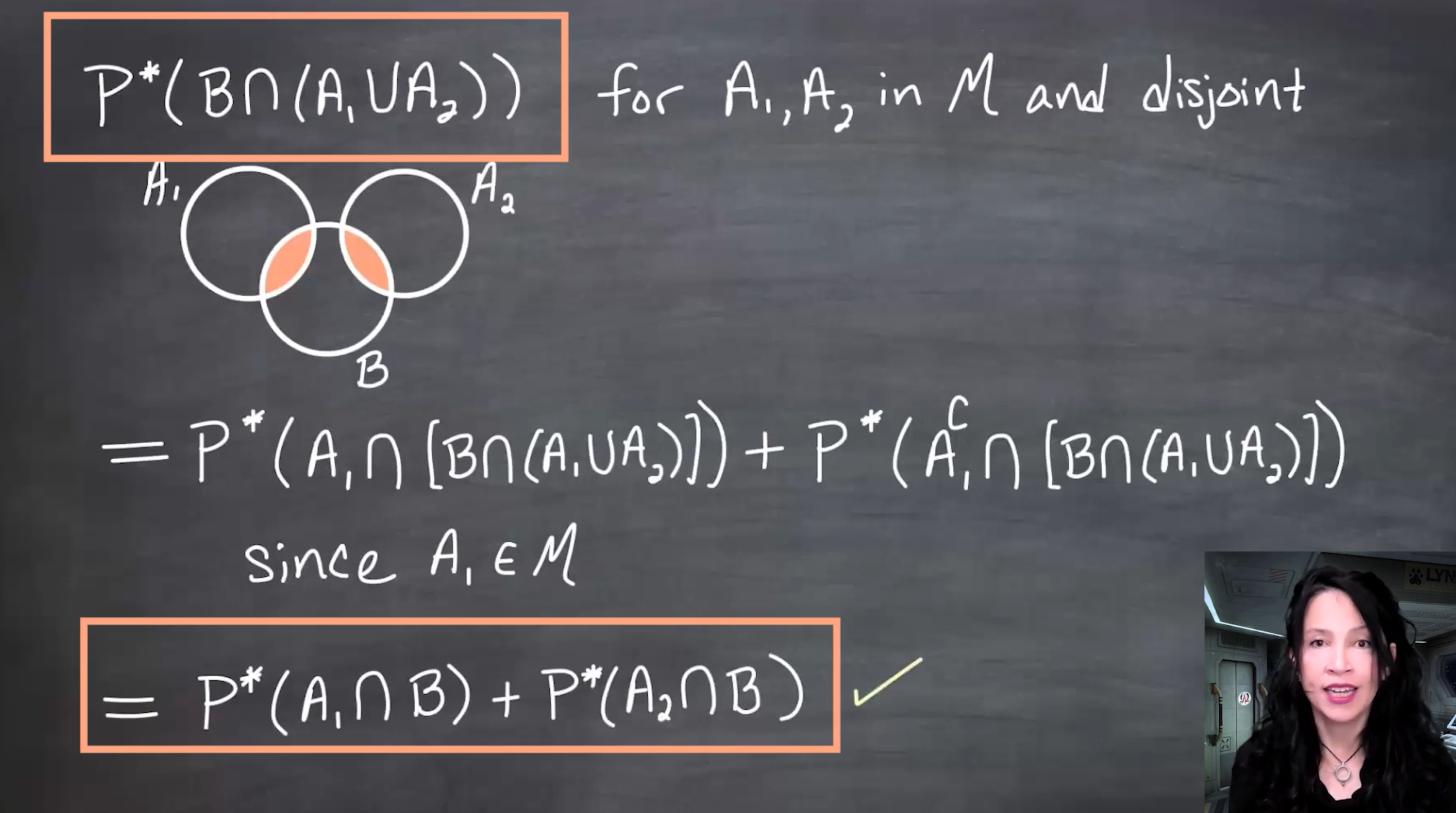
Using the defining property of A_1\in\mathcal{M}, applied to the test set B\cap(A_1\cup A_2),
P^*(B\cap(A_1\cup A_2)) = P^*(B\cap A_1)+P^*(B\cap A_2).
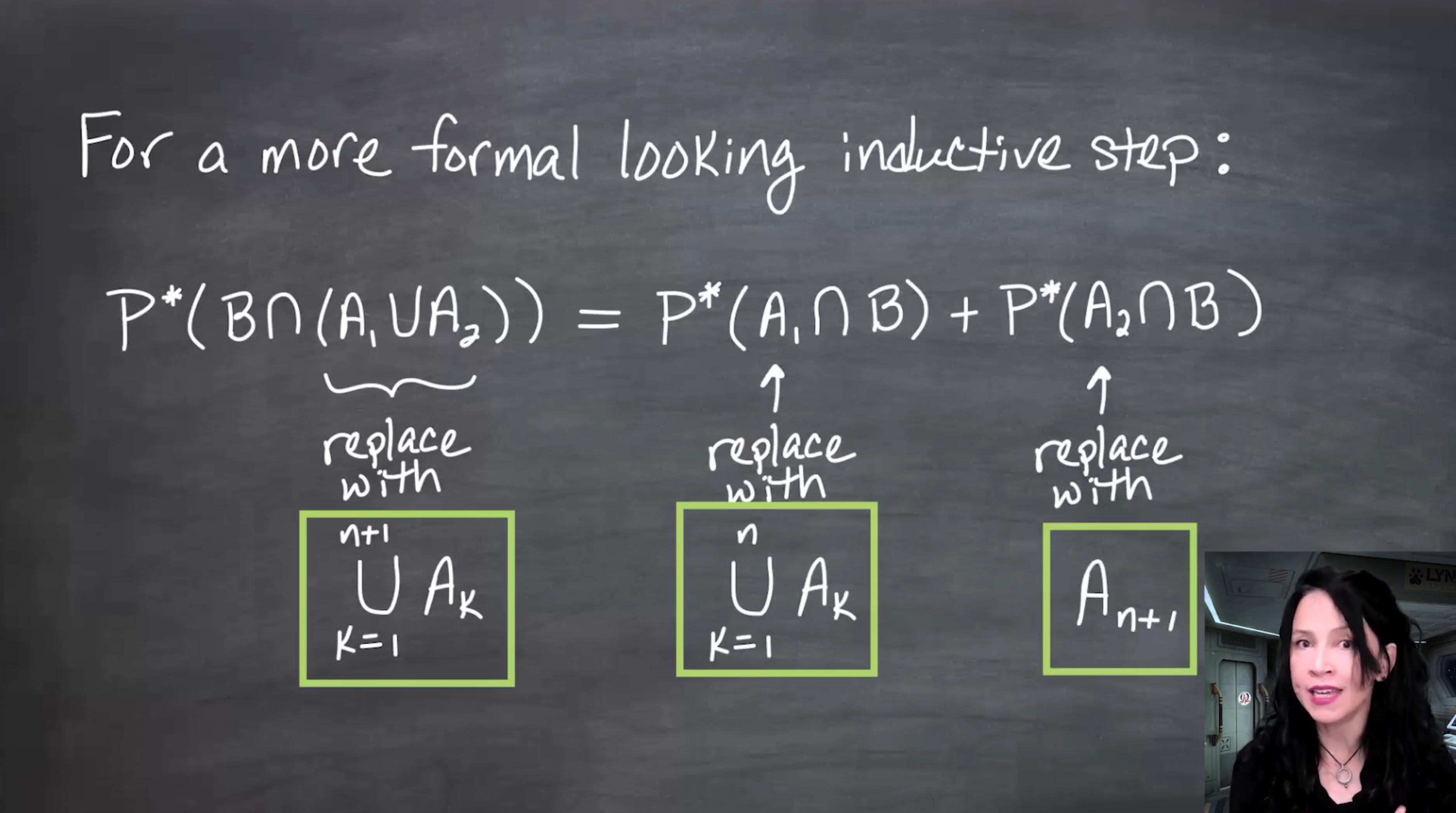
The finite case for general n follows by induction.
151.6.2 Countable case
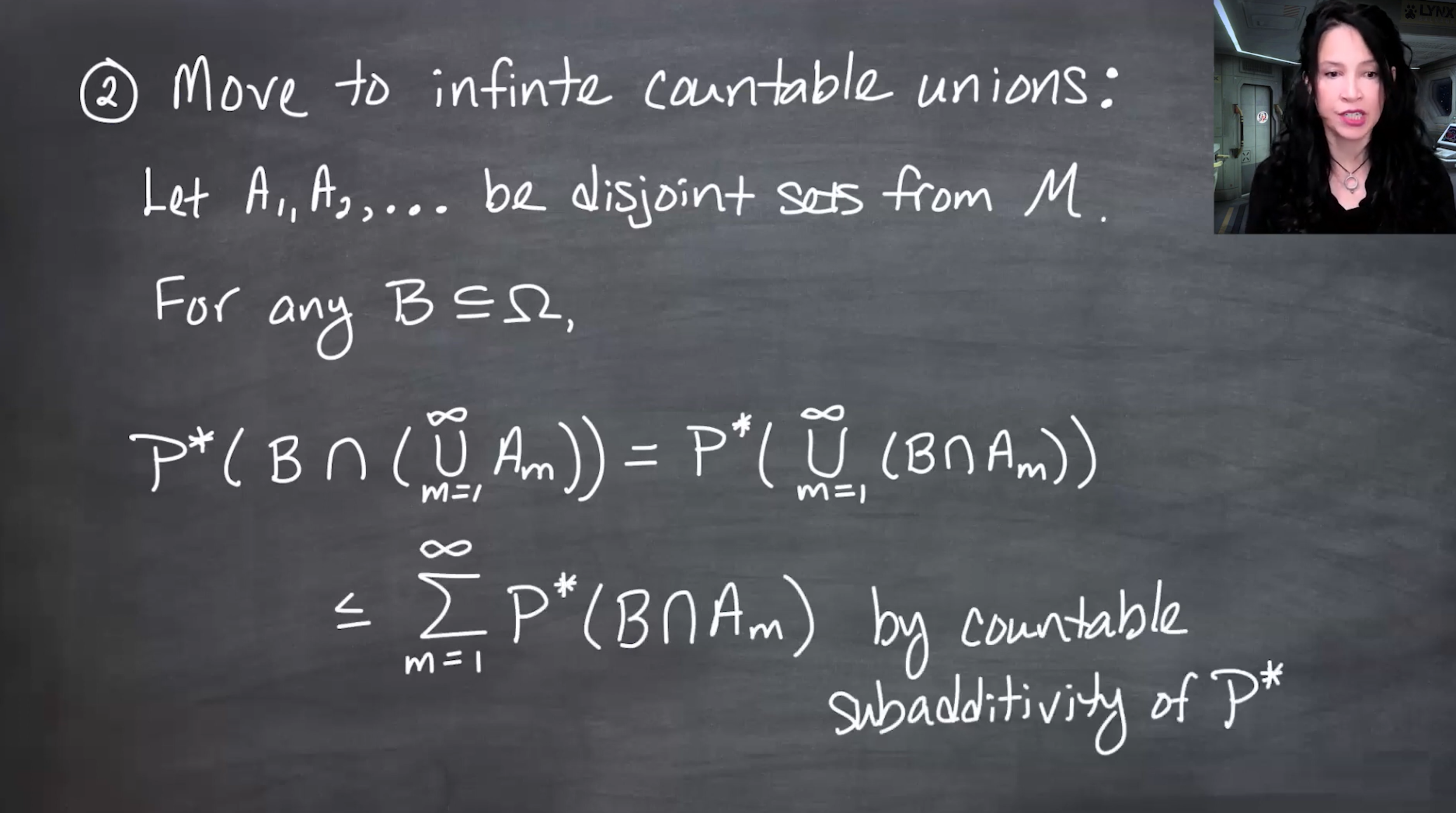
Now let A_1,A_2,\ldots\in\mathcal{M} be disjoint. We want
P^*\left(B\cap\bigcup_{n=1}^{\infty}A_n\right) = \sum_{n=1}^{\infty}P^*(B\cap A_n).
The \leq direction follows from countable subadditivity of P^*:
P^*\left(\bigcup_{n=1}^{\infty}(B\cap A_n)\right) \leq \sum_{n=1}^{\infty}P^*(B\cap A_n).
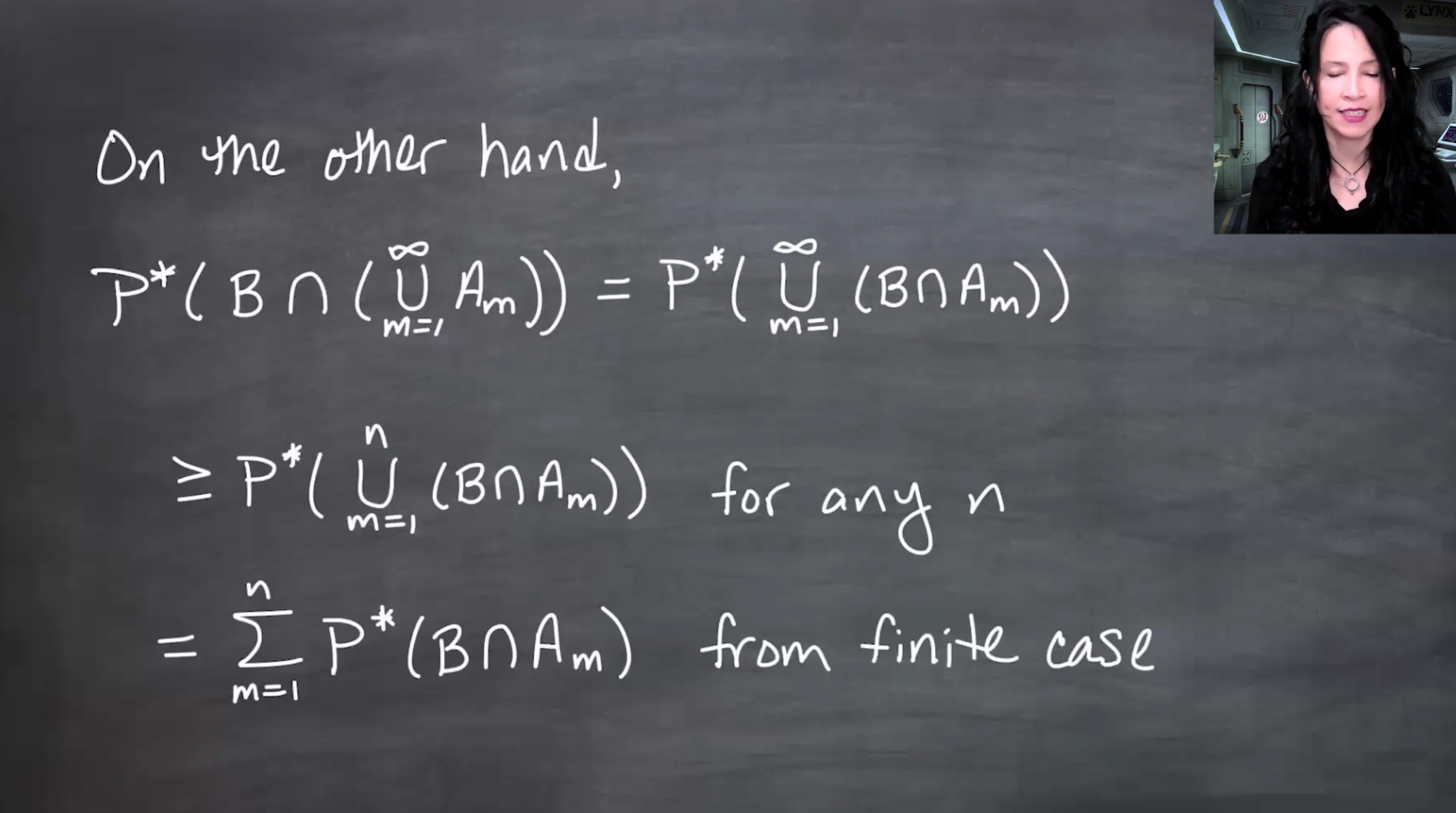
For the \geq direction, use monotonicity. For every finite m,
\bigcup_{n=1}^{m}(B\cap A_n) \subseteq \bigcup_{n=1}^{\infty}(B\cap A_n).
Therefore,
P^*\left(B\cap\bigcup_{n=1}^{\infty}A_n\right) \geq P^*\left(B\cap\bigcup_{n=1}^{m}A_n\right).
By the finite case,
P^*\left(B\cap\bigcup_{n=1}^{m}A_n\right) = \sum_{n=1}^{m}P^*(B\cap A_n).
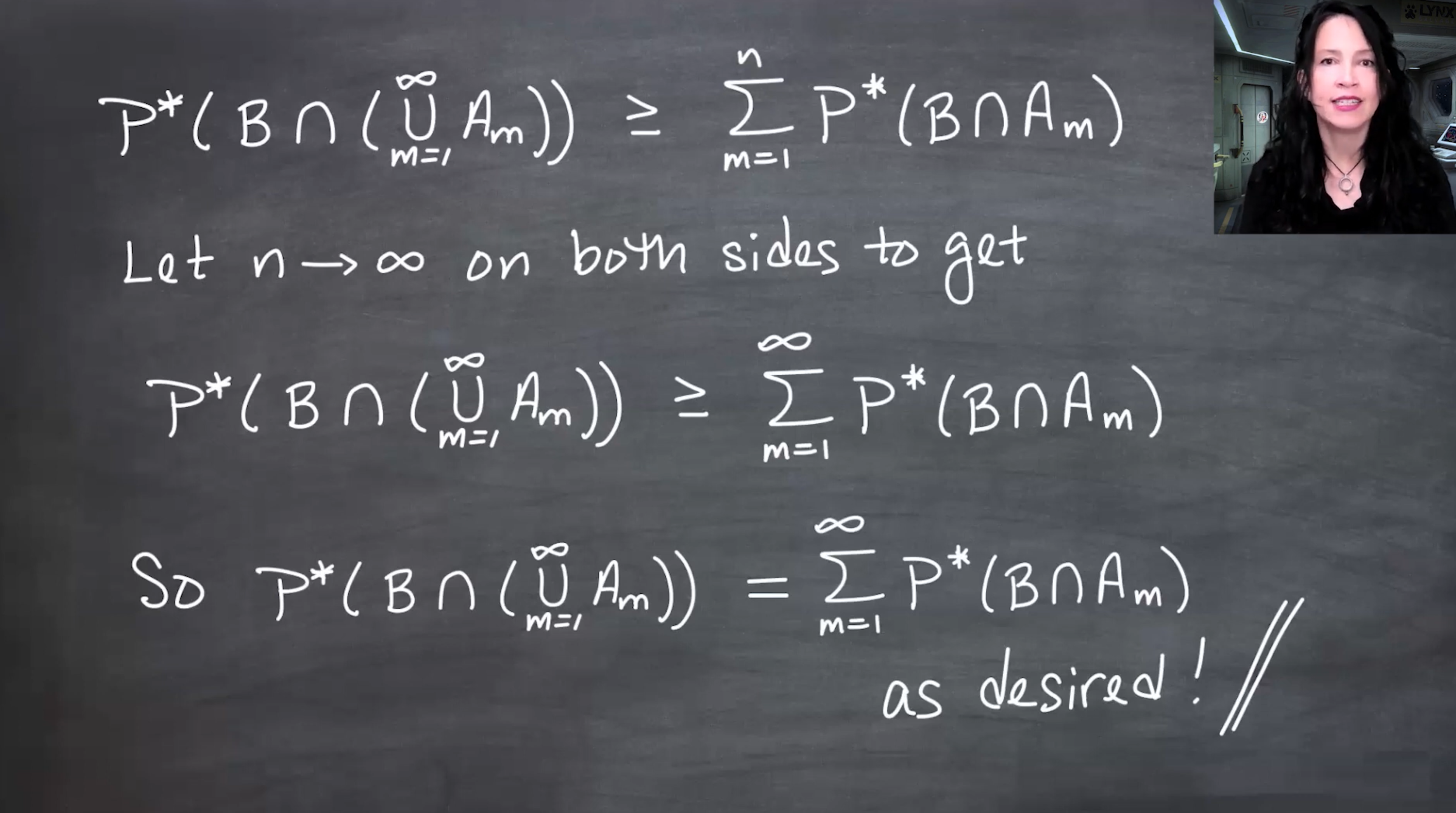
Letting m\to\infty gives
P^*\left(B\cap\bigcup_{n=1}^{\infty}A_n\right) \geq \sum_{n=1}^{\infty}P^*(B\cap A_n).
Together with the \leq direction, this proves equality.
Taking B=\Omega gives Lemma 2 exactly.
151.7 Lemma 3: \mathcal{M} is a sigma-field
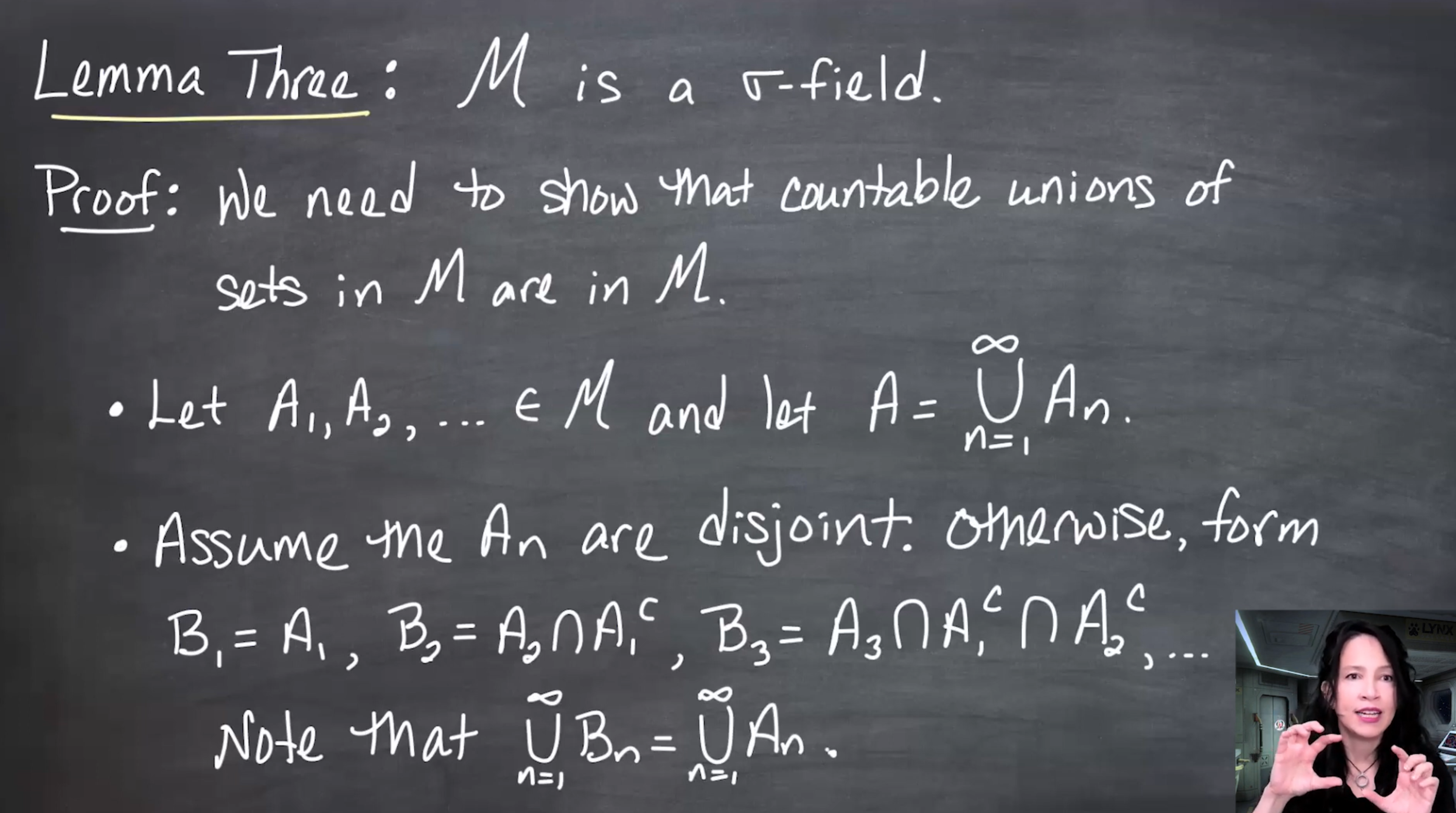
Lemma 151.3 (Lemma 3) The collection \mathcal{M} is a \sigma-field.
Lemma 1 already shows that \mathcal{M} is a field. Therefore, the only missing property is closure under countable unions.
Let
A=\bigcup_{n=1}^{\infty}A_n, \qquad A_n\in\mathcal{M}.
We must show A\in\mathcal{M}.
The A_n need not be disjoint. But we can replace them by disjoint pieces:
B_1=A_1,
B_2=A_2\setminus A_1,
B_3=A_3\setminus(A_1\cup A_2),
and so on. These B_n are disjoint and have the same union as the original A_n.
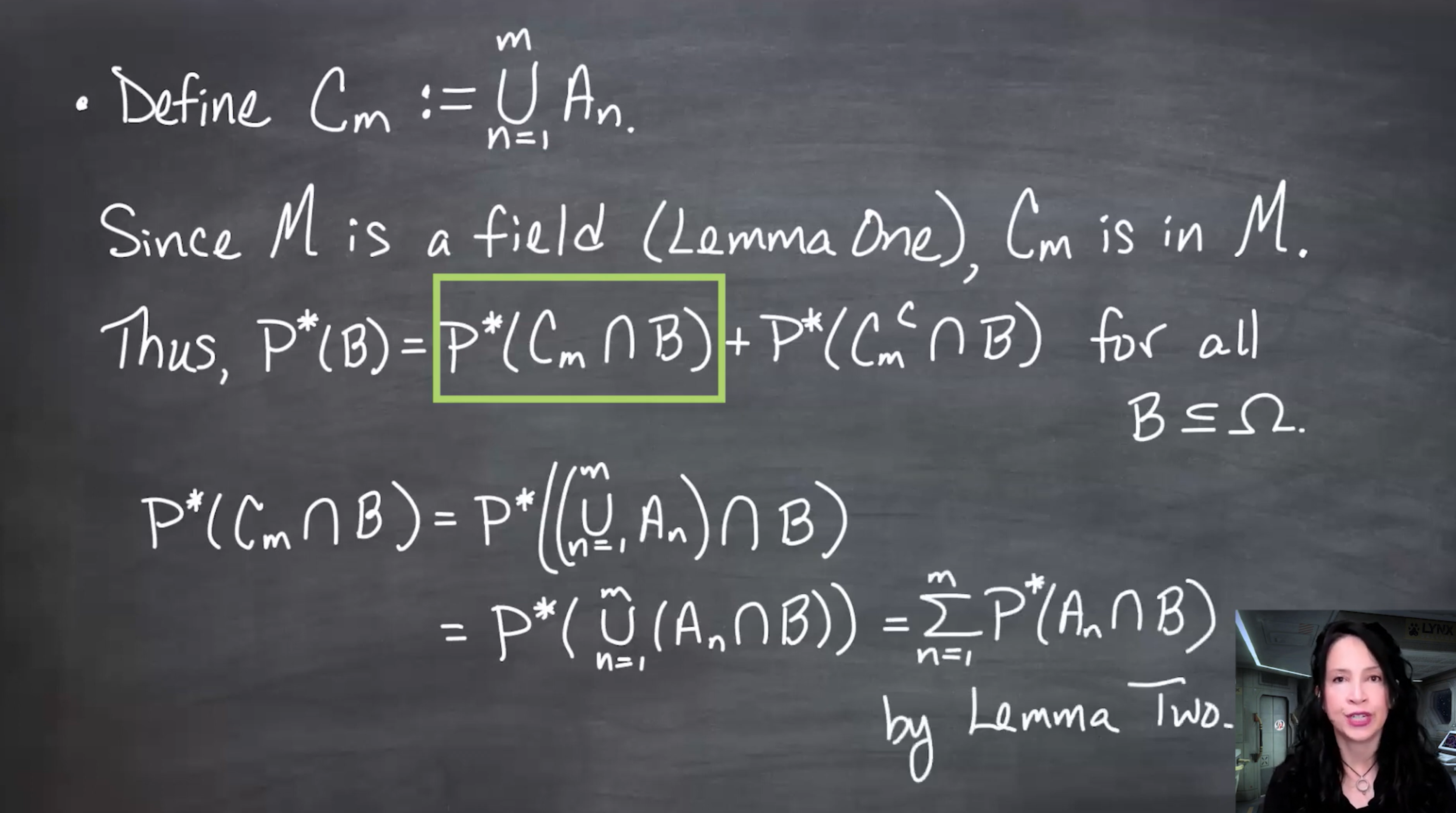
So assume the A_n are disjoint. Define the finite partial union
C_m=\bigcup_{n=1}^{m}A_n.
Since \mathcal{M} is a field, C_m\in\mathcal{M}.
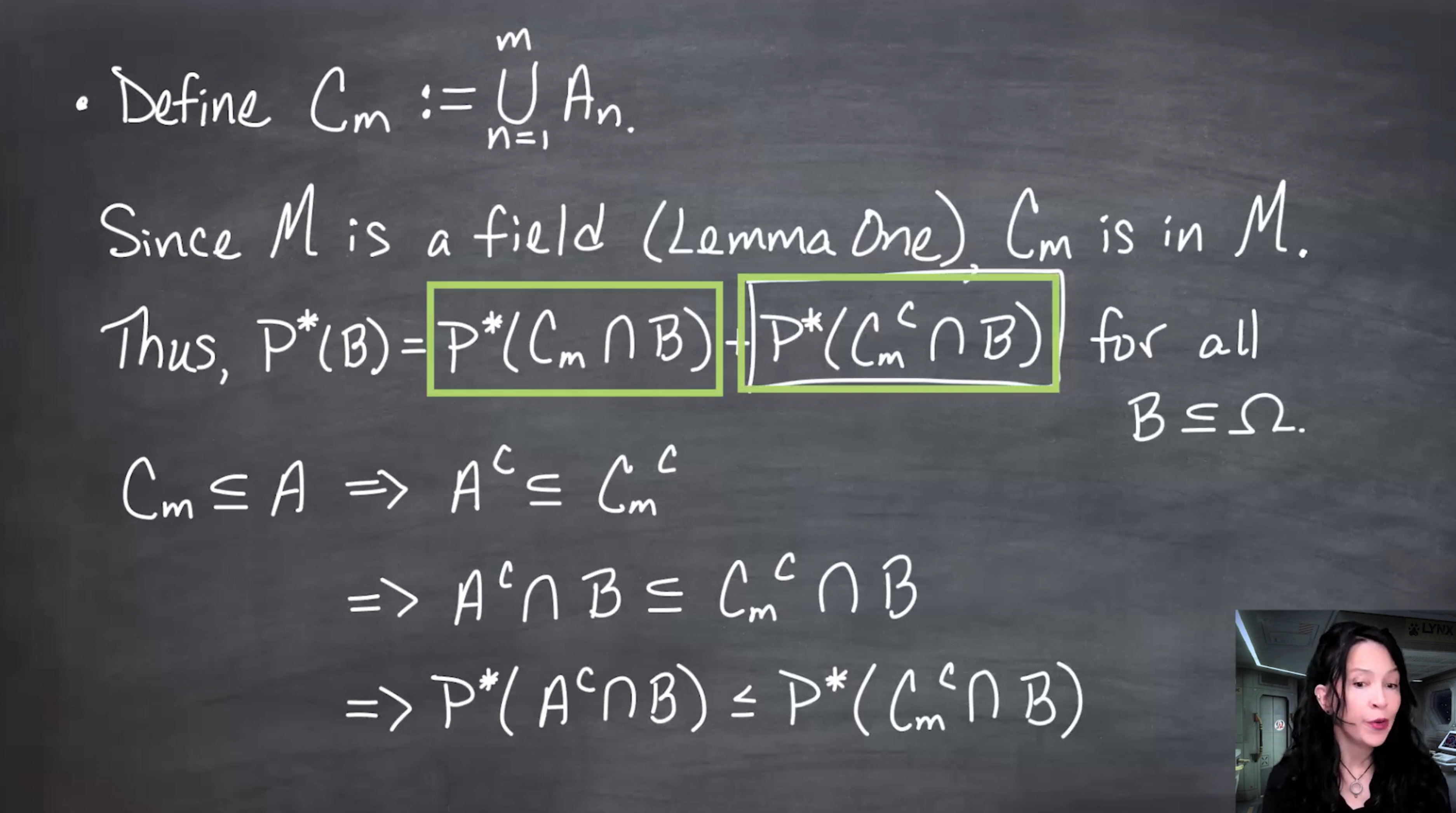
For any B\subseteq\Omega, because C_m\in\mathcal{M},
P^*(B) = P^*(C_m\cap B)+P^*(C_m^c\cap B).
Now
C_m\cap B = \bigcup_{n=1}^{m}(A_n\cap B),
and by Lemma 2,
P^*(C_m\cap B) = \sum_{n=1}^{m}P^*(A_n\cap B).
Also, since C_m\subseteq A, we have A^c\subseteq C_m^c, hence
A^c\cap B\subseteq C_m^c\cap B.
By monotonicity,
P^*(A^c\cap B)\leq P^*(C_m^c\cap B).
Putting these together,
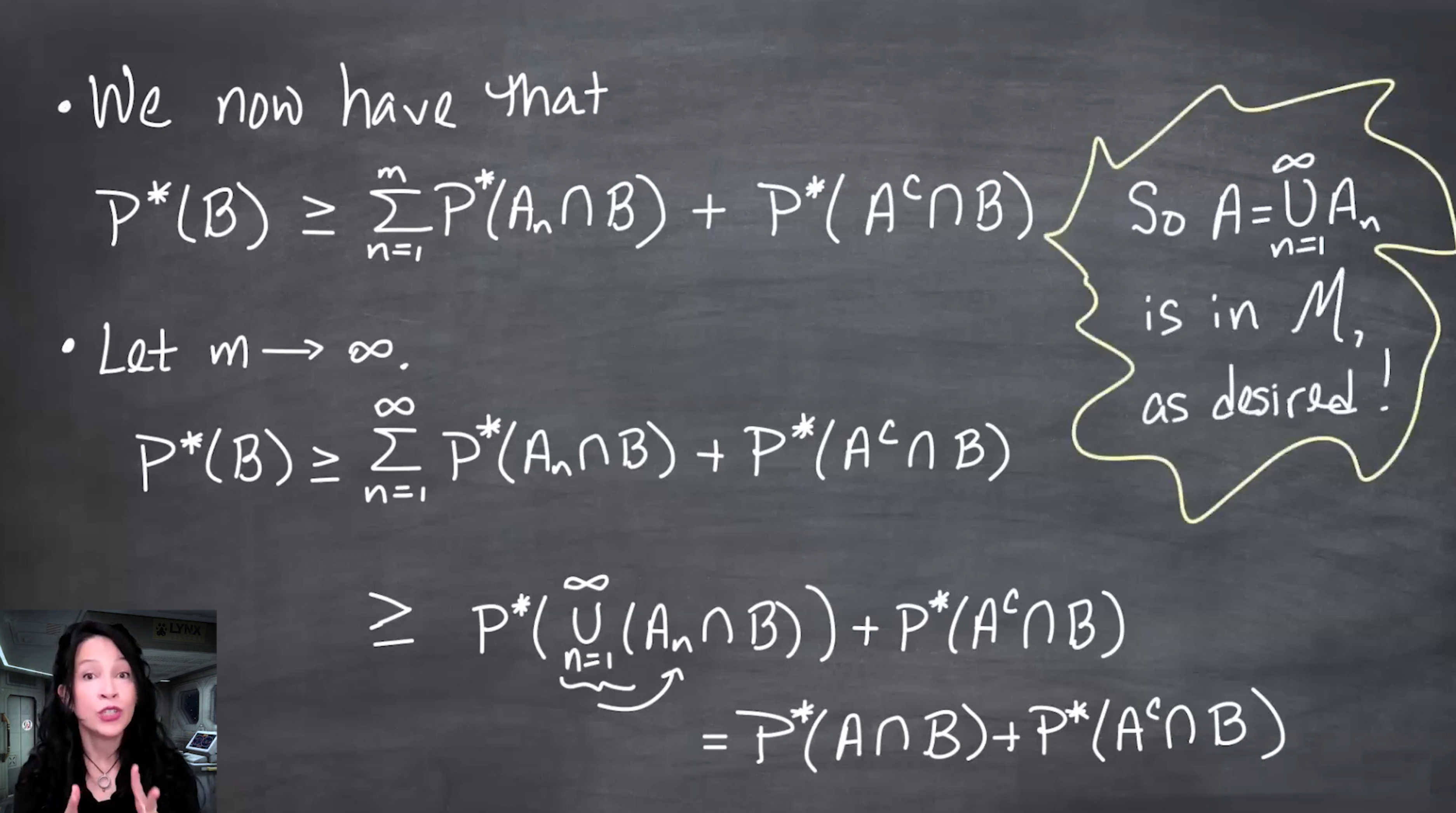
P^*(B) \geq \sum_{n=1}^{m}P^*(A_n\cap B)+P^*(A^c\cap B).
Letting m\to\infty,
P^*(B) \geq \sum_{n=1}^{\infty}P^*(A_n\cap B)+P^*(A^c\cap B).
By countable subadditivity,
\sum_{n=1}^{\infty}P^*(A_n\cap B) \geq P^*\left(\bigcup_{n=1}^{\infty}(A_n\cap B)\right) = P^*(A\cap B).
Therefore,
P^*(B) \geq P^*(A\cap B)+P^*(A^c\cap B).
This is the one-sided criterion for A\in\mathcal{M}. Hence \mathcal{M} is closed under countable unions.
Together with Lemma 1, this proves that \mathcal{M} is a \sigma-field.
151.8 Takeaway
This lesson proves the structural part of the extension theorem:
\mathcal{M} \text{ is a field} \quad\Longrightarrow\quad P^* \text{ is countably additive on } \mathcal{M} \quad\Longrightarrow\quad \mathcal{M} \text{ is a } \sigma\text{-field}.
The key proof pattern is:
- define \mathcal{M} by a splitting identity;
- use subadditivity of P^* to get one inequality for free;
- prove the reverse inequality where needed;
- use finite approximations and limits to move from finite to countable unions.
The next lesson proves Lemmas 4–6, which connect \mathcal{M} back to the original field \mathcal{F}_0 and complete the extension argument.