150.1 Lesson map
- 0:12 — Recap: extend a probability measure from a field \mathcal{F}_0 to \sigma(\mathcal{F}_0).
- 1:08 — The outer-measure idea: cover arbitrary A\subseteq\Omega by sets from \mathcal{F}_0.
- 3:37 — Definition of the outer measure P^*.
- 5:17 — What extension means: preserve old values on \mathcal{F}_0.
- 6:09 — Recap of the four known properties of P^*.
- 9:13 — Motivation: splitting a set B by A and A^c.
- 10:17 — Define the collection \mathcal{M} of sets that split every B correctly.
- 11:15 — Equivalent definition of \mathcal{M} using only one inequality.
- 13:04 — Proof roadmap: six lemmas.
- 16:59 — How the lemmas imply the desired extension theorem.
- 20:29 — Uniqueness of the extension.
- 25:14 — Stronger uniqueness theorem and future \pi-systems.
150.2 Recap: the outer-measure construction
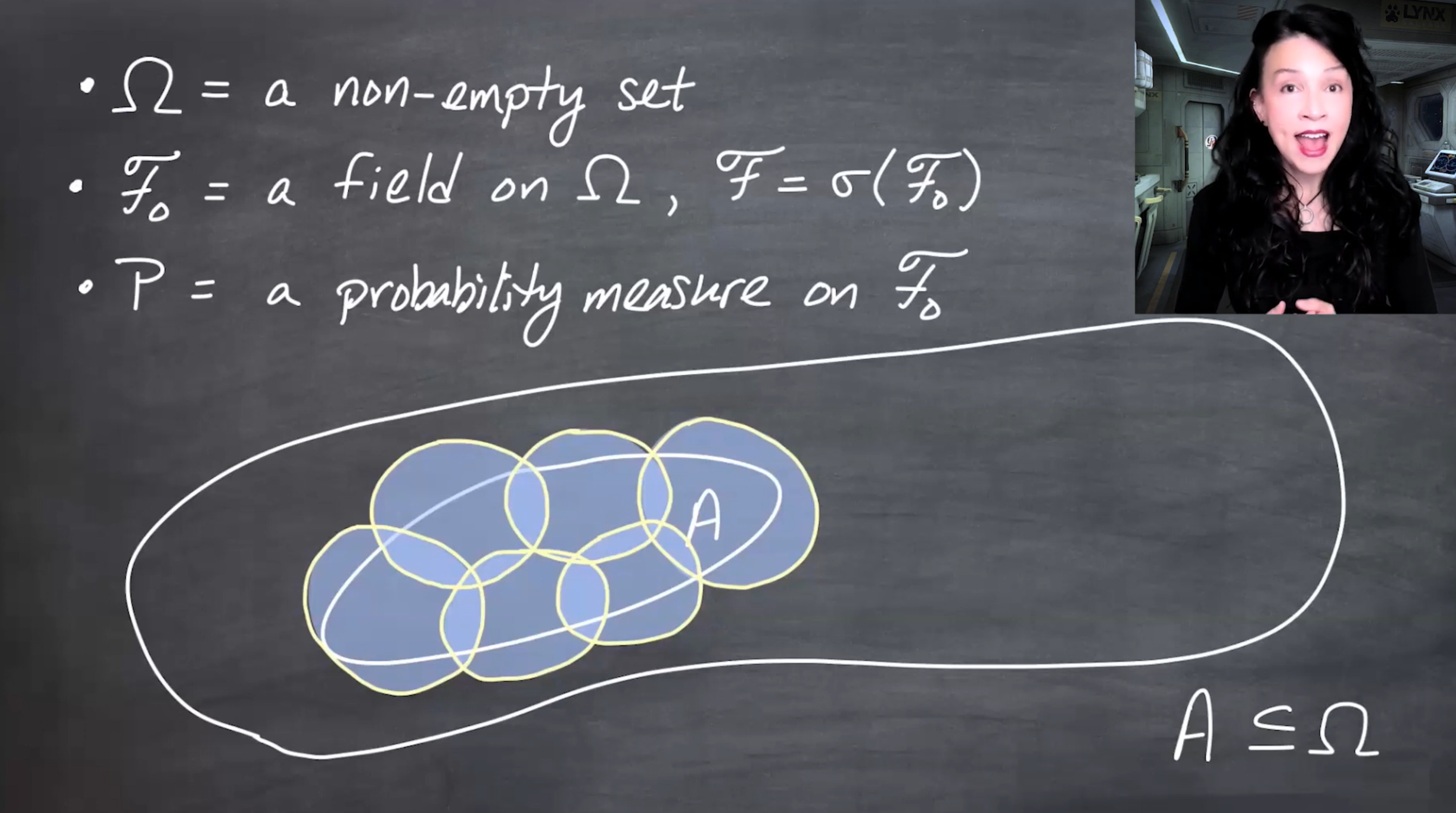
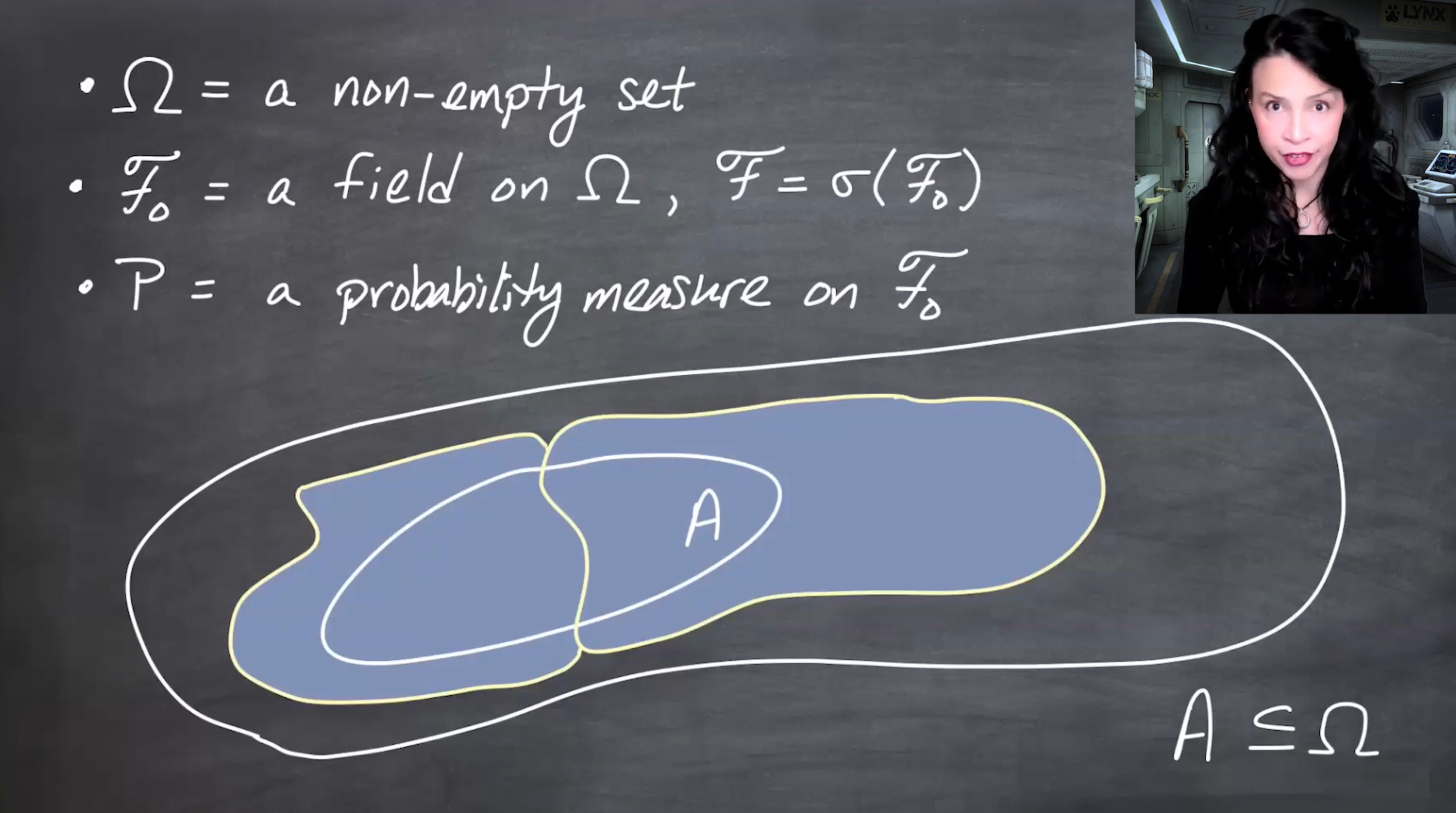
The previous lesson started with:
\Omega\neq\emptyset, \qquad \mathcal{F}_0 \text{ a field on } \Omega, \qquad \mathcal{F}=\sigma(\mathcal{F}_0),
and a probability measure
P:\mathcal{F}_0\to[0,1].
The goal is to extend P to the larger \sigma-field \mathcal{F}.
For an arbitrary subset A\subseteq\Omega, the idea was to cover A by countably many sets from \mathcal{F}_0, because those are the sets whose probabilities are already known.
The cover may include extra regions outside A, and the covering sets may overlap. So the sum of their probabilities is usually an overestimate.
150.3 Outer measure P^*
Definition 150.1 (Outer measure associated with P) For every subset A\subseteq\Omega, define
P^*(A) = \inf\left\{ \sum_{n=1}^{\infty}P(A_n) : A_n\in\mathcal{F}_0 \text{ and } A\subseteq\bigcup_{n=1}^{\infty}A_n \right\}.
This is called an outer measure because it approaches A from outside: cover A by measurable pieces from \mathcal{F}_0, sum their probabilities, and take the best possible upper bound.
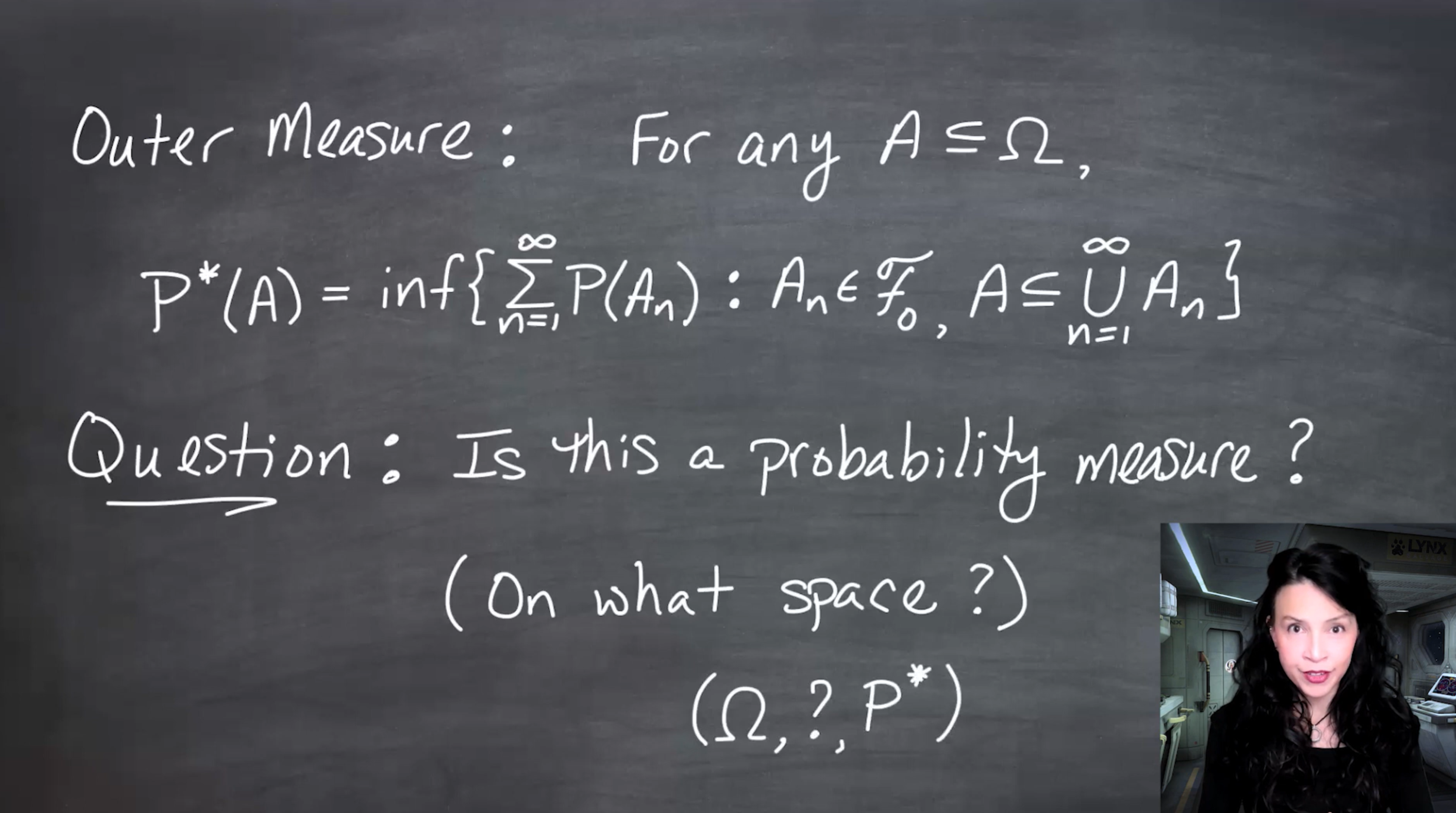
At this point, the terminology is slightly optimistic. We have called P^* an outer measure, but we have not yet proved that it behaves like a probability measure on the \sigma-field we care about.
150.4 What extension should mean
An extension must do two things:
- assign values to more sets;
- preserve the old values.
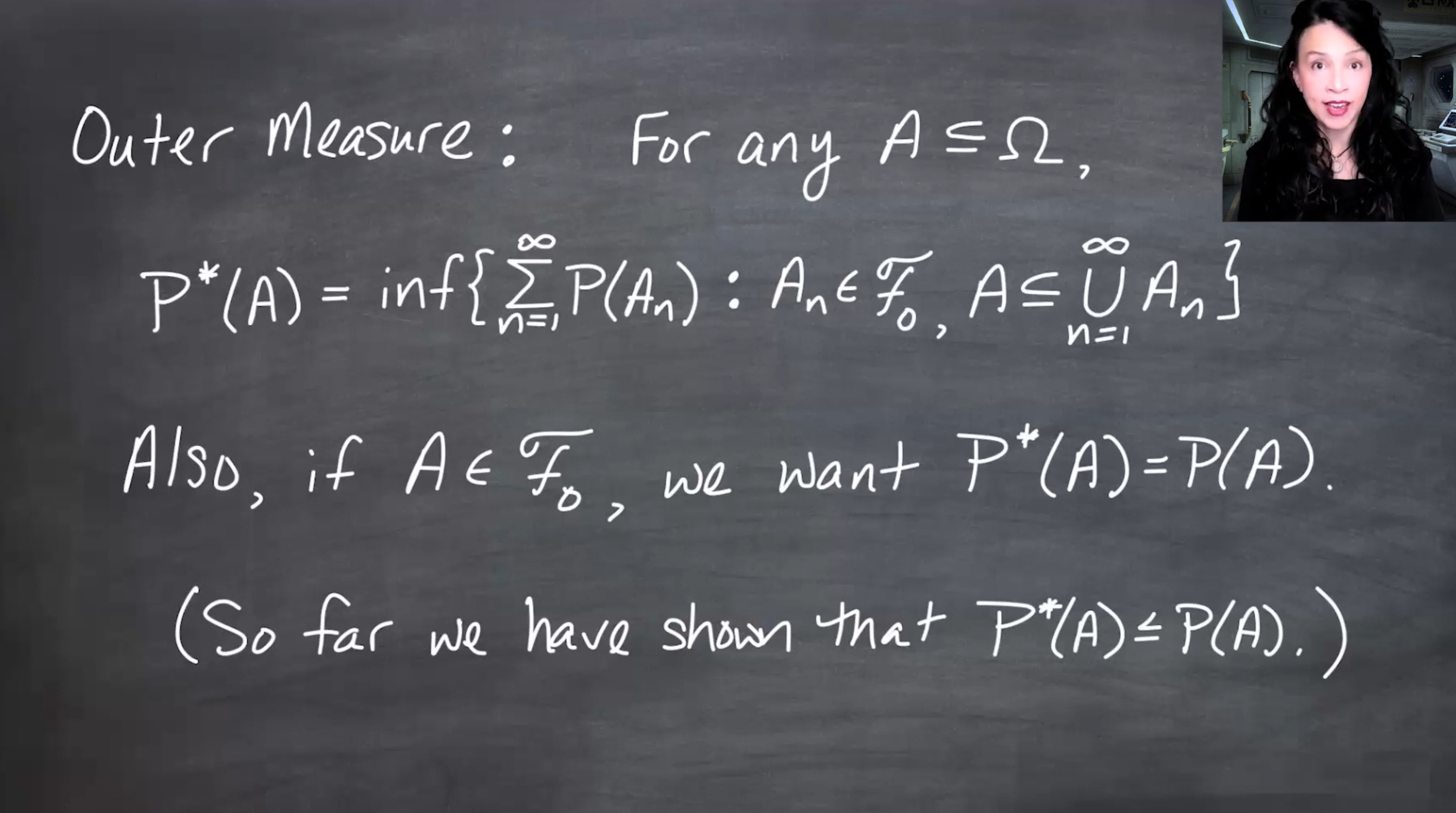
So for every A\in\mathcal{F}_0, we want
P^*(A)=P(A).
So far, the previous lesson only proved one direction:
P^*(A)\leq P(A) \qquad (A\in\mathcal{F}_0).
150.5 Four known properties of P^*
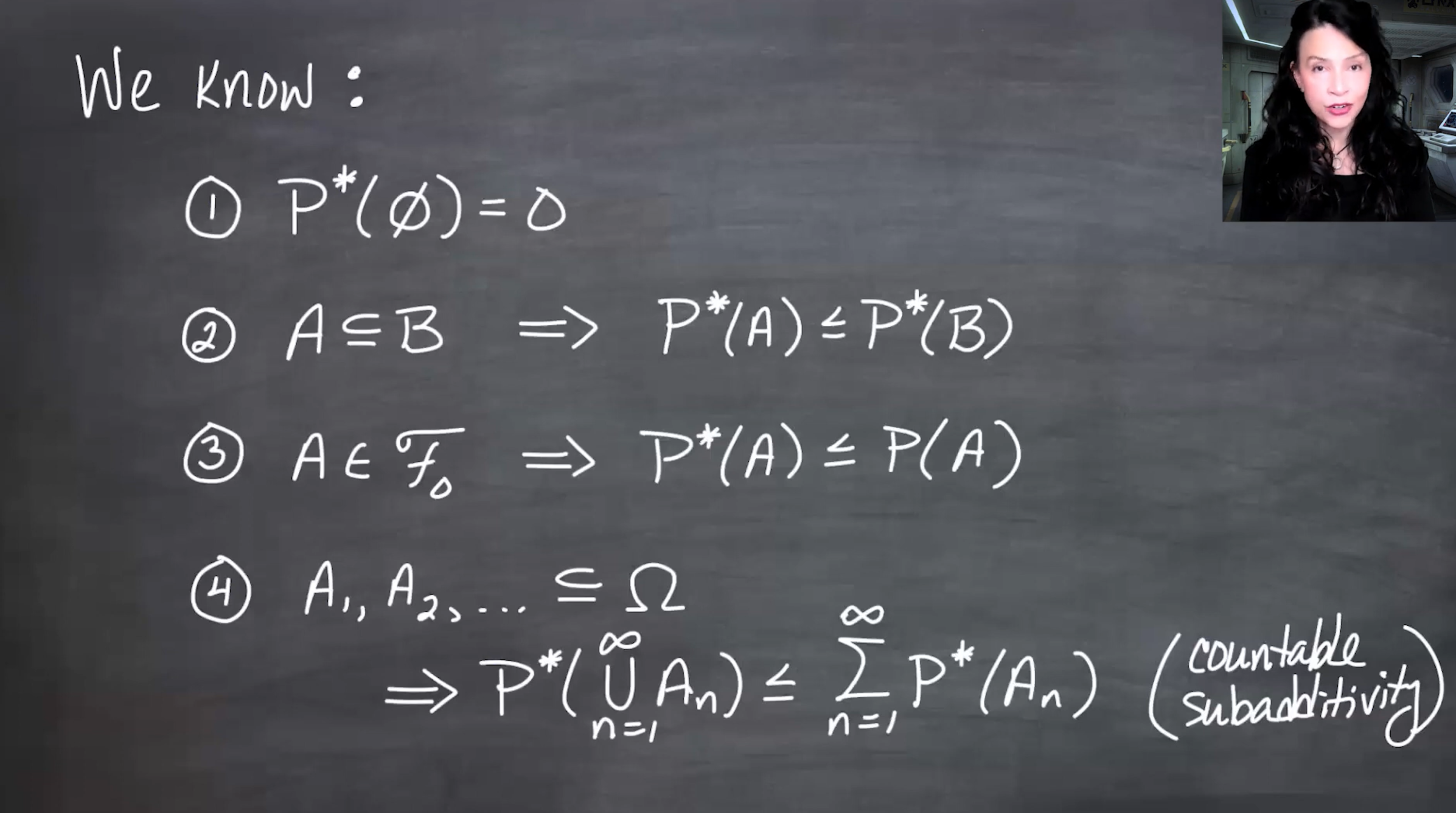
From Lesson 4, we know:
- P^*(\emptyset)=0.
- If A\subseteq B, then P^*(A)\leq P^*(B).
- If A\in\mathcal{F}_0, then P^*(A)\leq P(A).
- P^* is countably subadditive:
P^*\left(\bigcup_{n=1}^{\infty}A_n\right) \leq \sum_{n=1}^{\infty}P^*(A_n).
The missing pieces are:
- countable additivity on the right class of sets;
- P^*(\Omega)=1;
- equality P^*(A)=P(A) for A\in\mathcal{F}_0;
- identifying the \sigma-field on which P^* is a probability measure.
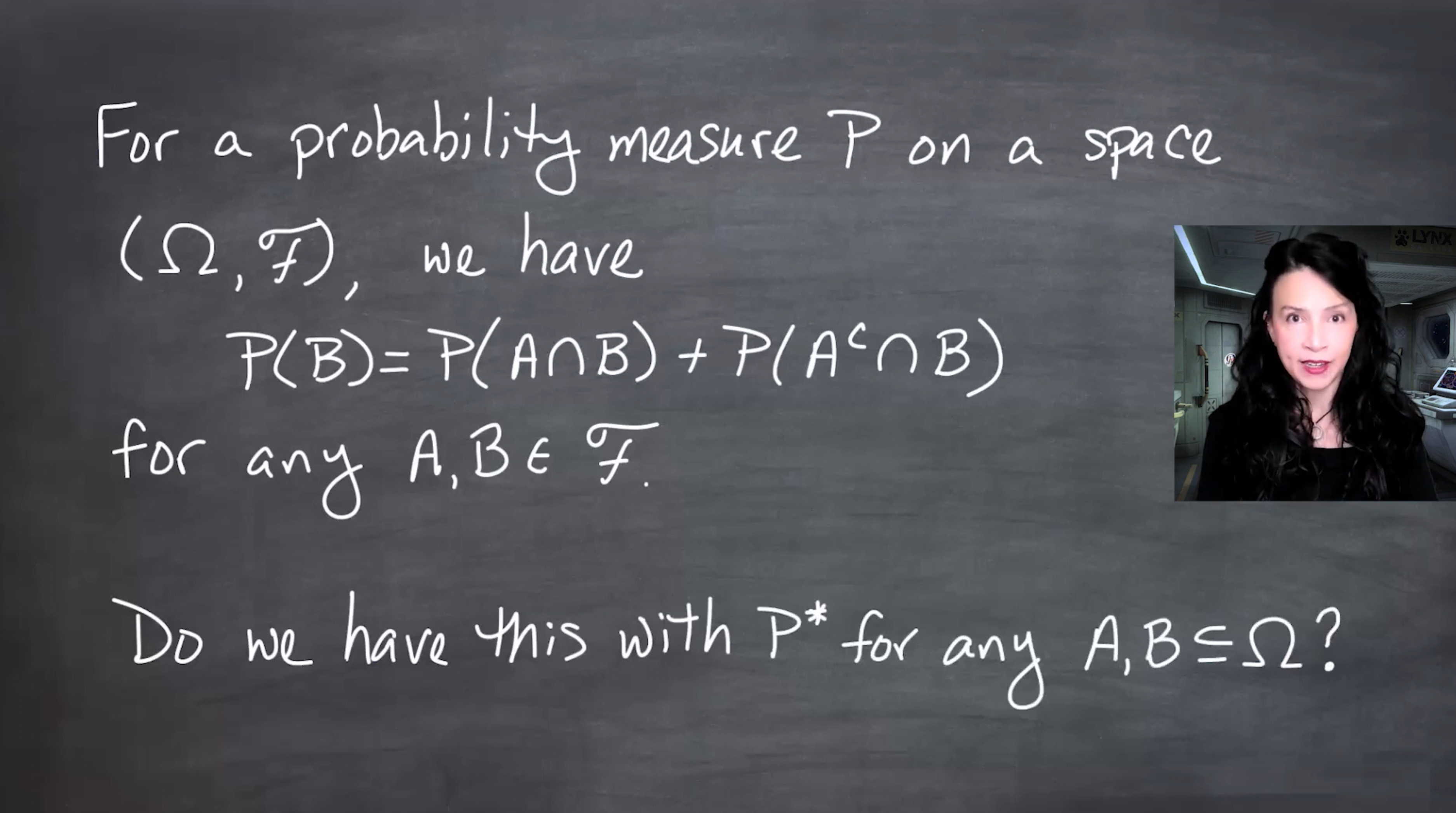
150.6 Splitting a set by A and A^c
For an actual probability measure, every measurable set B can be split into the part inside A and the part outside A:
B = (A\cap B)\cup(A^c\cap B),
where the two pieces are disjoint. Therefore,
P(B) = P(A\cap B)+P(A^c\cap B).
This motivates defining the sets for which P^* has this splitting property.
150.7 The collection \mathcal{M}
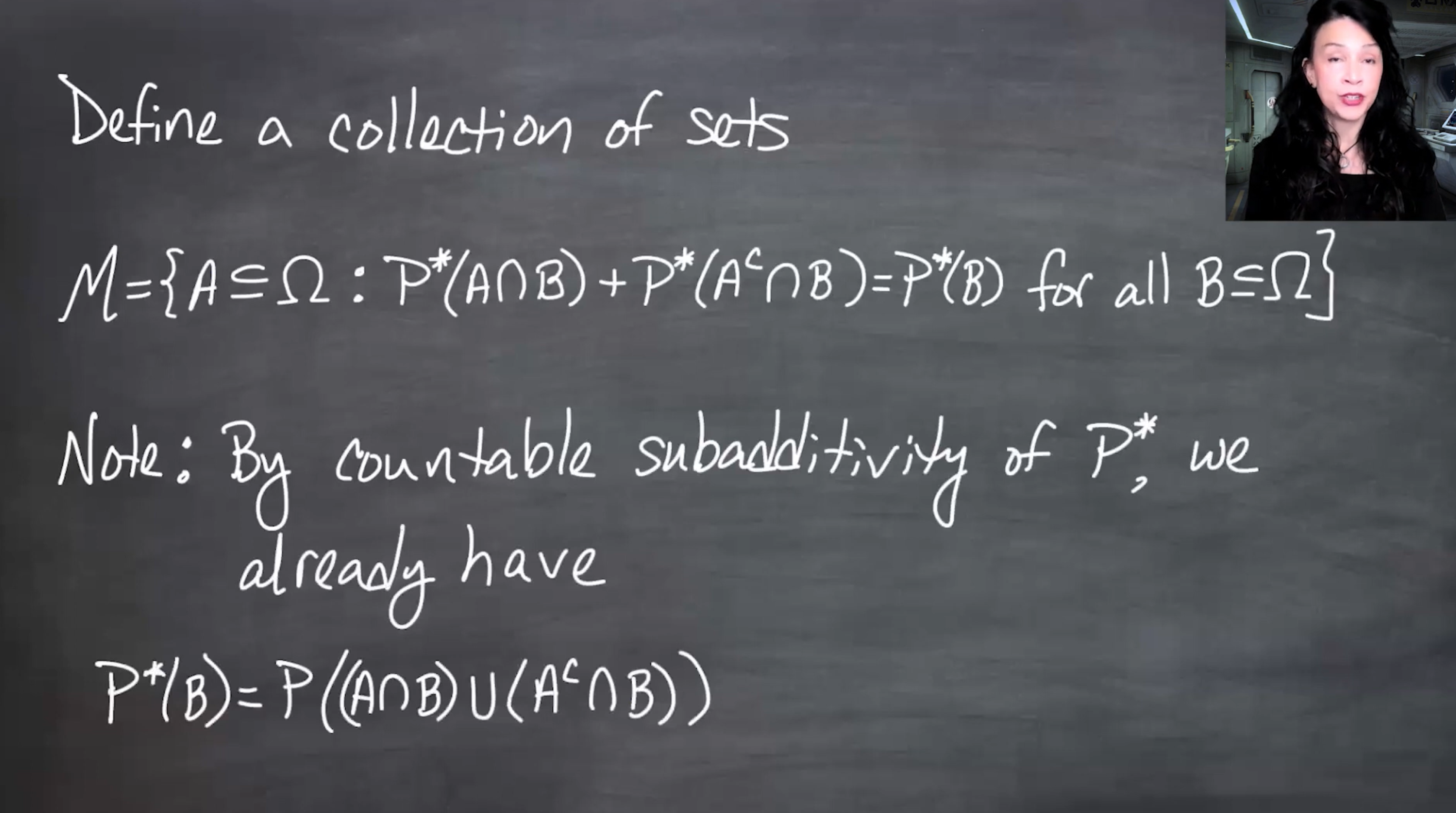
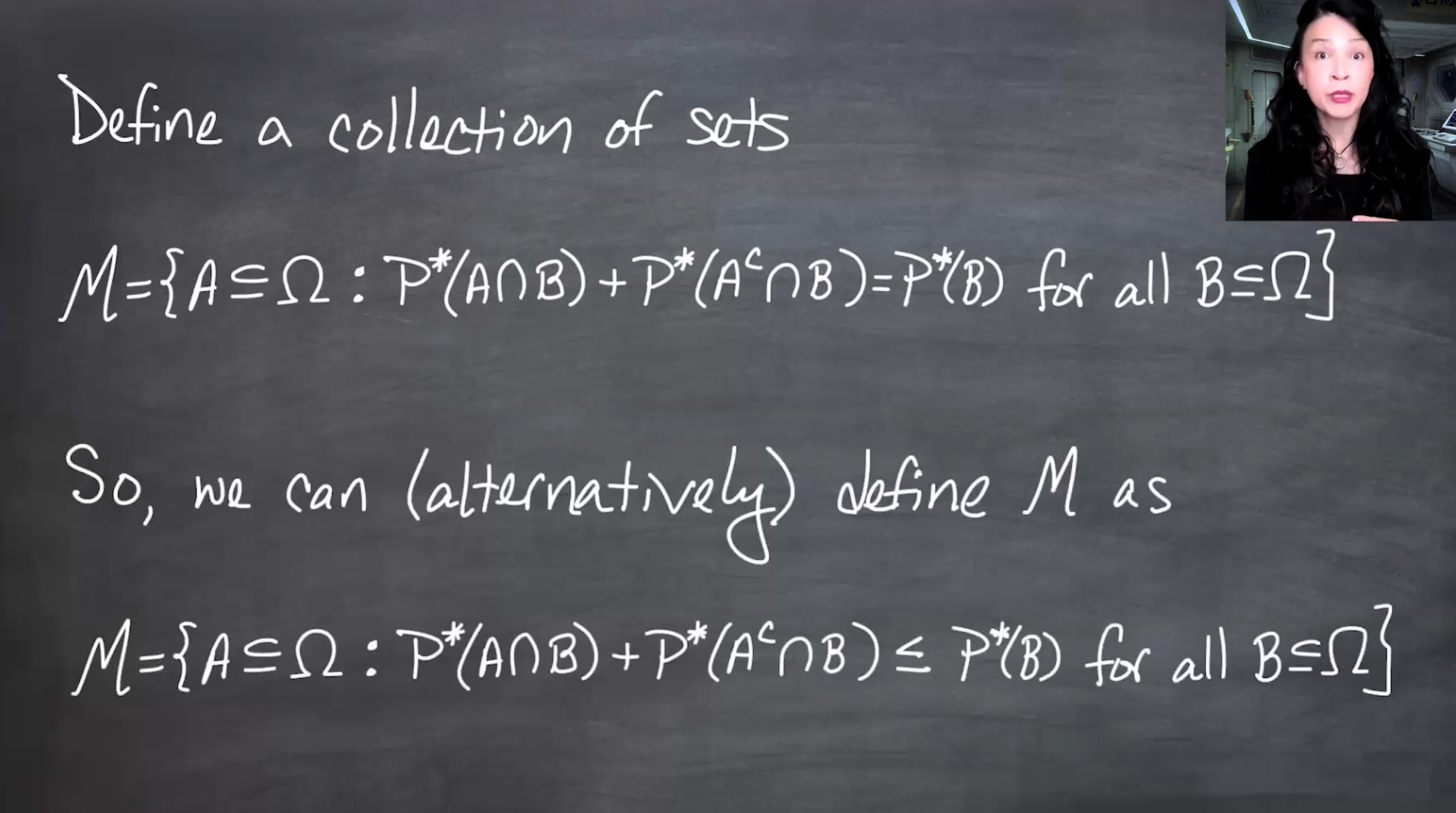
Definition 150.2 (The collection \mathcal{M}) Define \mathcal{M} to be the collection of all subsets A\subseteq\Omega such that, for every B\subseteq\Omega,
P^*(B) = P^*(A\cap B)+P^*(A^c\cap B).
These are the sets that split every test set B correctly under P^*.
This is the Carathéodory-style measurability condition, although the lesson introduces it operationally rather than as a named theorem.
150.7.1 Equivalent one-sided condition
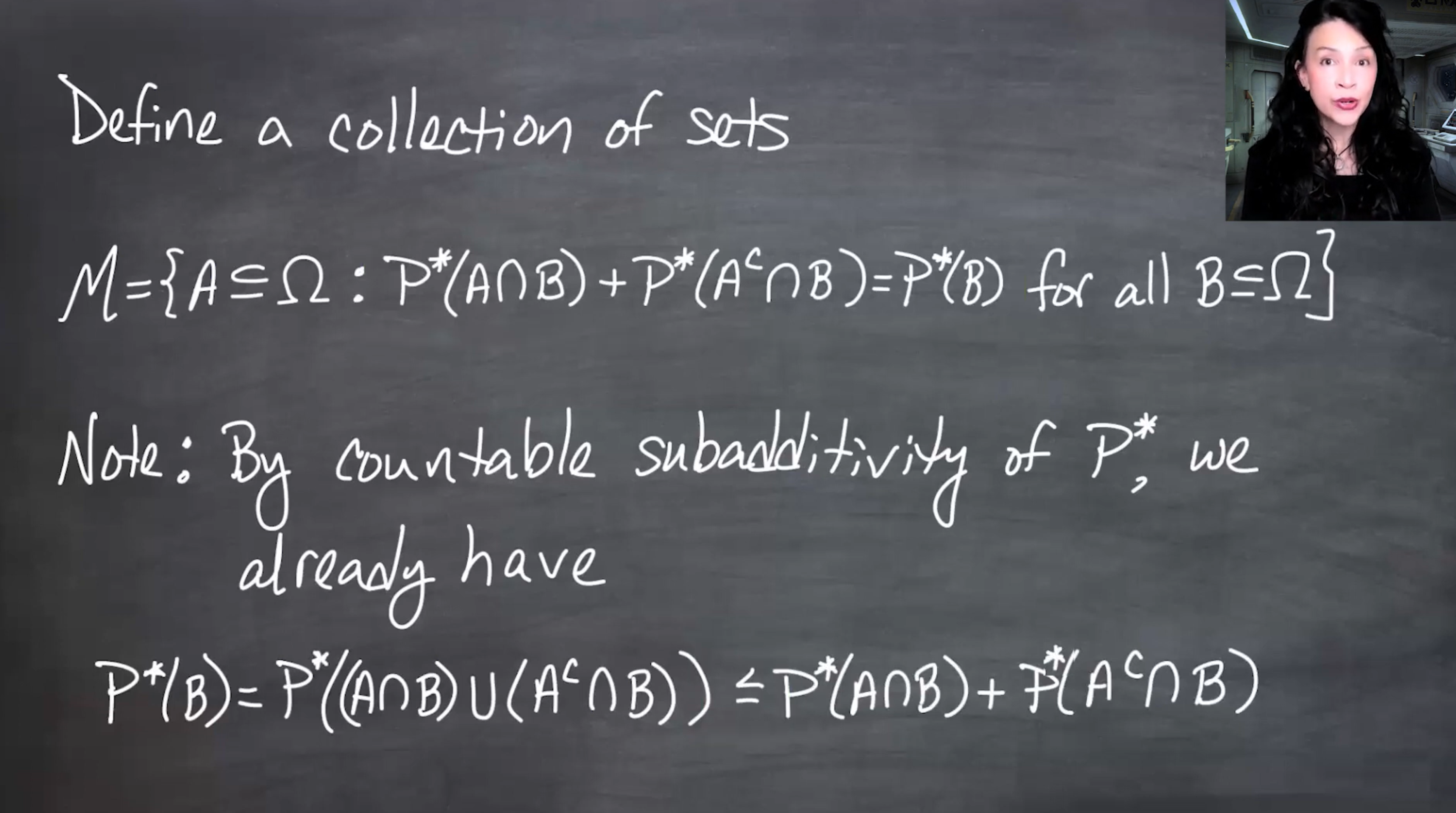
By countable subadditivity,
P^*(B) \leq P^*(A\cap B)+P^*(A^c\cap B)
always holds, because B=(A\cap B)\cup(A^c\cap B).
Therefore, to show equality it is enough to prove the reverse inequality:
P^*(A\cap B)+P^*(A^c\cap B) \leq P^*(B).
150.8 Roadmap: six lemmas
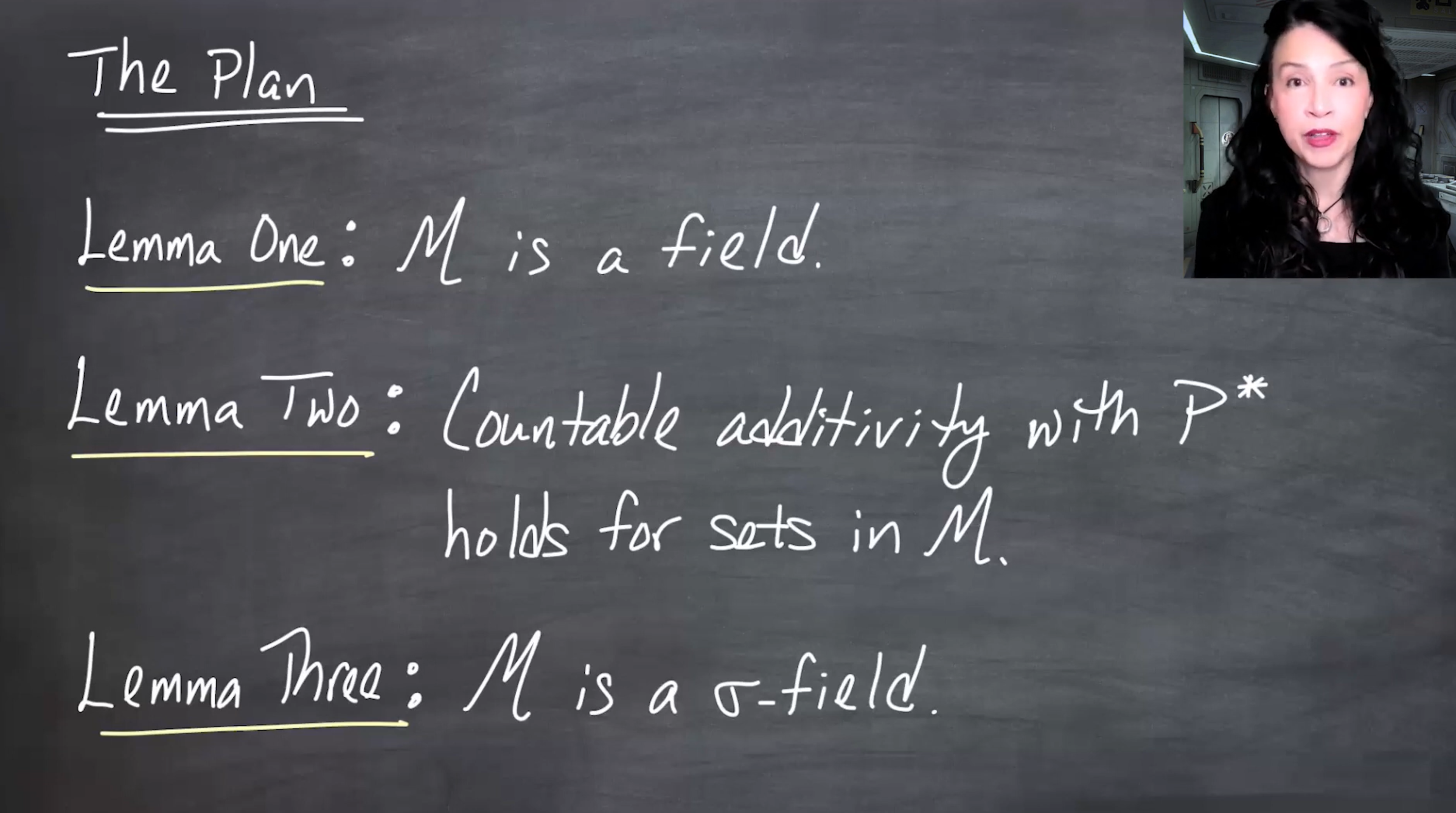
The proof that P^* extends P is long, so the lesson organizes it into six lemmas.
150.8.1 Lemma 1
\mathcal{M} \text{ is a field.}
This means:
- \Omega\in\mathcal{M};
- if A\in\mathcal{M}, then A^c\in\mathcal{M};
- if A,C\in\mathcal{M}, then A\cup C\in\mathcal{M}.
150.8.2 Lemma 2
P^* is countably additive on disjoint sets in \mathcal{M}:
P^*\left(\bigcup_{n=1}^{\infty}A_n\right) = \sum_{n=1}^{\infty}P^*(A_n),
whenever A_1,A_2,\ldots\in\mathcal{M} are disjoint.
150.8.3 Lemma 3
\mathcal{M} \text{ is a } \sigma\text{-field.}
Lemma 2 helps upgrade finite-union closure to countable-union closure.
150.8.4 Lemma 4
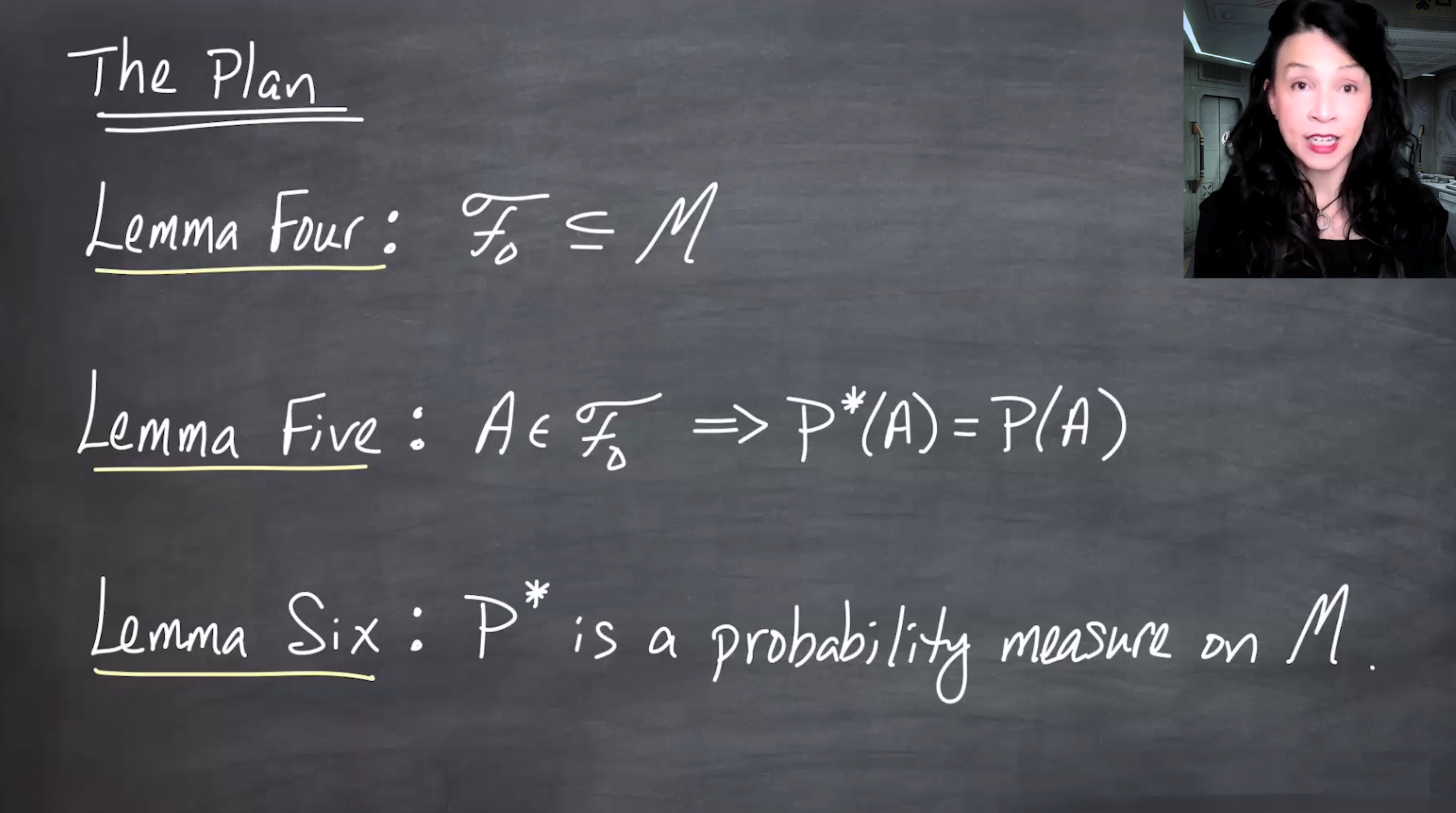
\mathcal{F}_0\subseteq\mathcal{M}.
Every original field set satisfies the splitting condition.
150.8.5 Lemma 5
For every A\in\mathcal{F}_0,
P^*(A)=P(A).
This completes the equality that Lesson 4 only proved in one direction.
150.8.6 Lemma 6
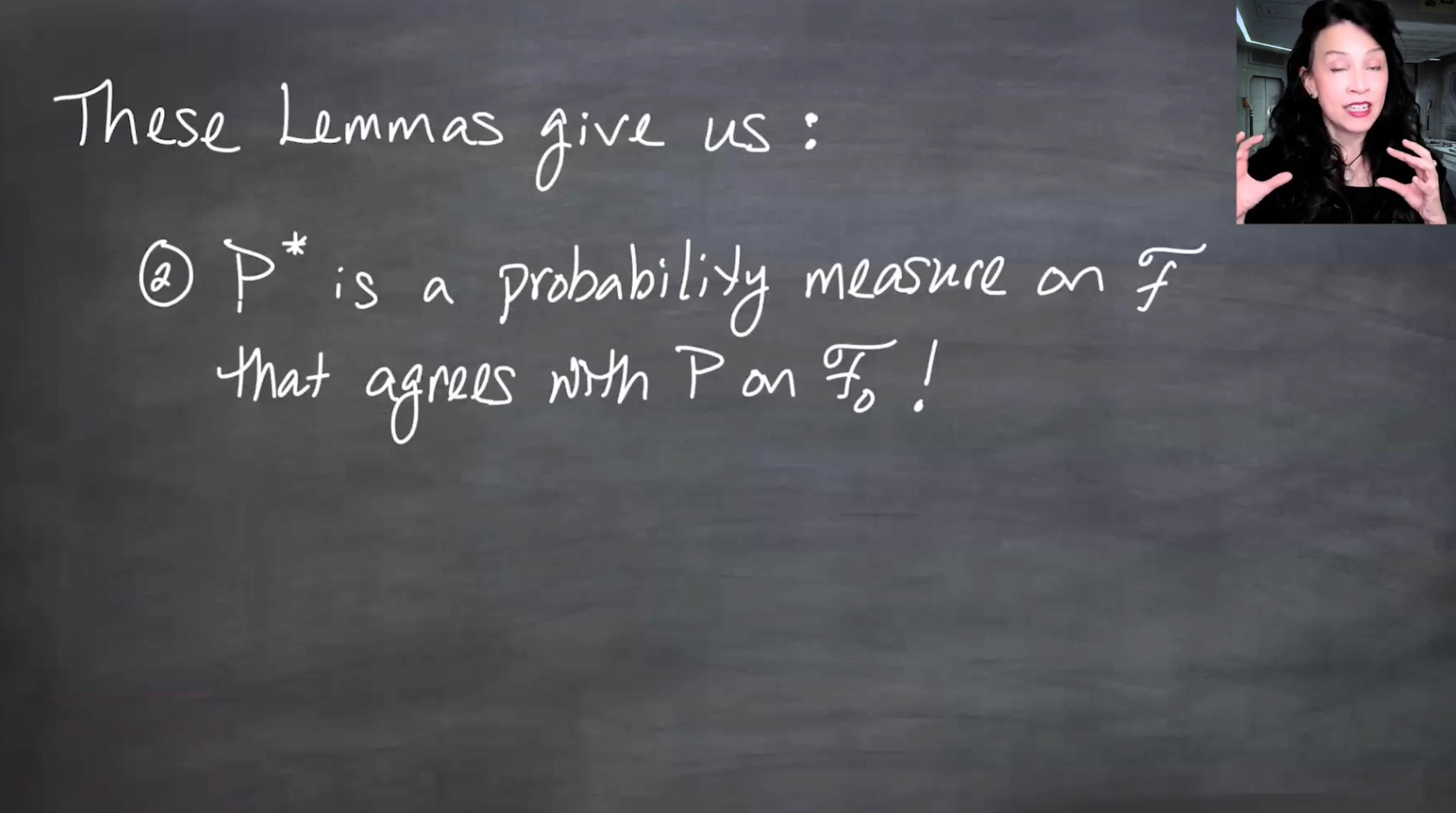
P^* is a probability measure on \mathcal{M}.
That is:
- P^*(\emptyset)=0;
- P^* is countably additive on \mathcal{M};
- P^*(\Omega)=1.
150.9 How the lemmas prove the extension theorem
Once the six lemmas are known, the extension theorem follows quickly.
Since Lemma 3 says \mathcal{M} is a \sigma-field, and Lemma 4 says \mathcal{F}_0\subseteq\mathcal{M}, the generated \sigma-field must satisfy
\mathcal{F} = \sigma(\mathcal{F}_0) \subseteq \mathcal{M}.
This is the same minimality argument used earlier: \sigma(\mathcal{F}_0) is the smallest \sigma-field containing \mathcal{F}_0, so it must be contained in any \sigma-field that contains \mathcal{F}_0.
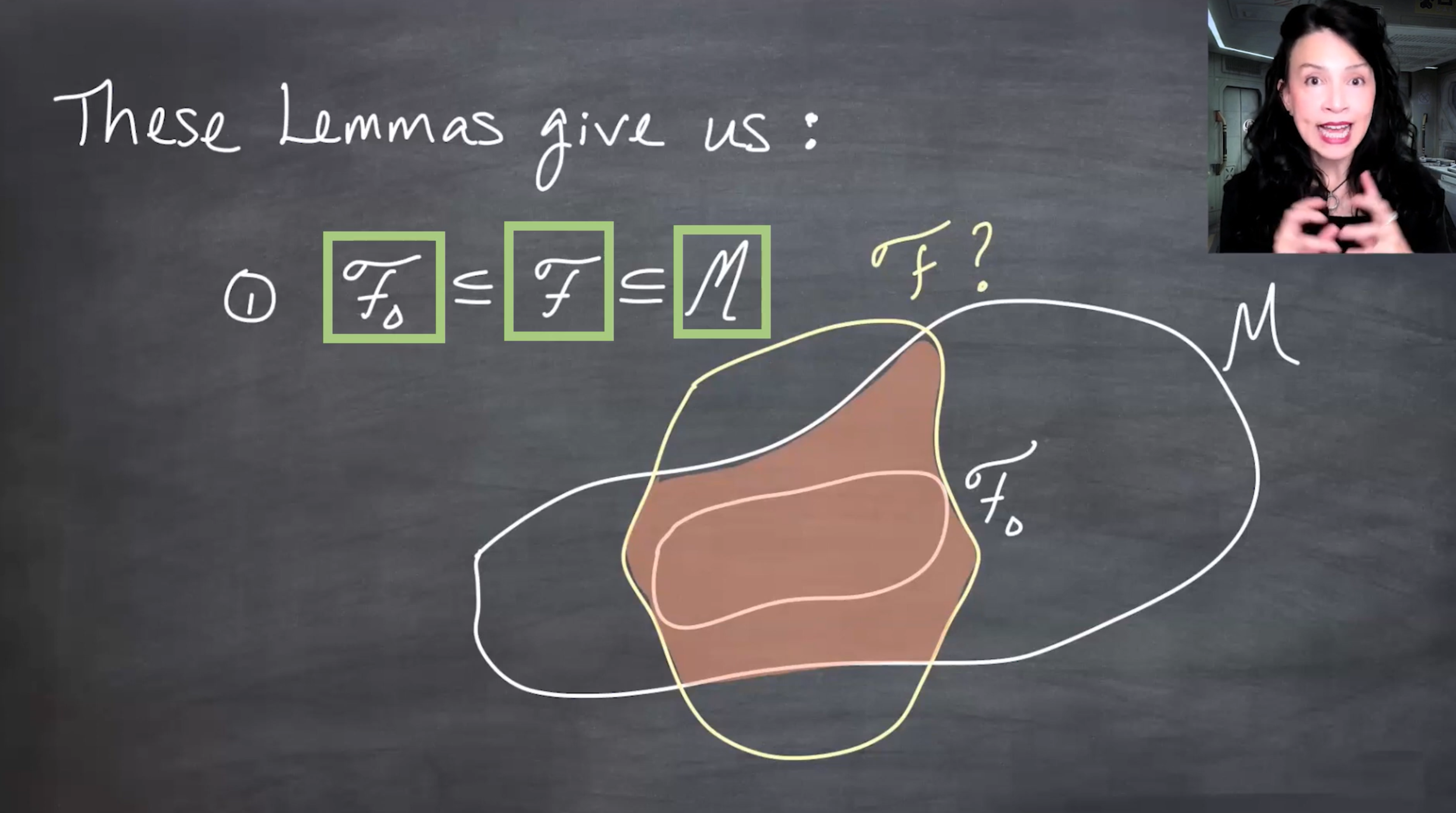
Since P^* is a probability measure on \mathcal{M}, it is also a probability measure when restricted to the smaller \sigma-field \mathcal{F}.
And since Lemma 5 says P^*=P on \mathcal{F}_0, this restriction is an extension of the original probability measure.
150.10 Uniqueness of the extension
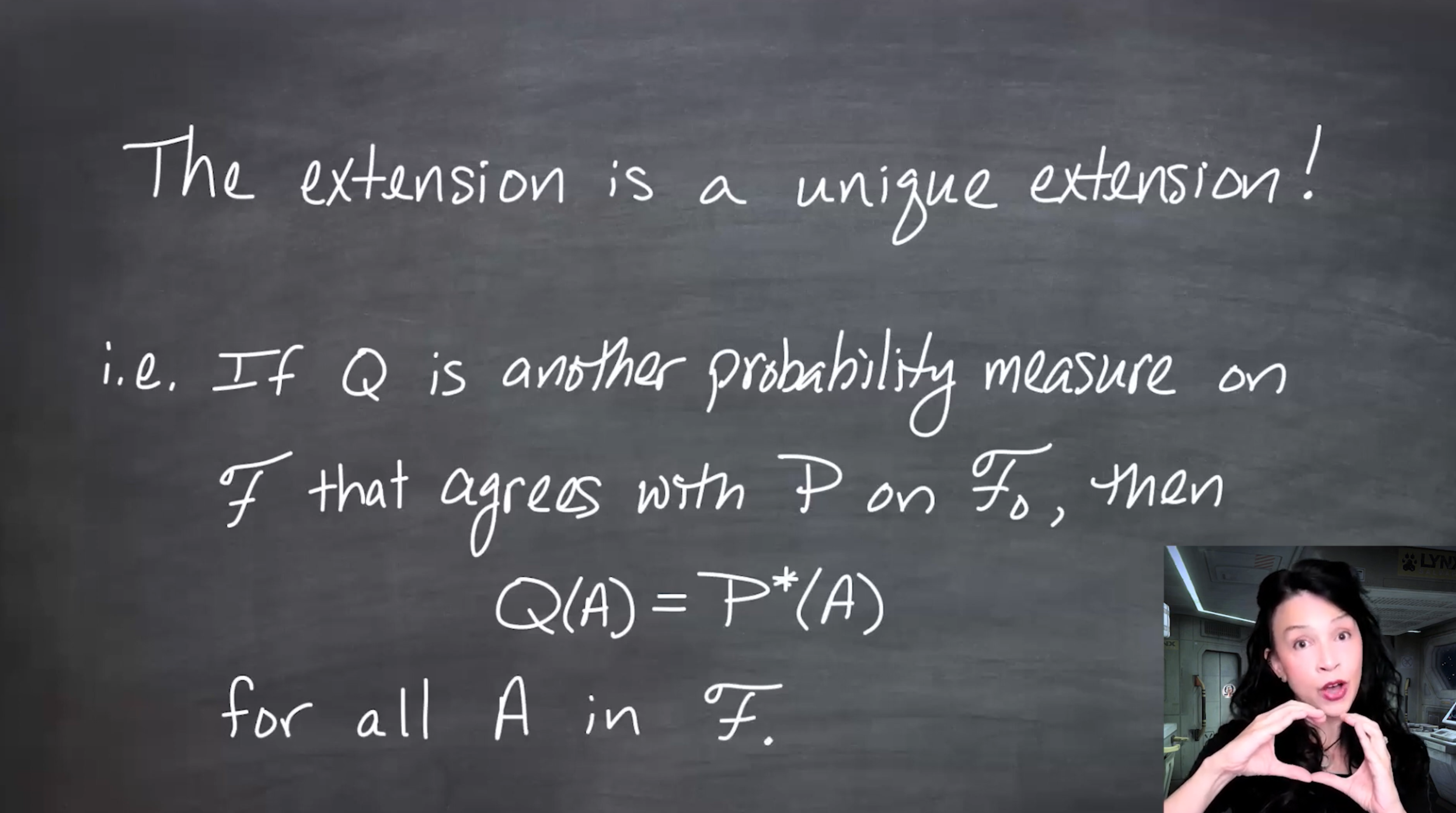
The lesson also proves a uniqueness result.
Suppose Q is another probability measure on \mathcal{F} and Q agrees with P on \mathcal{F}_0:
Q(A)=P(A) \qquad \text{for all } A\in\mathcal{F}_0.
Then
Q(A)=P^*(A) \qquad \text{for all } A\in\mathcal{F}.
150.10.1 First inequality
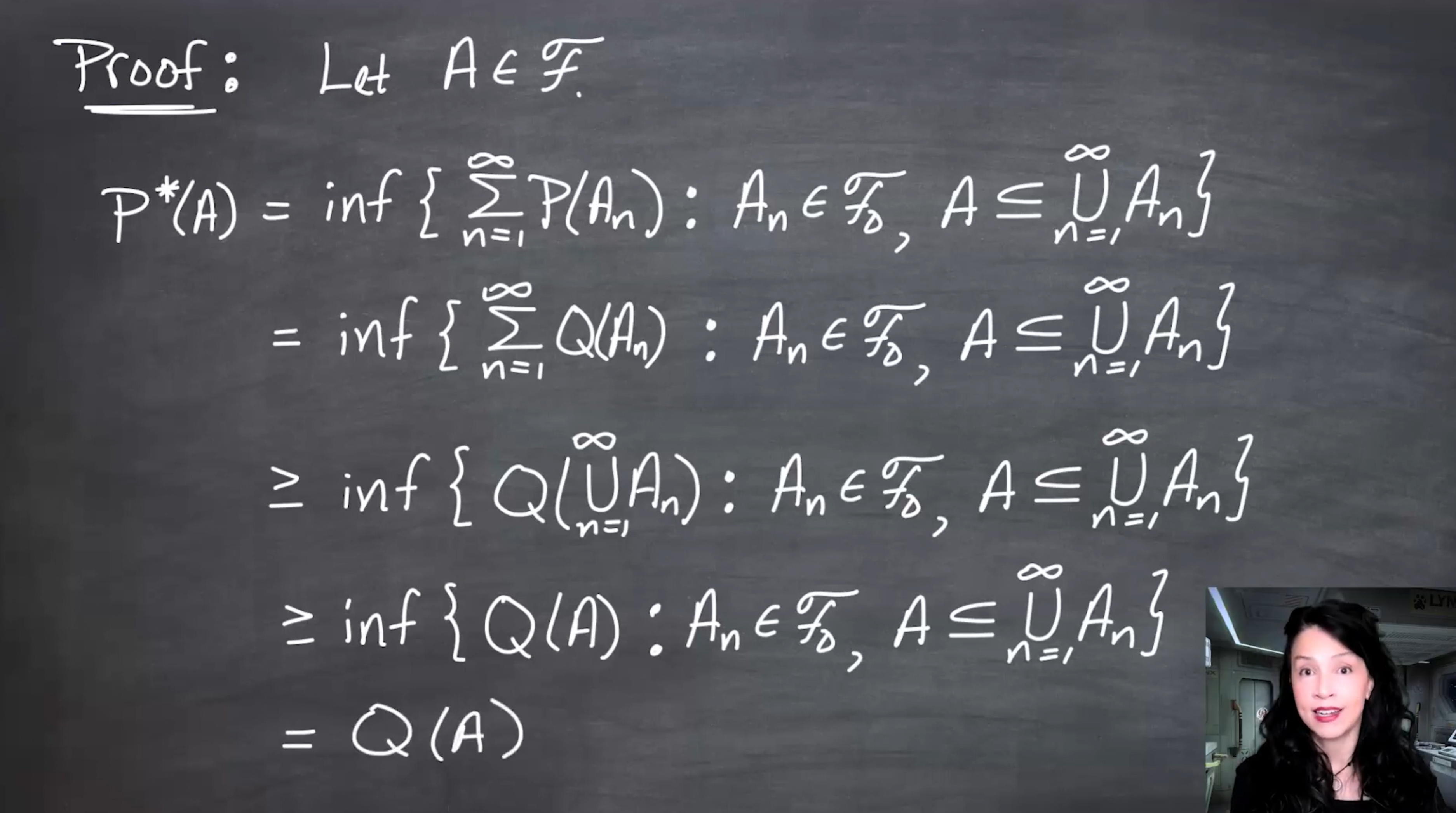
Take A\in\mathcal{F}. By definition,
P^*(A) = \inf \left\{ \sum_{n=1}^{\infty}P(A_n) : A_n\in\mathcal{F}_0,\; A\subseteq\bigcup_n A_n \right\}.
Since Q=P on \mathcal{F}_0,
P^*(A) = \inf \left\{ \sum_{n=1}^{\infty}Q(A_n) : A_n\in\mathcal{F}_0,\; A\subseteq\bigcup_n A_n \right\}.
By countable subadditivity of Q,
Q\left(\bigcup_n A_n\right) \leq \sum_n Q(A_n).
And since A\subseteq\bigcup_n A_n, monotonicity gives
Q(A) \leq Q\left(\bigcup_n A_n\right).
Therefore every admissible cover-sum is at least Q(A), so
P^*(A)\geq Q(A).
150.10.2 Reverse inequality
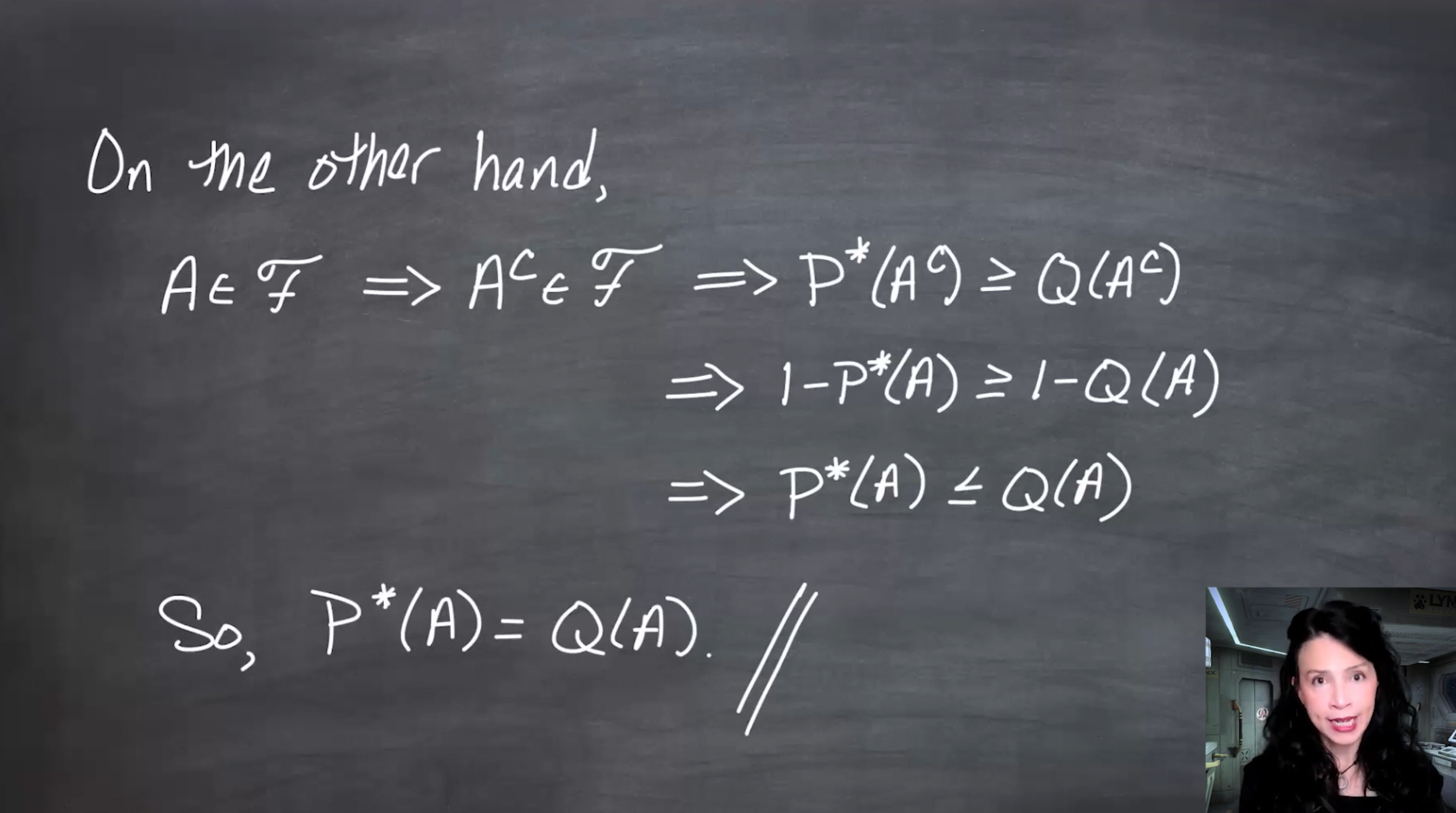
Since A\in\mathcal{F}, also A^c\in\mathcal{F}. Applying the previous inequality to A^c gives
P^*(A^c)\geq Q(A^c).
Both P^* and Q are probability measures on \mathcal{F}, so
P^*(A^c)=1-P^*(A), \qquad Q(A^c)=1-Q(A).
Thus,
1-P^*(A)\geq 1-Q(A),
which implies
P^*(A)\leq Q(A).
Combining both inequalities,
P^*(A)=Q(A).
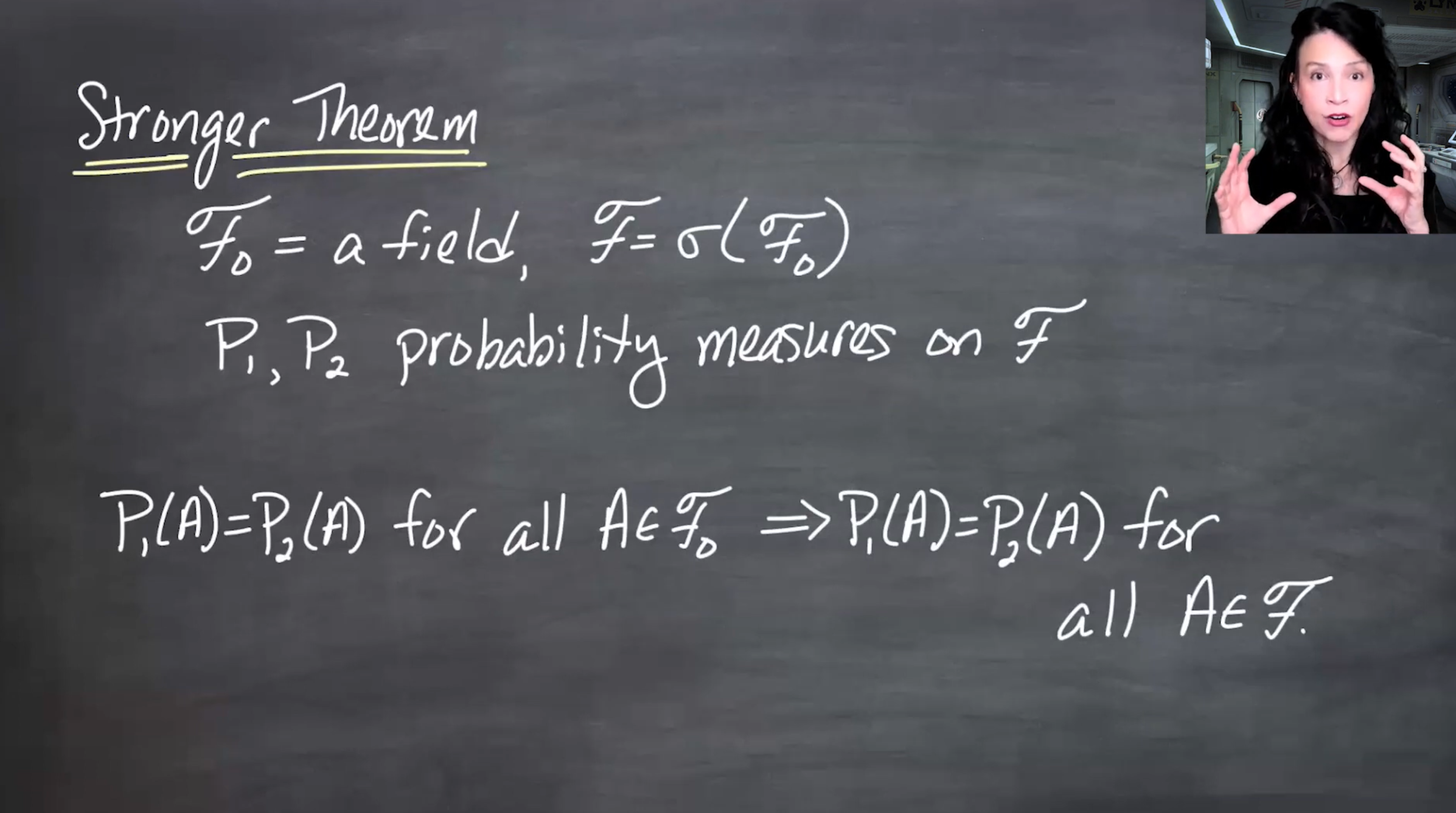
150.11 Stronger uniqueness theorem
The lesson ends by noting a stronger result:
If P_1 and P_2 are probability measures on \mathcal{F}=\sigma(\mathcal{F}_0) and
P_1(A)=P_2(A) \qquad \text{for all } A\in\mathcal{F}_0,
then
P_1(A)=P_2(A) \qquad \text{for all } A\in\mathcal{F}.
This stronger theorem does not depend on the outer-measure definition of P^*.
Jen notes that this stronger result is often proved using a weaker structure than a field, called a \pi-system, which will appear later.
150.12 Takeaway
The outer measure P^* is a “wannabe probability measure.” It is defined on all subsets of \Omega, but it becomes a genuine probability measure only on the right class of measurable sets.
The proof strategy is:
P \text{ on } \mathcal{F}_0 \quad\longrightarrow\quad P^* \text{ on all subsets of } \Omega \quad\longrightarrow\quad \mathcal{M} \text{ where } P^* \text{ behaves additively} \quad\longrightarrow\quad P^* \text{ on } \sigma(\mathcal{F}_0).
The six lemmas are the scaffolding that turns the outer-measure construction into a true extension theorem.