#: label: fisher-psi
y <- c(125, 18, 20, 34)
a <- y[1]
b <- y[2] + y[3]
c <- y[4]
psi <- (a - 2*b - c + sqrt((a - 2*b - c)^2 + 8*c*(a+b+c)))/(2*(a+b+c))
psi
[1] 0.6268215Mixture Models, Maximum Likelihood Estimation, Expectation-Maximization, full data log likelihood, EM algorithm, E step, M step, notes
The Expectation-Maximization (EM) algorithm is a broadly applicable statistical technique for maximizing complex likelihoods and handling the incomplete data problem. At each iteration step of the algorithm, two steps are performed:
E-Step consisting of projecting an appropriate functional containing the augmented data on the space of the original, incomplete data, and M-Step consisting of maximizing the functional.
In the course the EM algorithm is motivated by the following argument:
Maximum likelihood estimation (MLE) is the preferred estimator used within the frequentist paradigm to infer the parameters of statistical models. However, attempting to obtain (MLEs) \hat{\omega} and \hat{\theta} by directly maximizing the observed-data likelihood:
\mathcal{L}(\omega,\theta) = \arg \max_{\omega,\theta} \prod_{i=1}^{n} \sum_{k=1}^{K} \omega_k g_k(x_i|\theta_k) \tag{67.1}
isn’t feasible in practice, as it is a non-convex optimization problem.
Using numerical optimization methods, such as the Newton-Raphson algorithm, becomes increasingly more challenging when number of components in the mixture increases, as the likelihood surface becomes more complex with multiple local maxima.
This extended example is not from the Coursera specialization, rather it is due to a 2002 lecture by Terry Speed of UC at Berkeley by way of a handout for ISyE8843A by Brani Vidakovic titled on the EM Algorithm and Mixtures (accessed 2026-06-11). It has been adapted by me - spelling some things out in greater detail. I find that it helps to provide a bit more about Fisher’s Frame of mind as a Statistician who was working on genetics problems in the early 20th century. This is not a toy problem but also not very complicated, and it is a good illustration of the EM algorithm in a setting where the data is incomplete and the likelihood is complex.
Example 67.1 (Fisher’s Example)
In modern terminology, one has two linked bi-allelic loci, A and B say, with alleles A and a, and B and b, respectively, where A is dominant over a and B is dominant over b. A double heterozygote AaBb will produce gametes of four types: AB, Ab, aB and ab. Since the loci are linked, the types AB and ab will appear with a frequency different from that of Ab and aB, say 1 − r and r, respectively, in males, and 1 − r′ and r′ respectively in females. Here we suppose that the parental origin of these heterozygotes is from the mating AABB \times aabb, so that r and r′ are the male and female recombination rates between the two loci.
The problem is to estimate r and r′, if possible, from the offspring of selfed double heterozygotes.
Since gametes are produced in the following proportions:
| gamete | male proportion | female proportion |
|---|---|---|
| AB | (1 − r)/2 | (1 − r')/2 |
| Ab | r/2 | r'/2 |
| aB | r/2 | r'/2 |
| ab | (1 − r)/2 | (1 − r')/2 |
therefore zygotes are produced in the following proportions:
| P1 | P2 | zygote | proportion | phenotype |
|---|---|---|---|---|
| AB | AB | AABB | (1 − r)(1 − r')/4 | A^∗B^∗ |
| AB | Ab | AaBB | (1 − r)r'/4 | A^∗B^∗ |
| AB | aB | AABb | (1 − r)r'/4 | A^∗B^∗ |
| AB | ab | AaBb | r r'/4 | A^∗B^∗ |
| Ab | AB | AAbb | (1 − r)(1 − r')/4 | A^∗b^∗ |
| Ab | Ab | Aabb | (1 − r)r'/4 | A^∗b^∗ |
| Ab | aB | AaBb | r(1 − r')/4 | A^∗b^∗ |
| Ab | ab | AaBb | r r'/4 | A^∗b^∗ |
| aB | AB | aaBB | r(1 − r')/4 | a^∗B^∗ |
| aB | Ab | AaBb | r r'/4 | A^∗B^∗ |
| aB | aB | aaBB | r r'/4 | a^∗B^∗ |
| aB | ab | aaBb | r(1 − r')/4 | a^∗b^∗ |
| ab | AB | AaBb | r(1 − r')/4 | a^∗B^∗ |
| ab | Ab | AaBb | r r'/4 | a^∗B^∗ |
| ab | aB | aaBb | r r'/4 | a^∗b^∗ |
| ab | ab | aabb | (1 − r)(1 − r')/4 | a^∗b^∗ |
| phenotype | proportion |
|---|---|
| A^∗B^∗ | 9/16 |
| A^∗b^∗ | 3/16 |
| a^∗B^∗ | 3/16 |
| a^∗b^∗ | 1/16 |
The problem here is this:
Although there are 16 distinct offspring genotypes, taking parental origin into account, the dominance relations imply that we only observe 4 distinct phenotypes, which we denote by A^∗B^∗, A^∗b^∗, a^∗B^∗ and a^∗b^∗.
Here A^∗ (respectively B^∗) denotes the dominant, while a^∗ (respectively b^∗) denotes the recessive phenotype determined by the alleles at A (respectively B)
Thus individuals with genotypes AABB, AaBB, AABb or AaBb, which account for 9/16 gametic combinations (check!), all exhibit the phenotype A^∗B^∗, i.e. the dominant alternative in both characters, while those with genotypes AAbb or Aabb (3/16) exhibit the phenotype A^∗b^∗, those with genotypes aaB and aaBb (3/16) exhibit the phenotype a^∗B^∗, and finally the double recessives aabb (1/16) exhibit the phenotype a^∗b^∗.
It is a slightly surprising fact that the probabilities of the four phenotypic classes are definable in terms of the parameter
\psi = (1 − r)(1 − r')
as follows:
Now suppose we have a random sample of n offspring from the selfing of our double heterozygote. Thus the 4 phenotypic classes will be represented roughly in proportion to their theoretical probabilities, their joint distribution being multinomial,
Multinomial\left[n; \frac{(2 + \psi)}{4} , \frac{(1 − \psi)}{4} , \frac{(1 − \psi)}{4} , \frac{\psi}{4}\right]. \tag{67.2}
Note that here neither r nor r′ will be separately estimable from these data, but only the product (1 −r)(1 − r′).
Note that since we know that r ≤ 1/2 and r′ ≤ 1/2, it follows that \psi \ge 1/4
How do we estimate \psi?
(Fisher and Balmukand 1928) discuss a variety of methods that were in the literature at the time they wrote, and compare them with maximum likelihood, which is the method of choice in problems like this.
We describe a variant of their approach to illustrate the EM algorithm.
Let y = (125, 18, 20, 34) be a realization of vector y = (y_1, y_2, y_3, y_4) believed to be coming from the multinomial distribution given in (Equation 67.2).
The probability mass function, given the data, is
g(y, \psi) = \frac{n!}{y_1!y_2!y_3!y_4!} \left(\frac{1}{2} + \frac{\psi}{4}\right)^{y_1} \left(\frac{1}{4} - \frac{\psi}{4}\right)^{y_2+y_3} \left(\frac{\psi}{4}\right)^{y_4}
The log likelihood, and omitting an additive term not containing \psi, is:
\log L(\psi) = y_1 \log(2 + \psi) + (y_2 + y_3) \log(1 - \psi) + y_4 \log(\psi)
By differentiating with respect to \psi one gets
\frac{\partial \log L(\psi)}{\partial \psi} = \frac{y_1}{2 + \psi} - \frac{y_2 + y_3}{1 - \psi} + \frac{y_4}{\psi}
re-arranging for psi gives
Let (a=y_1,; b=y_2+y_3,; c=y_4). With common denominator (\psi(2+\psi)(1-\psi)),
\frac{a}{2+\psi}-\frac{b}{1-\psi}+\frac{c}{\psi} =\frac{,a\psi(1-\psi)-b\psi(2+\psi)+c(2+\psi)(1-\psi),}{\psi(2+\psi)(1-\psi)}.
Expanding the numerator and collecting powers of ():
a\psi(1-\psi)-b\psi(2+\psi)+c(2+\psi)(1-\psi) =-(a+b+c)\psi^2+(a-2b-c)\psi+2c.
Substitute back (a,b,c), the quadratic equation is:
\boxed{(y_1+y_2+y_3+y_4)\psi^2+\bigl(-y_1+2y_2+2y_3+y_4\bigr)\psi-2y_4=0}
so the solution is given by the quadratic formula:
\psi = \frac {y_1 - 2y_2 - 2y_3 - y_4 \pm \sqrt{(-y_1 + 2y_2 + 2y_3 + y_4)^2 +8y_4 (y_1 + y_2 + y_3 +y_4)}}{2(y_1 + y_2 + y_3 + y_4)}
So the equation \frac{\partial \log L(\psi)}{\partial \psi} = 0 can be solved by:
#: label: fisher-psi
y <- c(125, 18, 20, 34)
a <- y[1]
b <- y[2] + y[3]
c <- y[4]
psi <- (a - 2*b - c + sqrt((a - 2*b - c)^2 + 8*c*(a+b+c)))/(2*(a+b+c))
psi[1] 0.6268215Assume that instead of original value y_1 the counts y_{11} and y_{12}, such that y_{11} + y_{12} = y_1, could be observed, and that their probabilities are 1/2 and \psi/4, respectively.
The “complete data” can be defined as x = (y_{11}, y_{12}, y_2, y_3, y_4). The probability mass function of incomplete data y is
g(y, \psi) = \sum g_c(x, \psi)
where g_c(x, \psi) = c(x) \left(\frac{1}{2}\right)^{y_{11}} \left(\frac{\psi}{4}\right)^{y_{12}} \left(\frac{1}{4} - \frac{\psi}{4}\right)^{y_2+y_3} \left(\frac{\psi}{4}\right)^{y_4}
c(x) is free of \psi, and the summation is taken over all values of x for which y_{11} + y_{12} = y_1.
The “complete” log likelihood is
\log L_c(\psi) = (y_{12} + y_4) \log(\psi) + (y_2 + y_3) \log(1 - \psi) \tag{67.3}
Our goal is to find the conditional expectation of \log _c(\psi) given y, using the starting point for \psi^{(0)},
Q(\psi, \psi^{(0)}) = E_{\psi^{(0)}} \{\log _c(\psi)|y\}
As \log _c is a linear function in y_{11} and y_{12}, the E-Step is done by simply by replacing y_{11} and y_{12} by their conditional expectations, given y.
Considering Y_{11} to be a random variable corresponding to y_{11}, it is easy to see that
Y_{11} \sim \text{Bin}(y_1, \frac{1/2}{1/2 + \psi^{(0)}/4})
Thus, the conditional expectation of Y_{11} given y_1 is
E_{\psi^{(0)}} (Y_{11}|y_1) = y_{12} \frac{1/2}{1/2 + \psi^{(0)}/4} = y_{11}^{(0)}
Of course,
y_{12}^{(0)} = y_1 - y_{11}^{(0)}
This completes the E-Step part.
In the M-Step one chooses \psi^{(1)} so that Q(\psi, \psi^{(0)}) is maximized.
After replacing y_{11} and y_{12} by their conditional expectations
y_{11}^{(0)} and y_{12}^{(0)}
in the Q-function, the maximum is obtained at
\psi^{(1)} = \frac{y_{12}^{(0)} + y_4}{y_{12}^{(0)} + y_2 + y_3 + y_4} = \frac{y_{12}^{(0)} + y_4}{n - y_{11}^{(0)}}
Now, the E- and M-Steps are alternating.
At the iteration k we have
\psi^{(k+1)} = \frac{y_{12}^{(k)} + y_4}{n - y_{11}^{(k)}}
where
y_{11}^{(k)} = \frac{1}{2} \frac{y_1}{1/2 + \psi^{(k)}/4} \qquad y_{12}^{(k)} = y_1 - y_{11}^{(k)}
we can use the following R code to implement the EM algorithm for this problem:
#: label: fisher-em-port
em_example <- function(y1, y2, y3, y4, tol = 1e-6, start = 0.5) {
  n <- y1 + y2 + y3 + y4
  psi_current <- start
  psi_last <- 0

  while (abs(psi_last - psi_current) > tol) {
    # E-step
    y11 <- (1/2 * y1) / (1/2 + psi_current / 4)
    y12 <- y1 - y11

    # M-step
    psi_new <- (y12 + y4) / (n - y11)

    # Update for next iteration
    psi_last <- psi_current
    psi_current <- psi_new
  }

  return(psi_current)
}

em_example(125, 18, 20, 34, 1e-6, 0.5)
[1] 0.6268214I should mention that MLE is more of a frequentist approach, as it provides point estimates of the parameters rather than a distributional view. In contrast, Bayesian methods we will consider later provide a full posterior distribution of the parameters, which is more informative and allows for uncertainty quantification. However in many complex models where dimensionality is high, researchers are more interested in a point estimate and some uncertainty quantification, so things may not look all that different from the MLE approach.
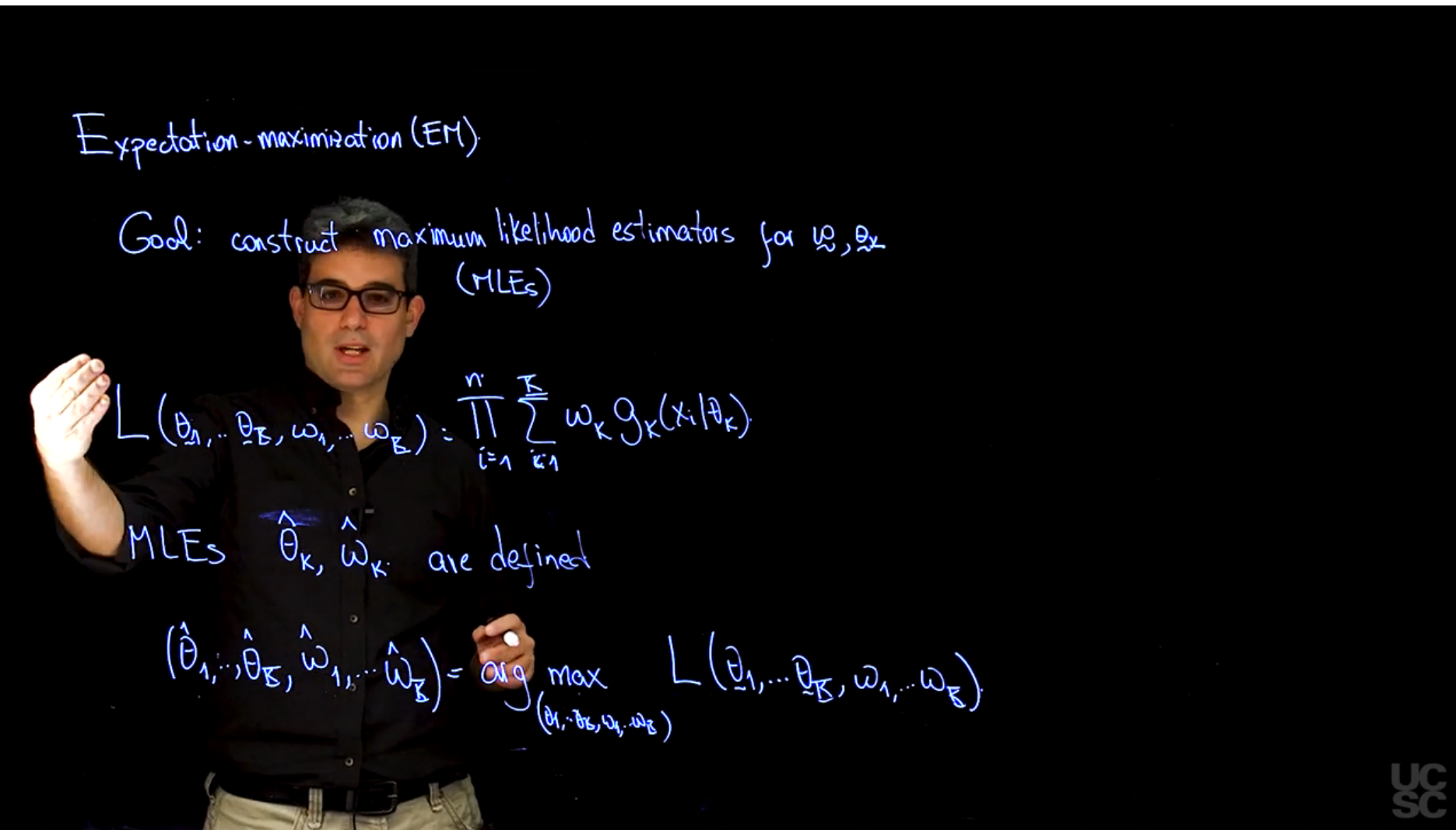
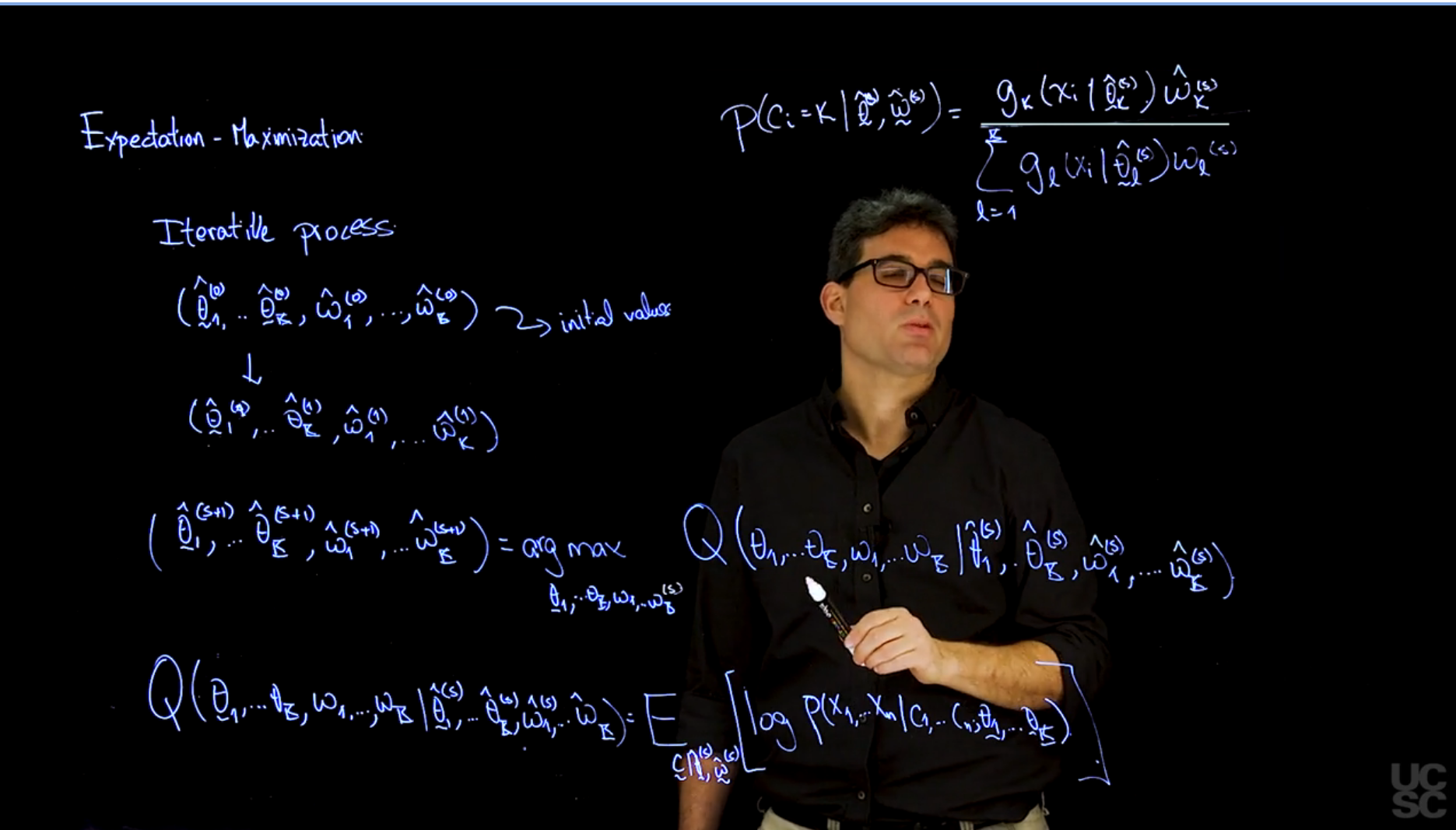
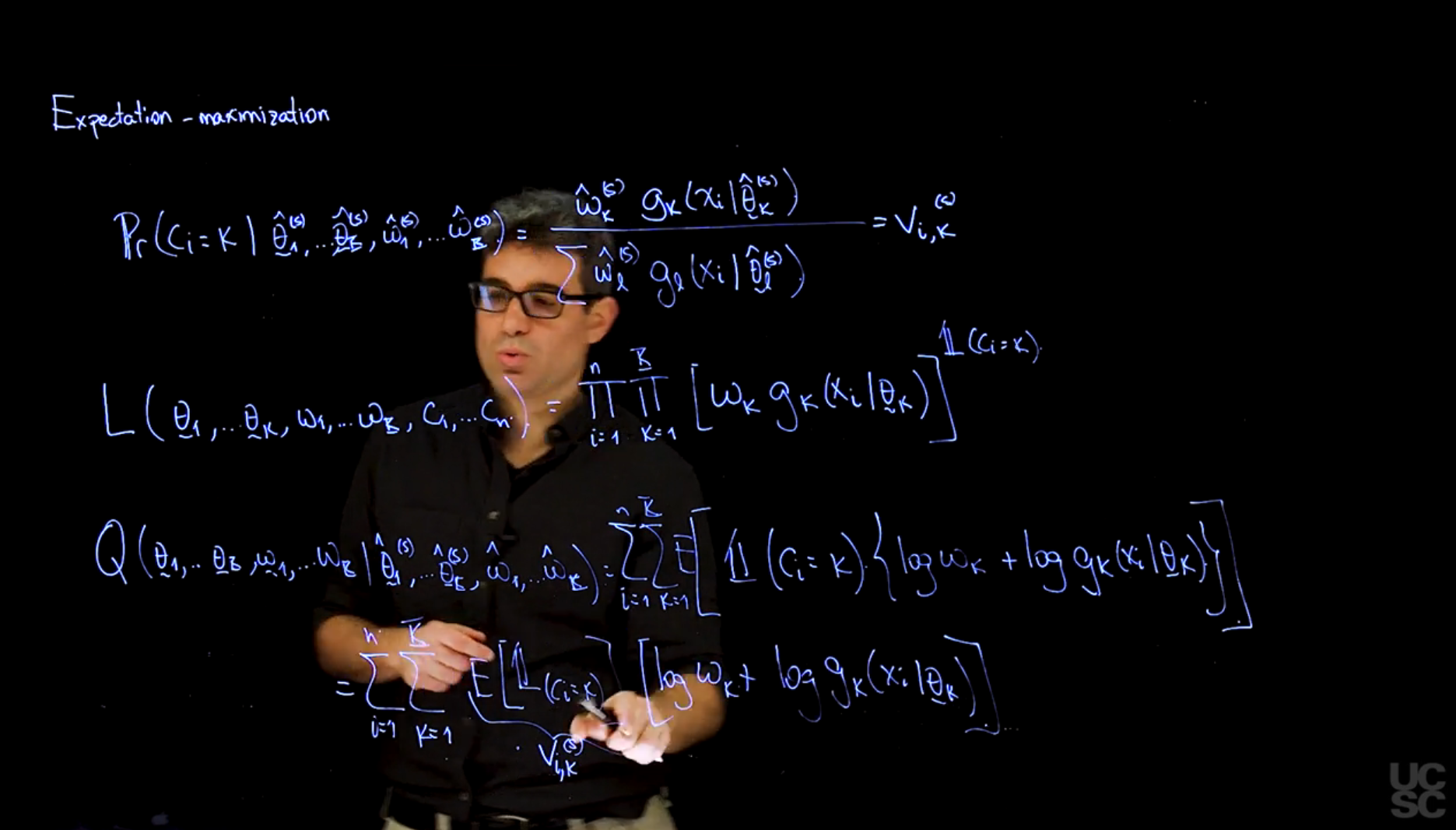
The EM algorithm comes up a lot in NLP and other fields so it is worthwhile to understand it the way we will do so in the course.
It also important that the EM algorithm we use for mixture models is from the 1970s and is not the same as the general EM algorithm. c.f. (Dempster et al. 1977)
The goal of the EM algorithm is to find the parameters \omega and \theta for which the observed-data likelihood is maximized. We start with the complete-data log-likelihood Q function and then use it to construct maximum likelihood estimators for the parameters we are interested in, these are primarily the weights \omega and the parameters \theta of the distributional components.
we can express the complete-data log-likelihood as:
L(\mathbb{\theta},\mathbb{\omega}) = \prod_{i=1}^{N} \sum_{k=1}^{K} \omega_k g_k(x_i \mid \theta_k) \tag{67.4}
MLE’s \hat{\theta} and \hat{\omega} are defined
(\mathbb{\theta},\mathbb{\omega}) \stackrel{.}{=} \arg \max_{\mathbb{\theta},\mathbb{\omega}} L(\mathbb{\theta},\mathbb{\omega})
The EM algorithm is iterative and consists of two steps: the E-step and the M-step. The E-step computes the expected value of the complete-data log-likelihood given the observed data and the current parameter estimates, while the M-step maximizes this expected log-likelihood with respect to the parameters. However before we start these steps we need to set initial values for the parameters.
Algorithm 67.1
Set
Q(\omega,\theta \mid \omega^{(t)}, \theta^{(t)},x) = E_{c \mid \omega^{(t)},\theta^{(t)}, x} \left[ \log \mathbb{P}r(x,c \mid \omega,\theta) \right] \tag{67.5}
Where c is the latent variable indicating the component from which each observation was generated, \omega are the weights, and \theta are the parameters of the Gaussian components (means and standard deviations).
Set
\hat{\omega}^{(t+1)},\hat{\theta}^{(t+1)} = \arg \max_{\omega,\theta} Q(\omega,\theta \mid \hat{\omega}^{(t)}, \hat{\theta}^{(t)},y) \tag{67.6}
where \hat{\omega}^{(t)} and \hat{\theta}^{(t)} are the current estimates of the parameters, and y is the observed data.
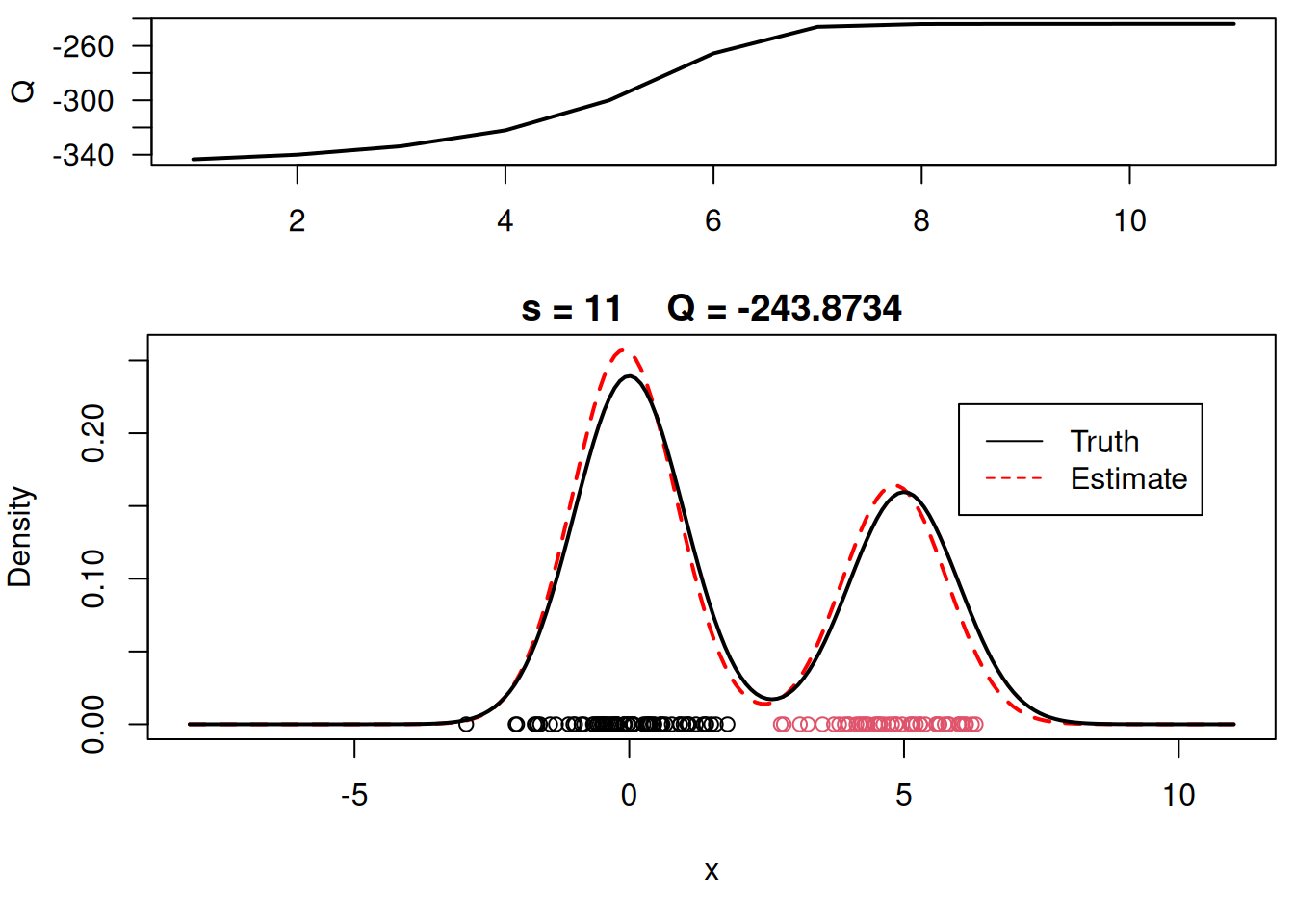
These two steps are repeated until convergence, which is typically defined as the change in the full-data log-likelihood Q function being below a certain threshold.
A key point is that if we condition each component independently on the \omega, \theta, x we can write:
\mathbb{P}r(c_i=k \mid \omega, \theta, x_i) = \frac{\omega_k g_k(x_i \mid \theta_k)}{\sum_{j=1}^{K} \omega_j g_j(x_i \mid \theta_j)}= v_{ik}(\omega, \theta)
where the value of v_{ik} is interpreted as the probability that the i-th observation comes from the k-th component of the mixture assuming the population parameters \omega and \theta.
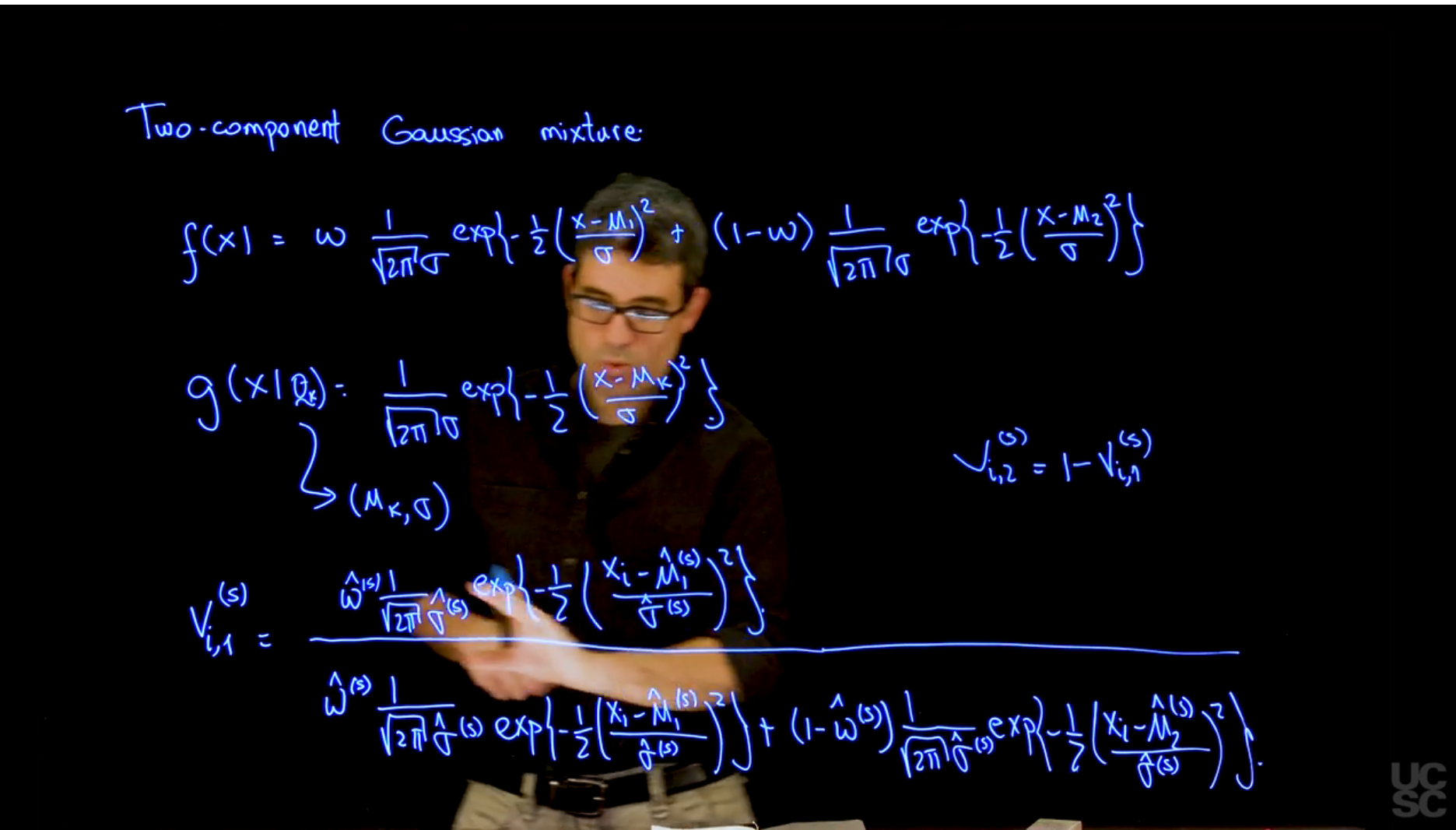
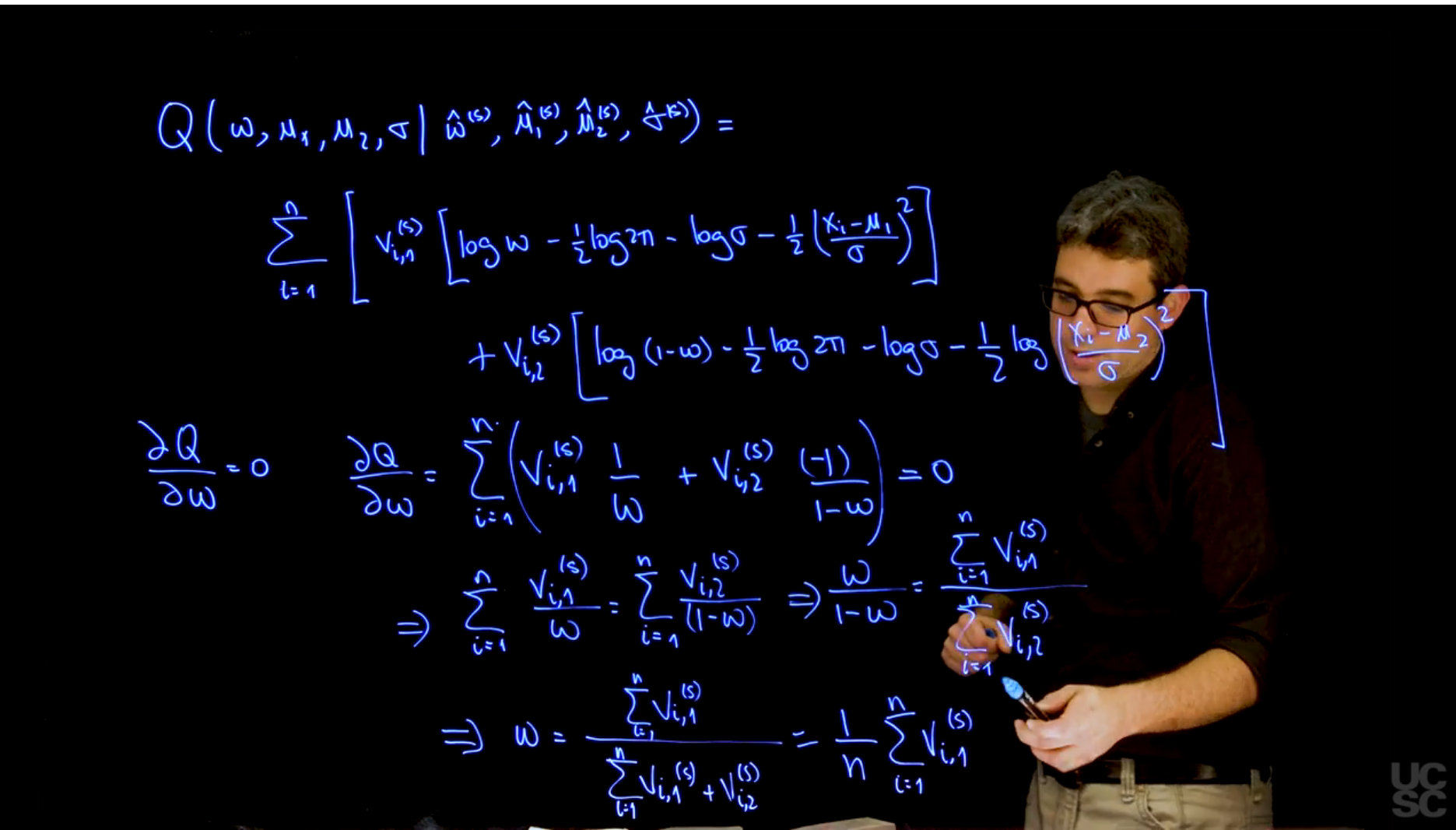
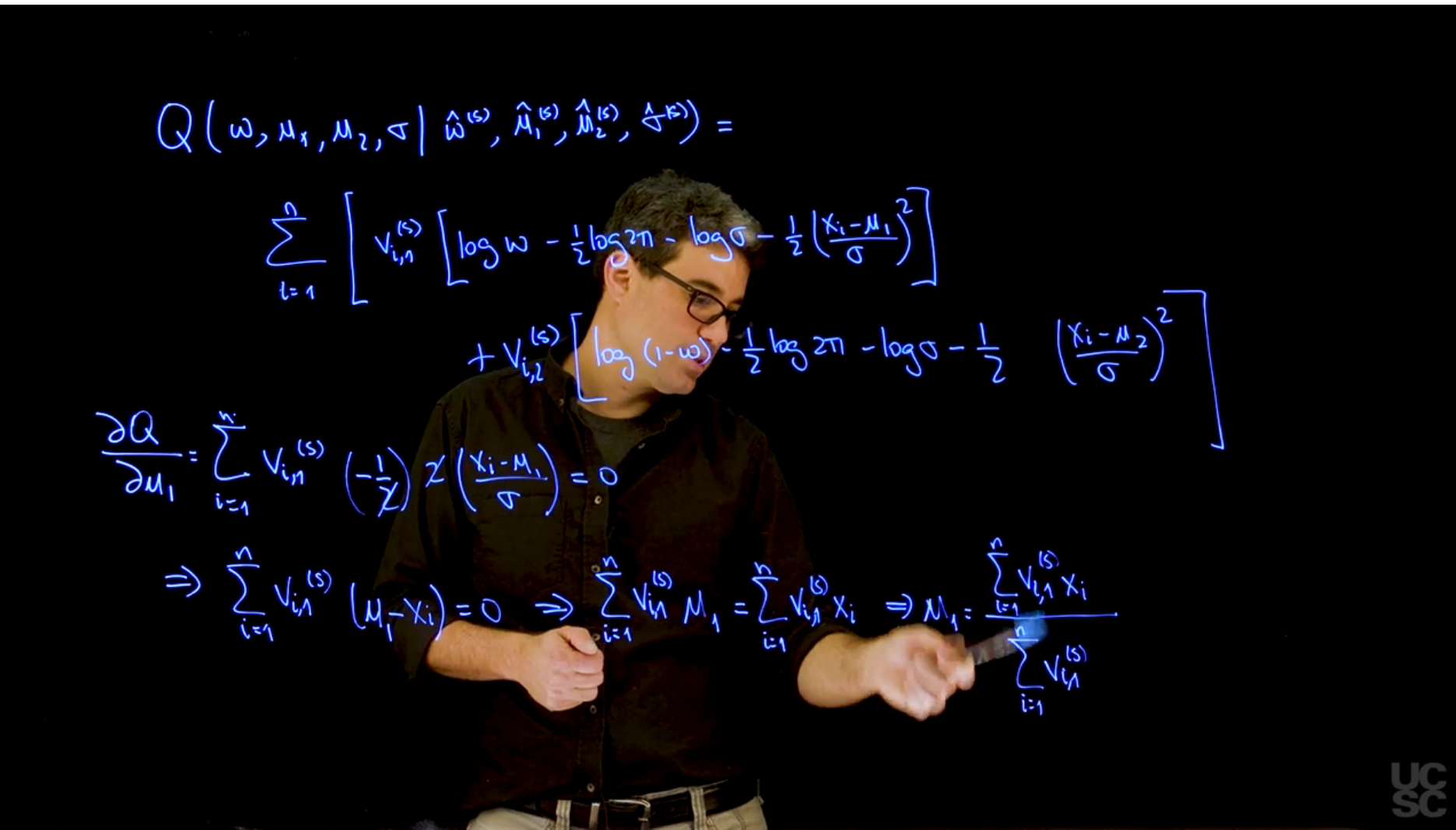
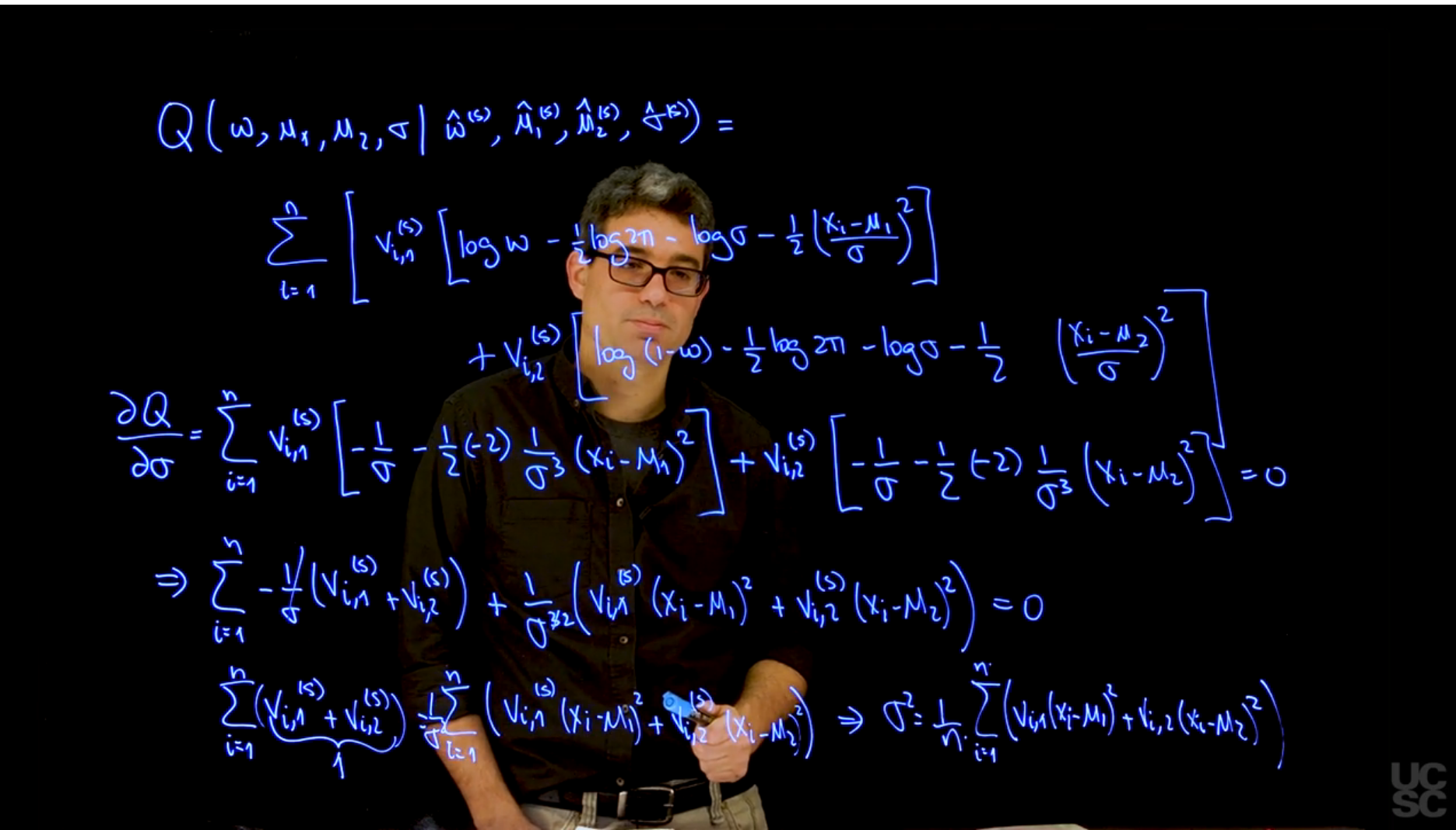
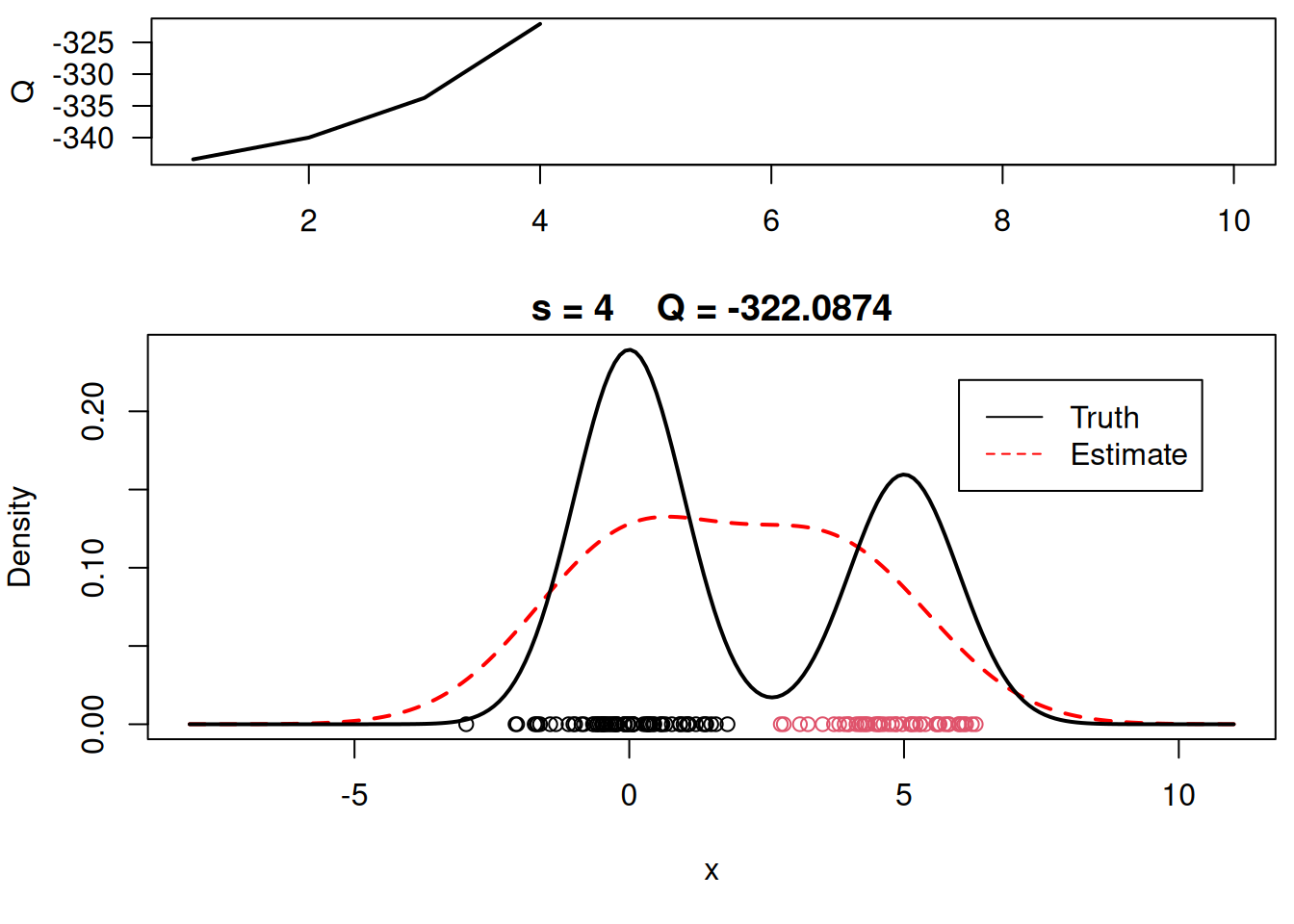
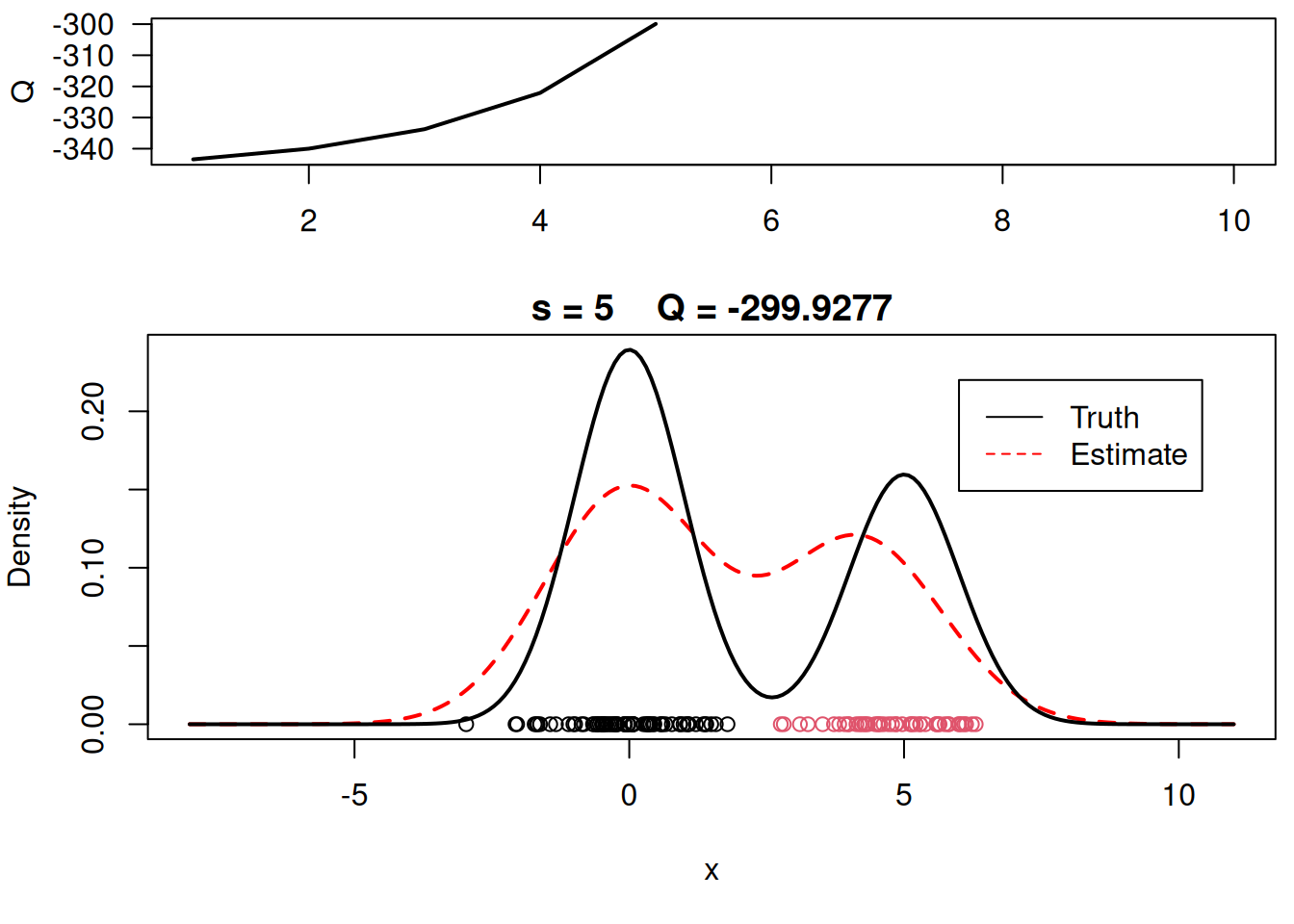
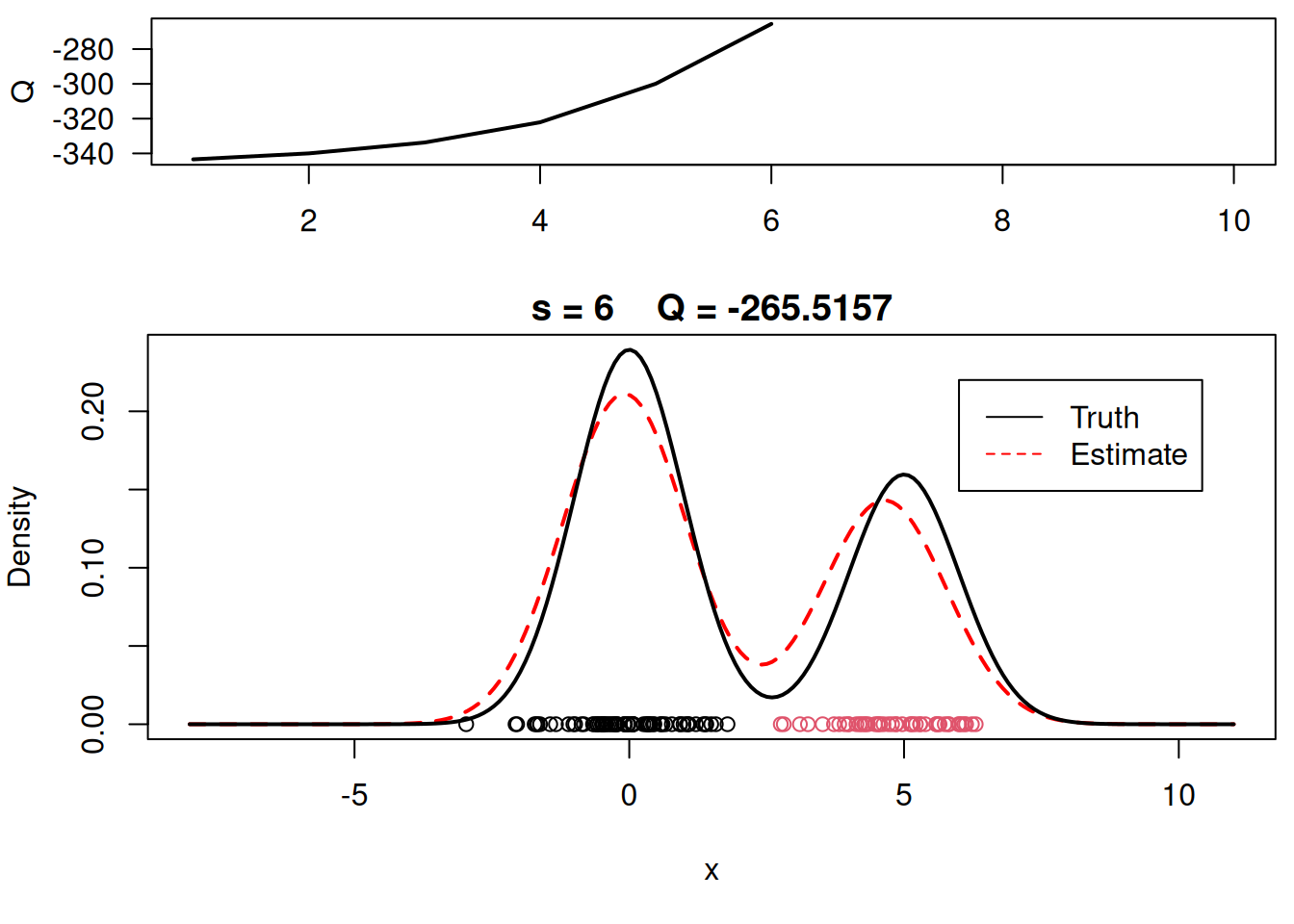
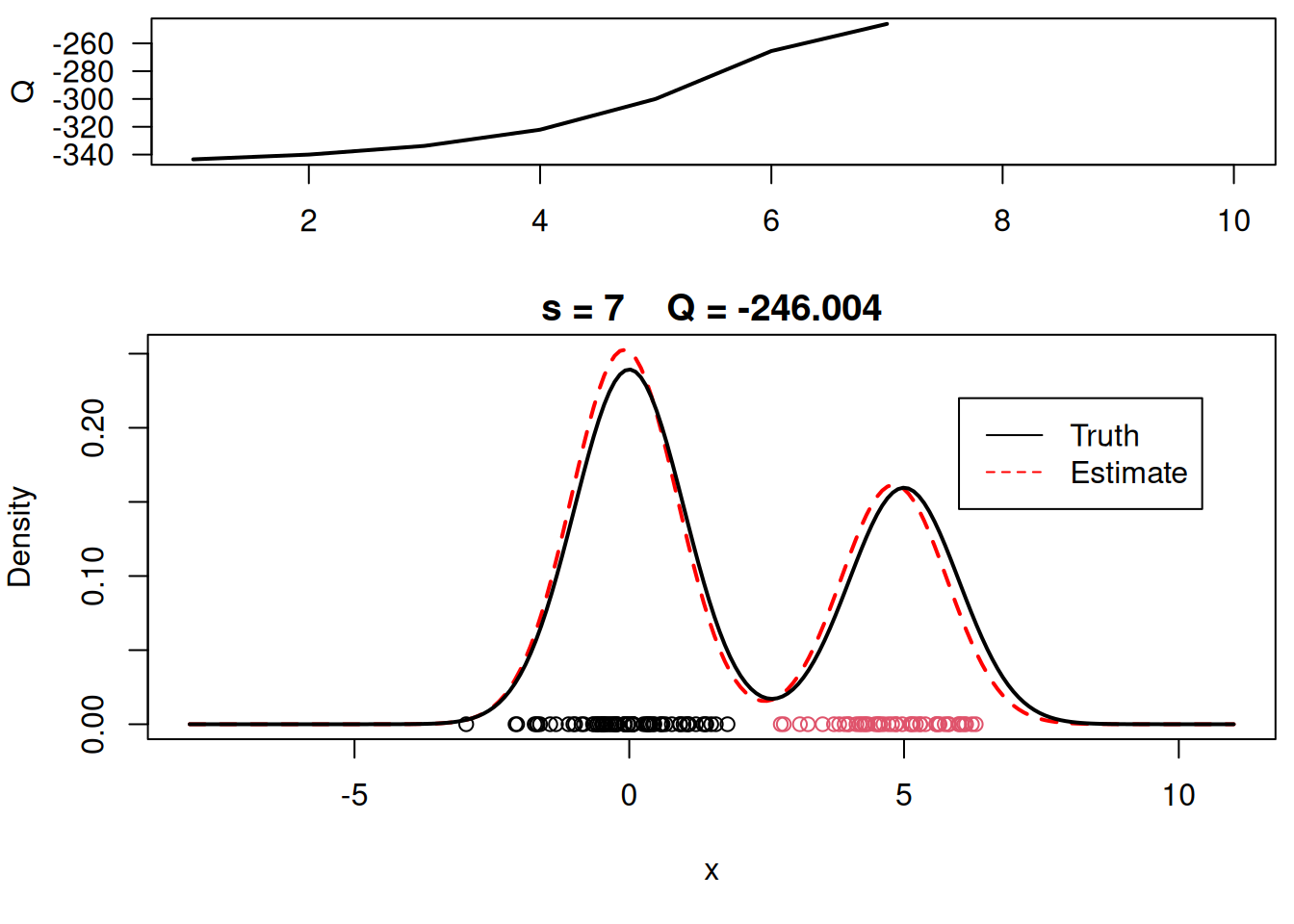
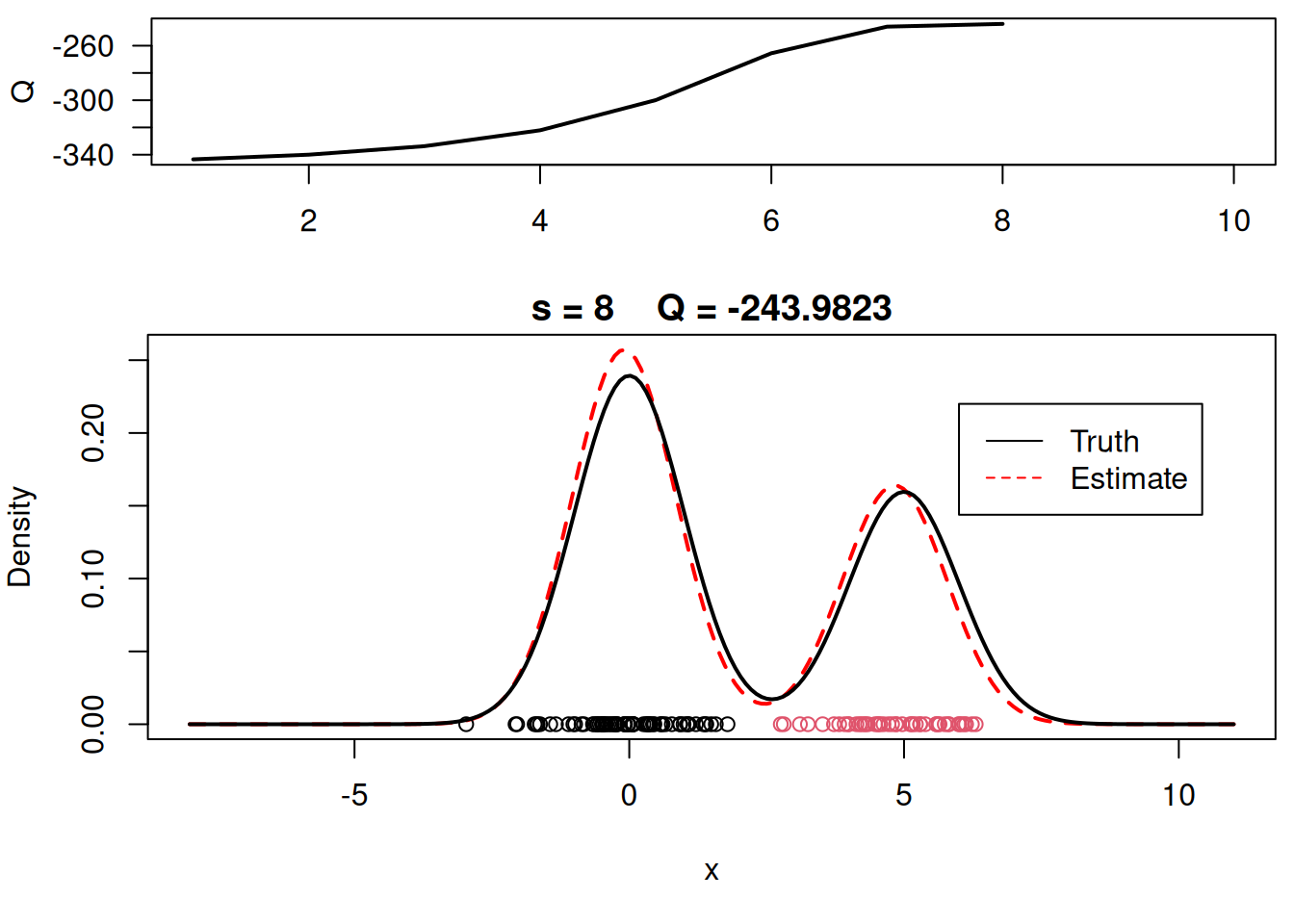
This video covers the code sample given in the listings below. It is a simple implementation of the alg. 67.1 for fitting a 2-component Gaussian location mixture model to simulated data.
We start in Listing 67.1 with some house cleaning by clearing the environment and setting the seed for reproducibility.
rm(list=ls())
set.seed(81196)Since the algorithm will be tested on simulated data, we proceed in Listing 67.2 to generate the synthetic dataset from a mixture of 2 Gaussians.
## Ground Truth parameters initialization
KK = 2
w.true = 0.6
mu.true = rep(0, KK)
mu.true[1] = 0
mu.true[2] = 5
sigma.true = 1
n = 120
cc = sample(1:KK, n, replace=T, prob=c(w.true,1-w.true))
x = rep(0, n)
for(i in 1:n){
# sample from a distribution with mean selected by component indicator
# the SD is the same for all components as this is a location mixture
x[i] = rnorm(1, mu.true[cc[i]], sigma.true)
}Let us plot the data and the true components before running the EM algorithm.
# Plot the true density
par(mfrow=c(1,1))
xx.true = seq(-8,11,length=200)
yy.true = w.true*dnorm(xx.true, mu.true[1], sigma.true) +
          (1-w.true)*dnorm(xx.true, mu.true[2], sigma.true)
plot(xx.true, yy.true, type="l", xlab="x", ylab="True density", lwd=2)
points(x, rep(0,n), col=cc)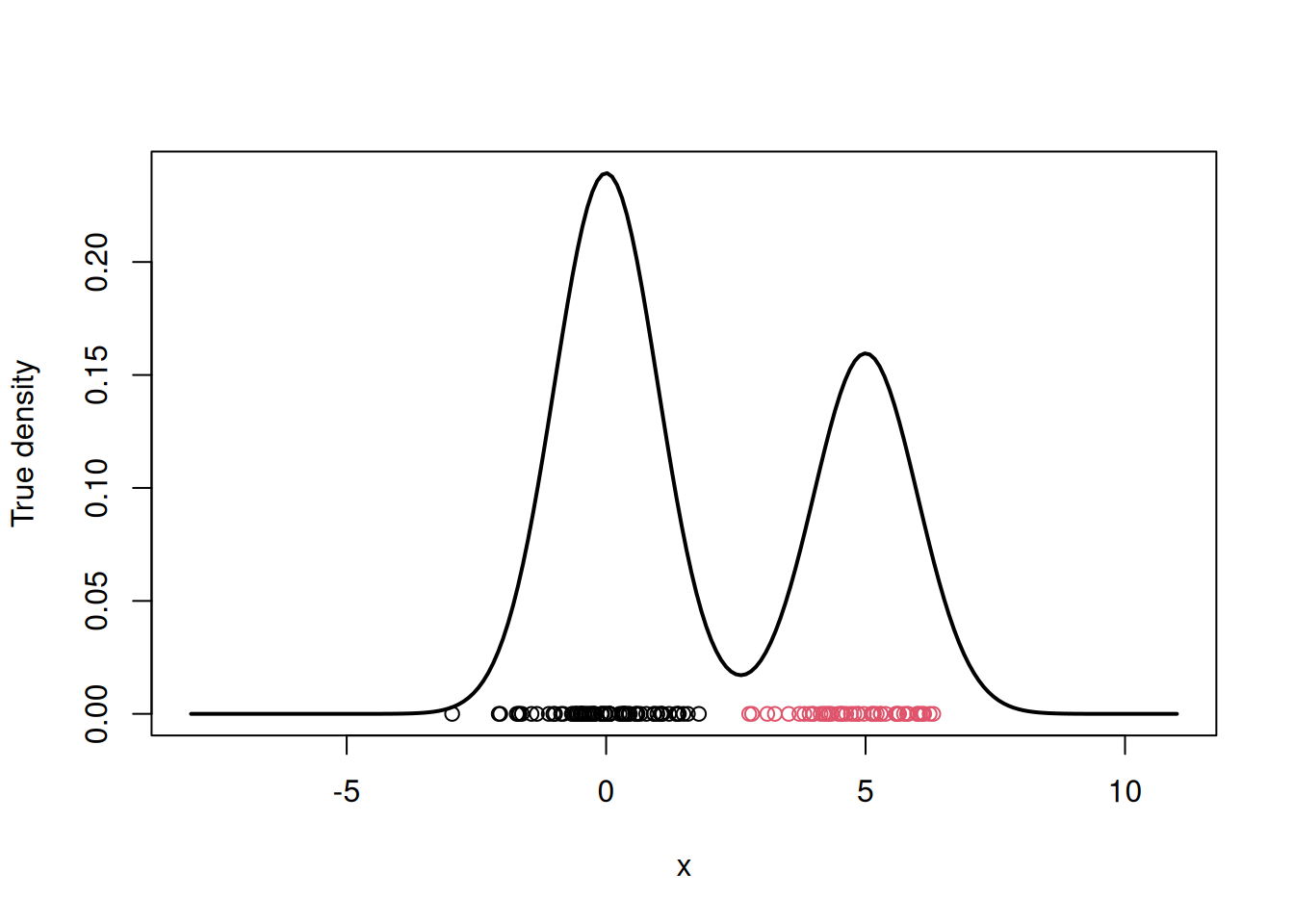
plot_components <- function(  mu, sigma, w, xx, yy.true, x, cc, s, QQ.out){
  # Plot current estimate over data
  layout(matrix(c(1,2),2,1), widths=c(1,1), heights=c(1.3,3))
  par(mar=c(3.1,4.1,0.5,0.5))
  plot(QQ.out[1:s],type="l", xlim=c(1,max(10,s)), las=1, ylab="Q", lwd=2)

  par(mar=c(5,4,1.5,0.5))
  xx = seq(-8,11,length=200)
  yy = w*dnorm(xx, mu[1], sigma) + (1-w)*dnorm(xx, mu[2], sigma)
  plot(xx, yy, type="l", ylim=c(0, max(c(yy,yy.true))), main=paste("s =",s,"   Q =", round(QQ.out[s],4)), lwd=2, col="red", lty=2, xlab="x", ylab="Density")
  lines(xx.true, yy.true, lwd=2)
  points(x, rep(0,n), col=cc)
  legend(6,0.22,c("Truth","Estimate"),col=c("black","red"), lty=c(1,2))
}
Now it is time to run the actual EM algorithm - in Listing 67.5 we initialize the parameters of the algorithm.
## Initialize the parameters
w     = 1/2                         # Assign equal weight to each component to start with
mu    = rnorm(KK, mean(x), sd(x))   # Random cluster centers randomly spread over the support of the data
sigma = sd(x)                       # Initial standard deviation

s  = 0
sw = FALSE
QQ = -Inf
QQ.out = NULL
epsilon = 10^(-5)
Mow we can Plot the initial guess for the density
xx = seq(-8,11,length=200)
yy = w*dnorm(xx, mu[1], sigma) + (1-w)*dnorm(xx, mu[2], sigma)
plot(xx, yy, type="l", ylim=c(0, max(yy)), xlab="x", ylab="Initial density")
points(x, rep(0,n), col=cc)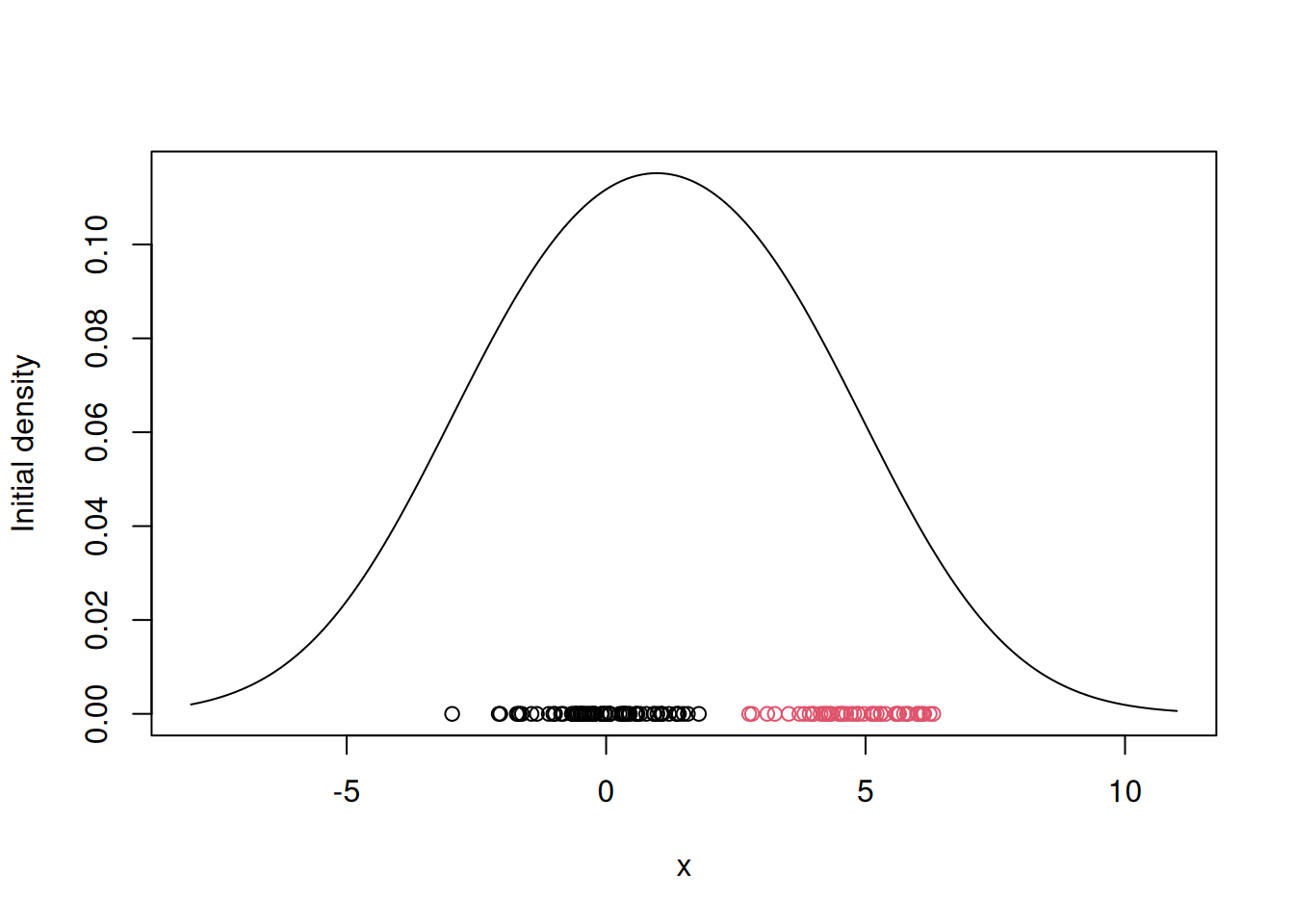
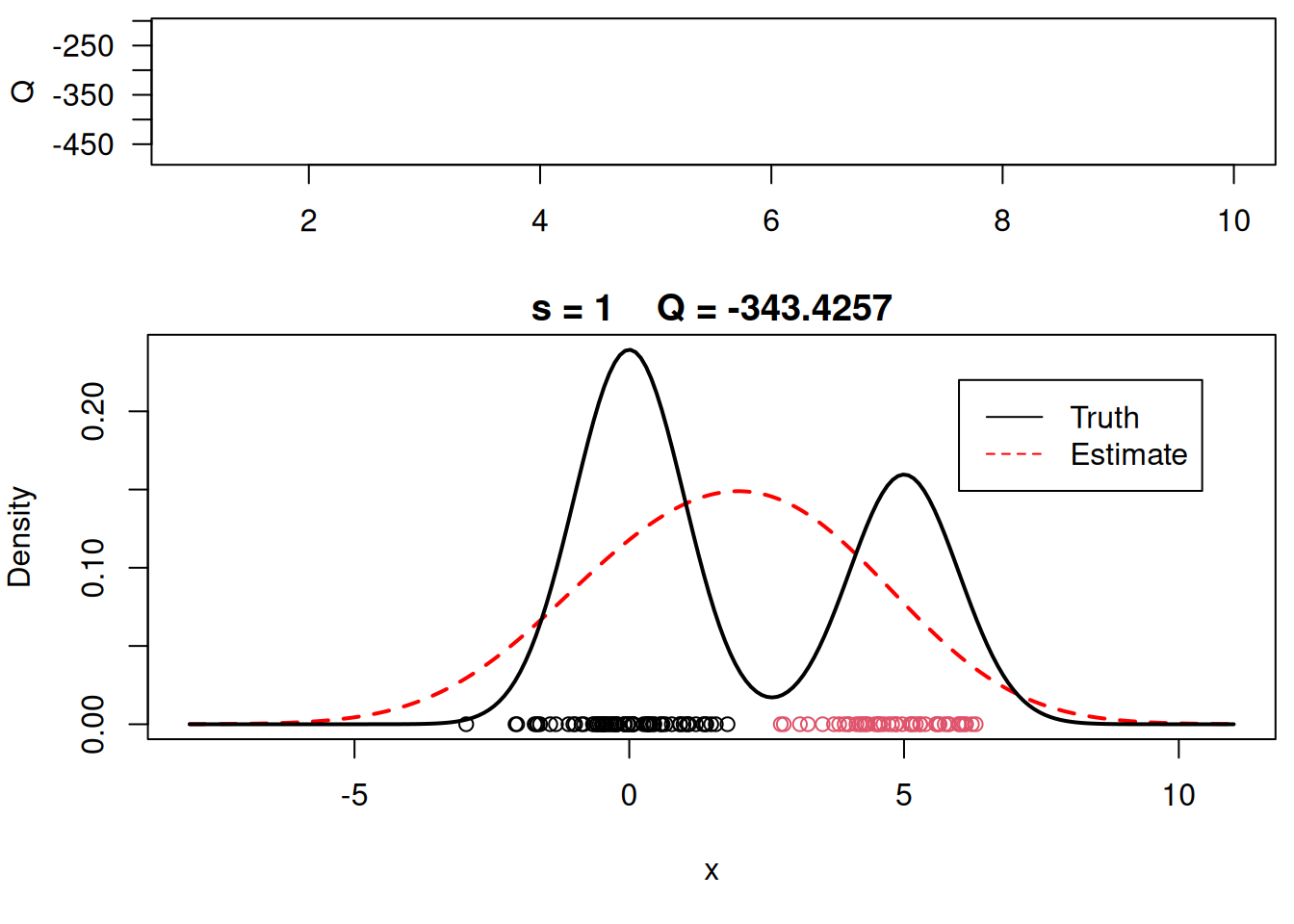
in Listing 67.7 we run the E and M steps until convergence.
## Checking convergence of the algorithm
while(!sw){
  ## E step
  v = array(0, dim=c(n,KK))
  v[,1] = log(w) + dnorm(x, mu[1], sigma, log=TRUE)    # Compute the log of the weights
  v[,2] = log(1-w) + dnorm(x, mu[2], sigma, log=TRUE)  # Compute the log of the weights
  for(i in 1:n){
    v[i,] = exp(v[i,] - max(v[i,]))/sum(exp(v[i,] - max(v[i,])))  #Go from logs to actual weights in a numerically stable manner
  }

  ## M step
  # Weights
  w = mean(v[,1])
  mu = rep(0, KK)
  for(k in 1:KK){
    for(i in 1:n){
      mu[k]    = mu[k] + v[i,k]*x[i]
    }
    mu[k] = mu[k]/sum(v[,k])
  }
  # Standard deviations
  sigma = 0
  for(i in 1:n){
    for(k in 1:KK){
      sigma = sigma + v[i,k]*(x[i] - mu[k])^2
    }
  }
  sigma = sqrt(sigma/sum(v))

  ##Check convergence
  QQn = 0 # This is the value of the Q function at the new parameter estimates
  for(i in 1:n){
    QQn = QQn + v[i,1]*(log(w)   + dnorm(x[i], mu[1], sigma, log=TRUE)) +
                v[i,2]*(log(1-w) + dnorm(x[i], mu[2], sigma, log=TRUE))
  }
  if(abs(QQn-QQ)/abs(QQn)<epsilon){
    sw=TRUE
  }
  QQ = QQn
  QQ.out = c(QQ.out, QQ)
  s = s + 1
  # print(paste(s, QQn))
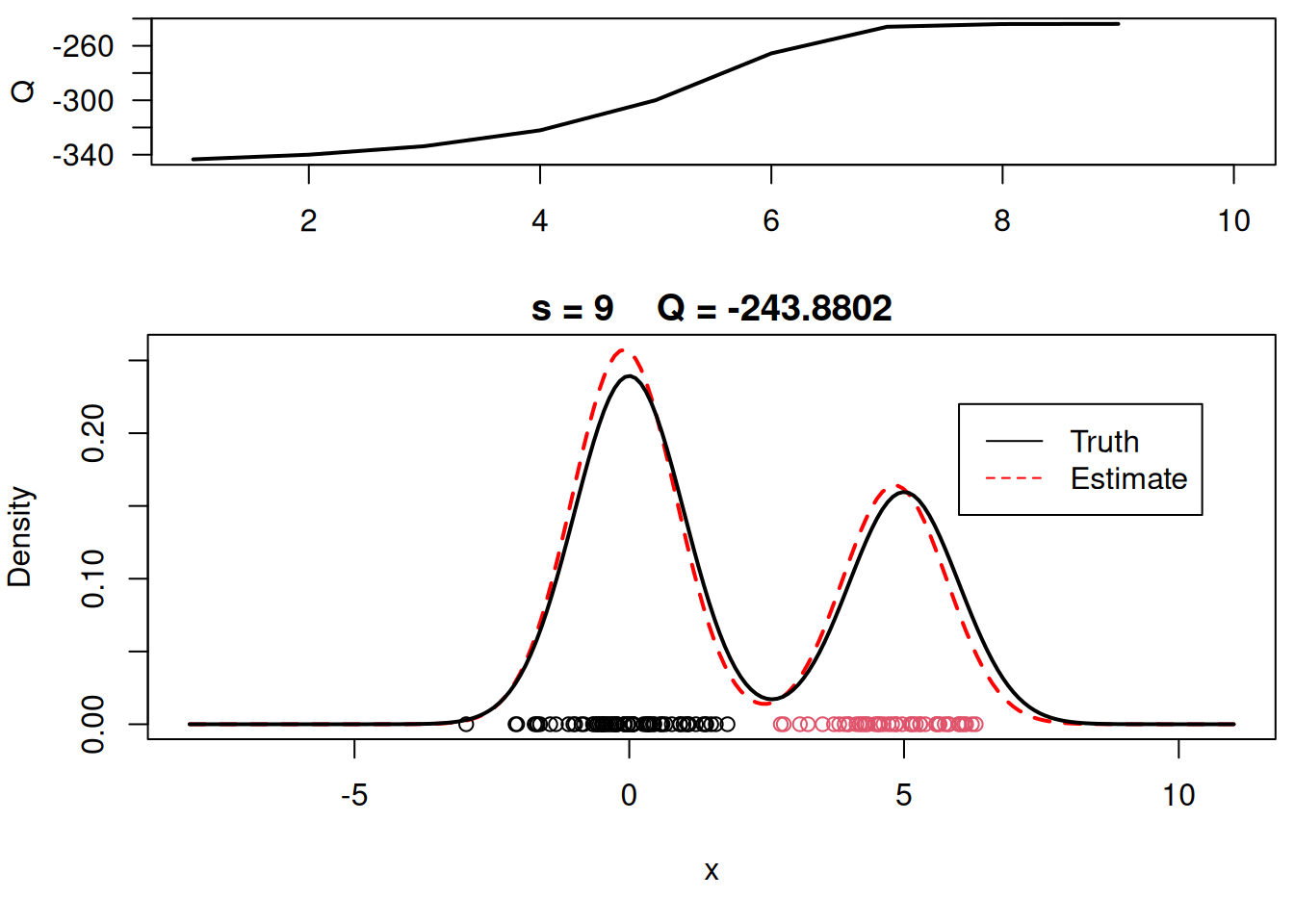
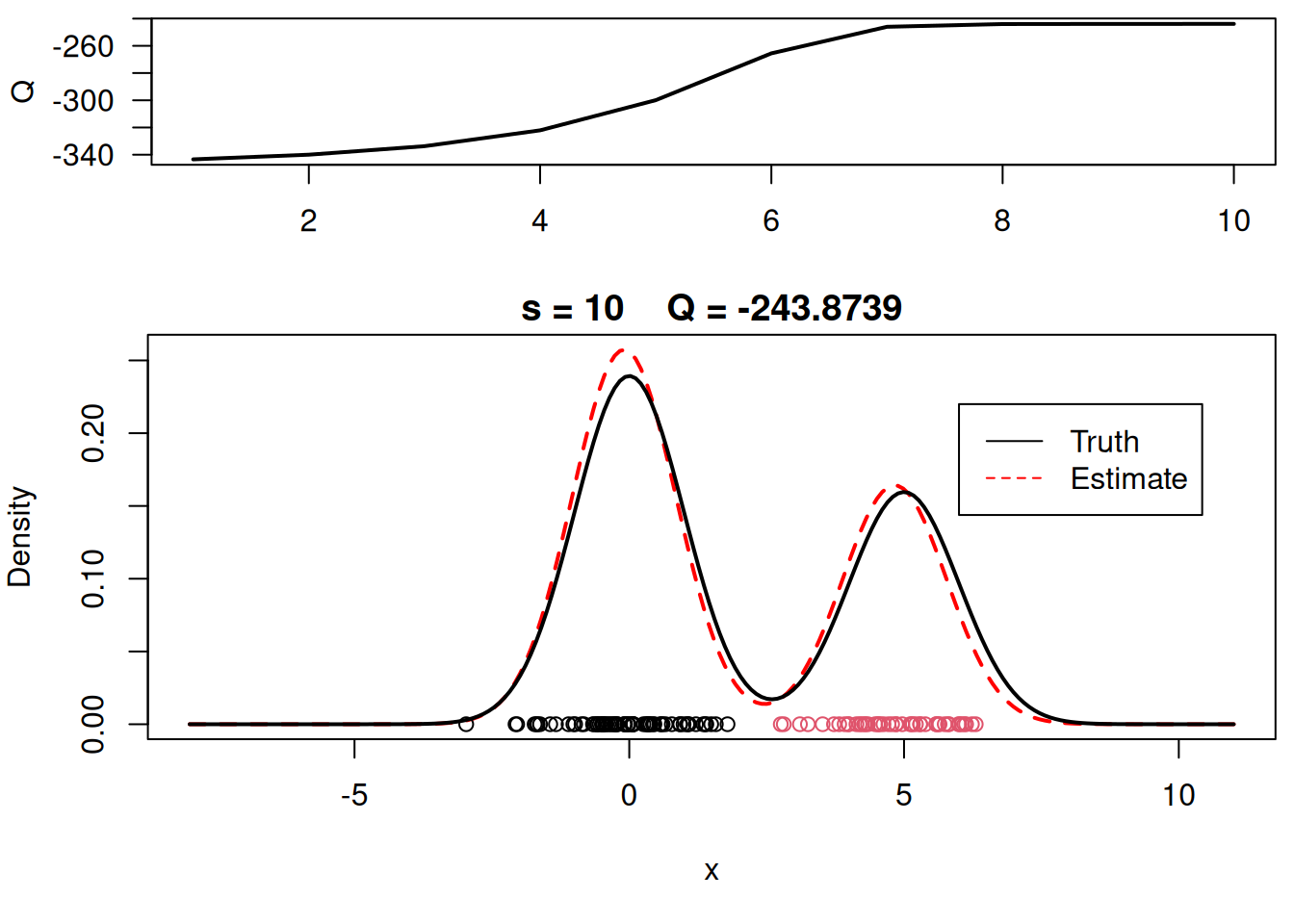
  plot_components(mu, sigma, w, xx, yy.true, x, cc, s, QQ.out)

}
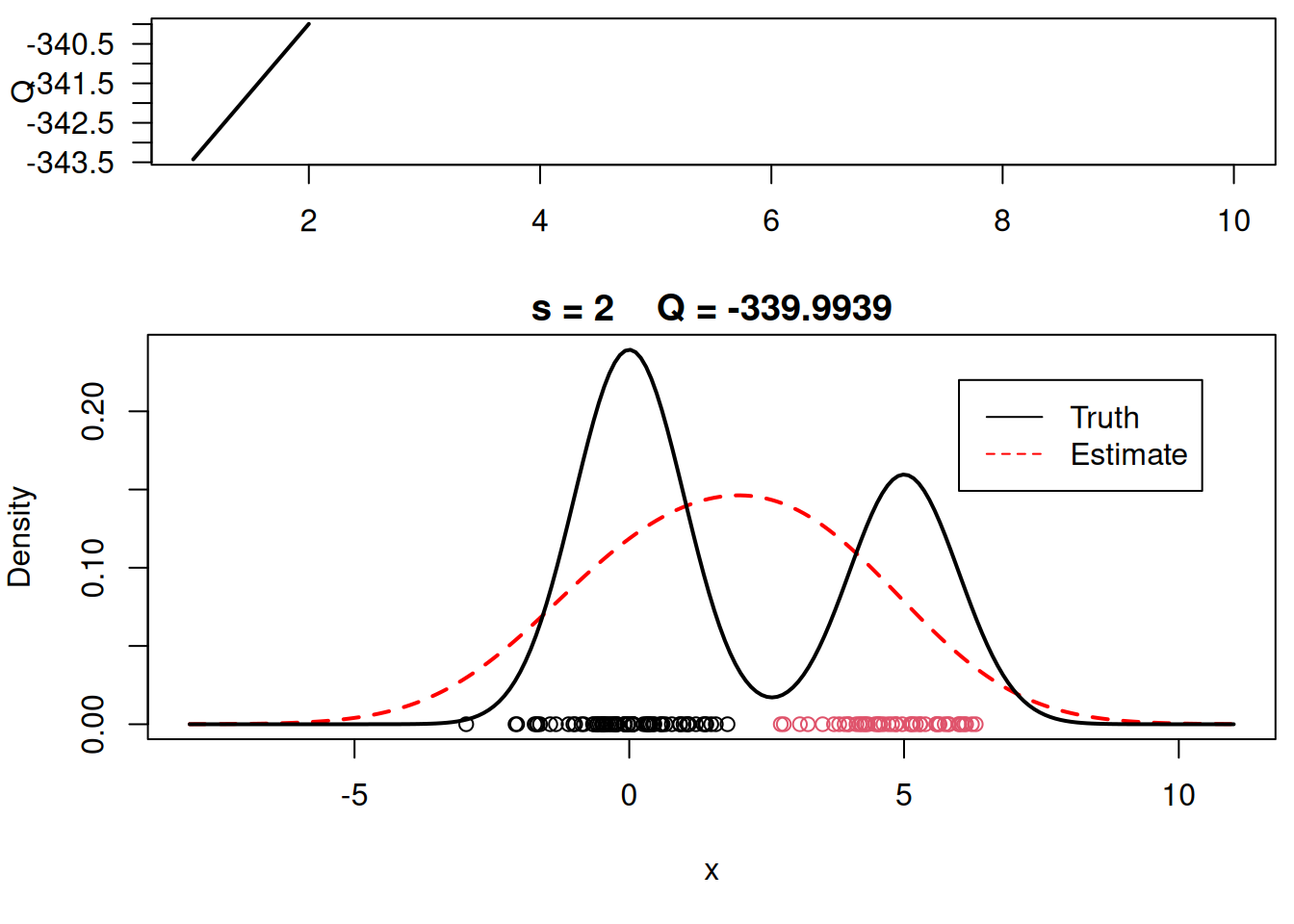
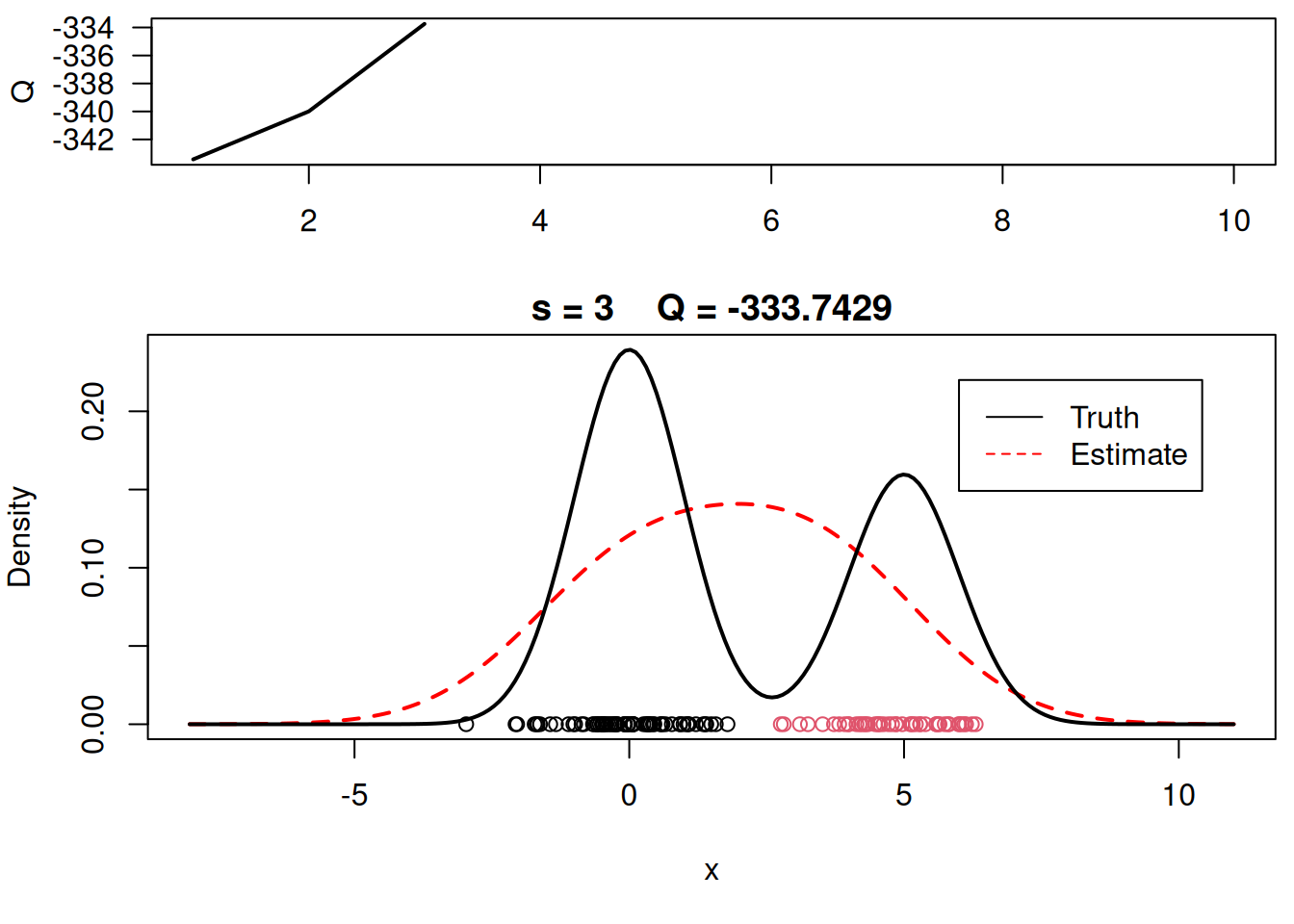
# Plot final estimate over data
layout(matrix(c(1,2),2,1), widths=c(1,1), heights=c(1.3,3))
par(mar=c(3.1,4.1,0.5,0.5))
plot(QQ.out[1:s],type="l", xlim=c(1,max(10,s)), las=1, ylab="Q", lwd=2)

par(mar=c(5,4,1.5,0.5))
xx = seq(-8,11,length=200)
yy = w*dnorm(xx, mu[1], sigma) + (1-w)*dnorm(xx, mu[2], sigma)
plot(xx, yy, type="l", ylim=c(0, max(c(yy,yy.true))), main=paste("s =",s,"   Q =", round(QQ.out[s],4)), lwd=2, col="red", lty=2, xlab="x", ylab="Density")
lines(xx.true, yy.true, lwd=2)
points(x, rep(0,n), col=cc)
legend(6,0.22,c("Truth","Estimate"),col=c("black","red"), lty=c(1,2), bty="n")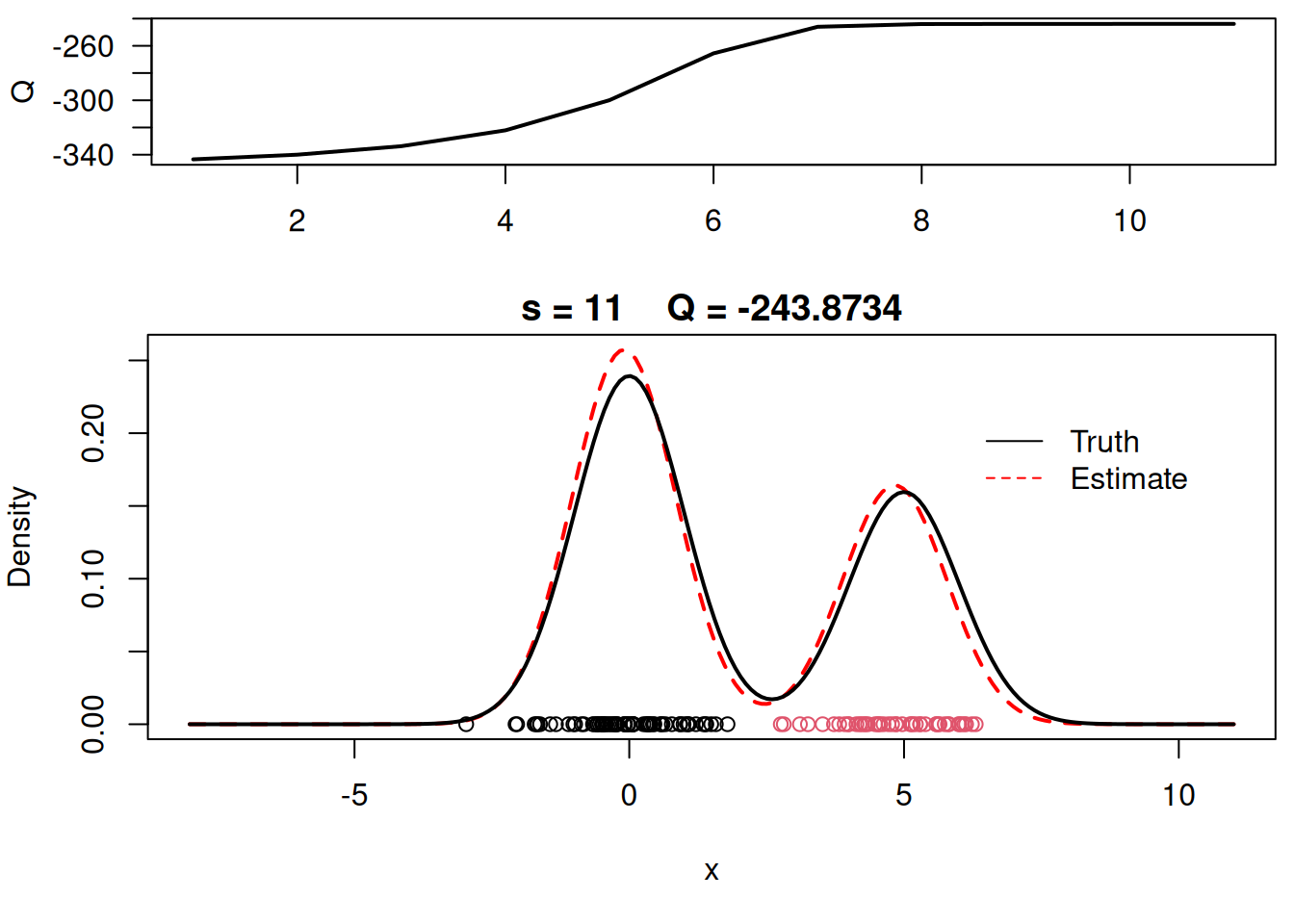
This video covers the code sample given in Section 67.8 below. It is a more advanced implementation of the EM algorithm for fitting a mixture of multivariate Gaussian components to simulated data.
This variant differs from the code sample above in that it uses the mvtnorm package to generate multivariate normal distributions. It also uses the ellipse package to plot the ellipses around the means of the components.
This is an example of an EM algorithm for fitting a mixtures of K p-variate Gaussian components. The algorithm is tested using simulated data
rm(list=ls())
library(mvtnorm)
library(ellipse)
set.seed(63252)This code block generates the synthetic data for MVN data using three clusters
## Generate data from a mixture with 3 components
KK = 3
p = 2
w.true = c(0.5,0.3,0.2)
mu.true = array(0, dim=c(KK,p))
mu.true[1,] = c(0,0)
mu.true[2,] = c(5,5)
mu.true[3,] = c(-3,7)
Sigma.true = array(0, dim=c(KK,p,p))
Sigma.true[1,,] = matrix(c(1,0,0,1),p,p)
Sigma.true[2,,] = matrix(c(2,0.9,0.9,1),p,p)
Sigma.true[3,,] = matrix(c(1,-0.9,-0.9,4),p,p)
n = 120
cc = sample(1:3, n, replace=T, prob=w.true)
x = array(0, dim=c(n,p))
for(i in 1:n){
x[i,] = rmvnorm(1, mu.true[cc[i],], Sigma.true[cc[i],,])
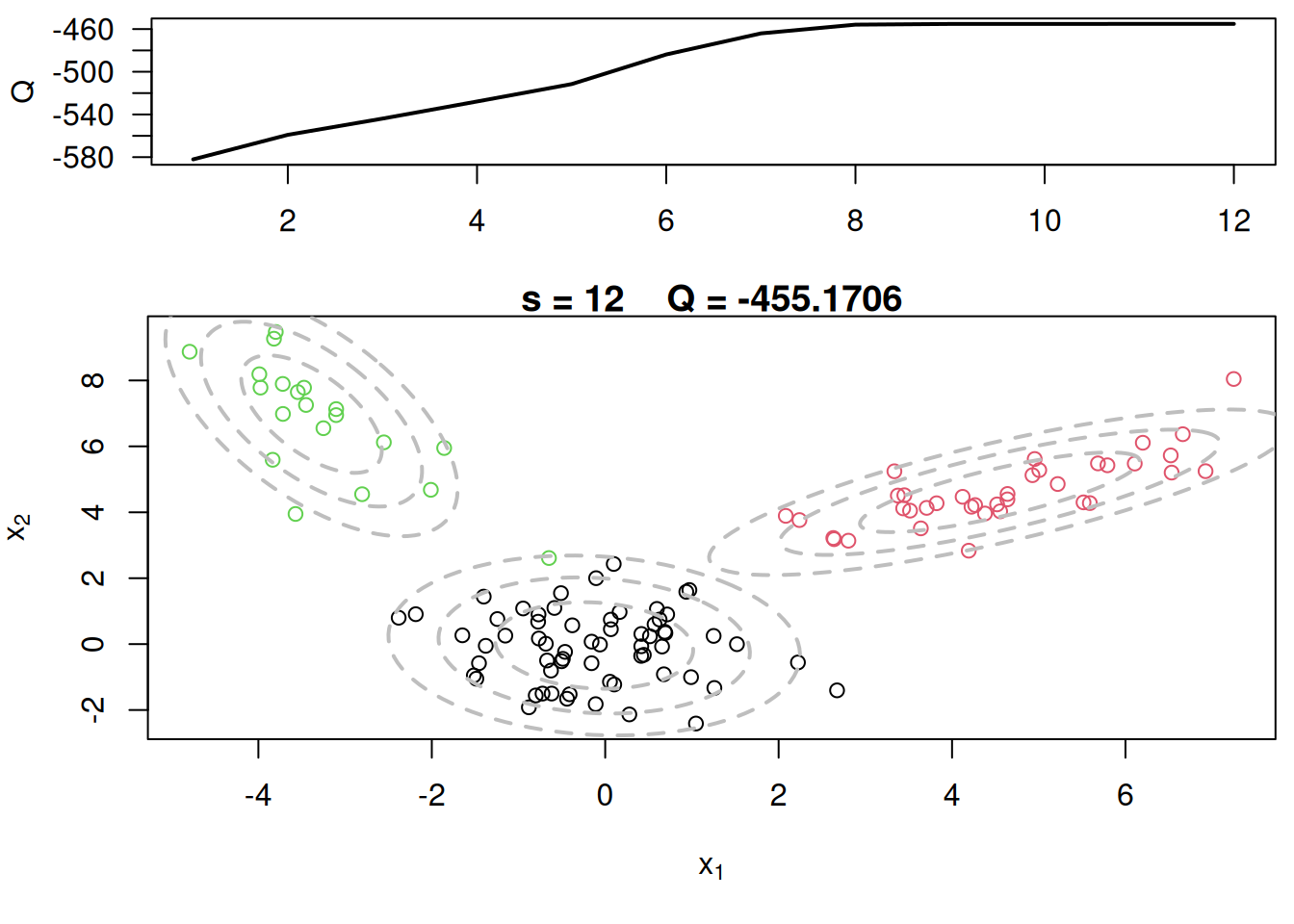
}Let us visualize the data and the true components before running the EM algorithm. The ellipses represent the contours of the true Gaussian components at different confidence levels (50%, 82%, and 95%).
par(mfrow=c(1,1))
plot(x[,1], x[,2], col=cc, type="n", xlab=expression(x[1]), ylab=expression(x[2]))
text(x[,1], x[,2], seq(1,n), col=cc, cex=0.6)
for(k in 1:KK){
  lines(ellipse(x=Sigma.true[k,,], centre=mu.true[k,], level=0.50), col="grey", lty=2, lwd=2)
  lines(ellipse(x=Sigma.true[k,,], centre=mu.true[k,], level=0.82), col="grey", lty=2, lwd=2)
  lines(ellipse(x=Sigma.true[k,,], centre=mu.true[k,], level=0.95), col="grey", lty=2, lwd=2)
}
title(main="Data + True Components")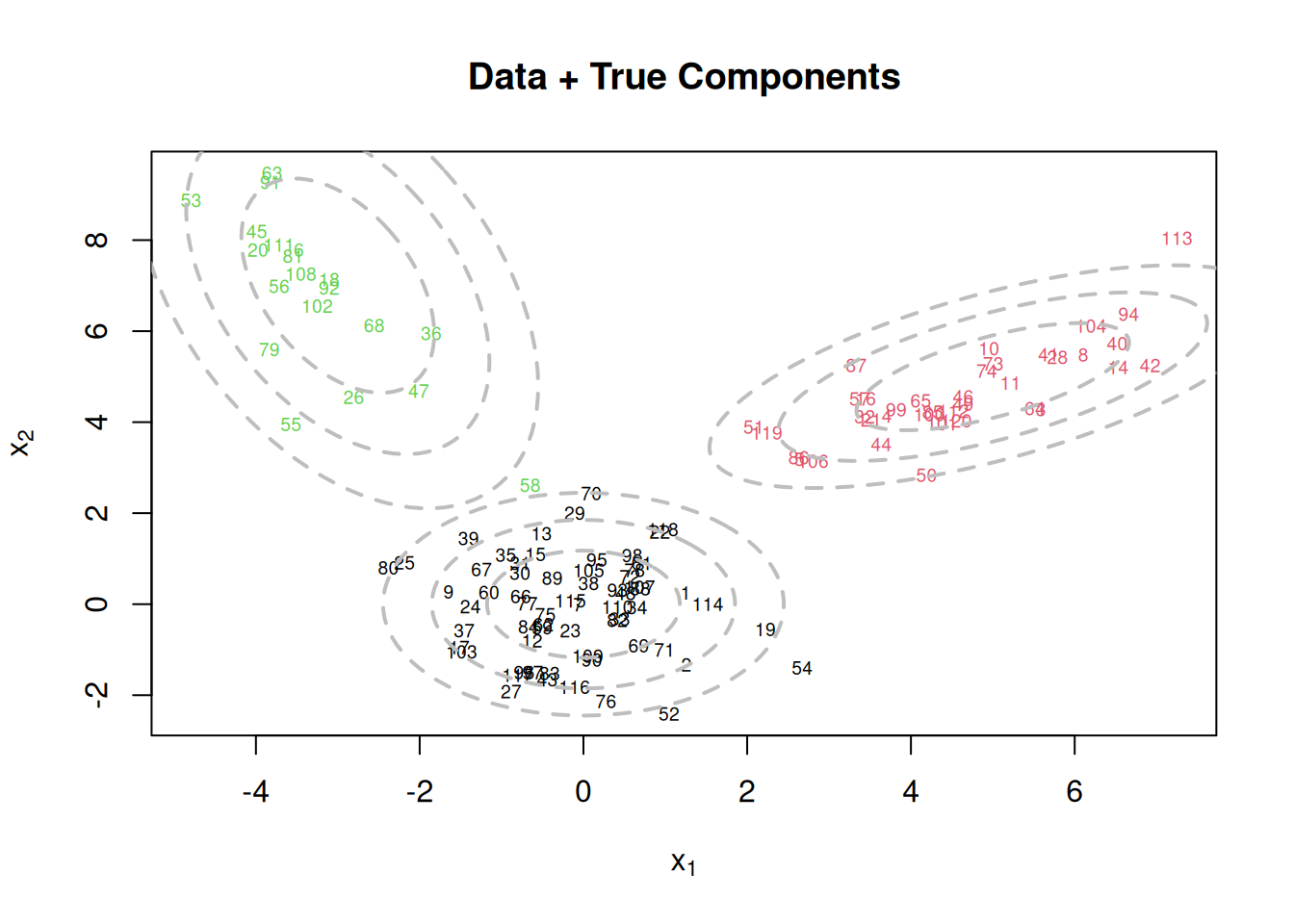
The EM algorithm now fits a mixture of multivariate Gaussian components to the data.
The E-step computes the responsibilities (or weights) for each data point and component, while the M-step updates the parameters (weights, means, and covariances) of the Gaussian components based on these responsibilities. The algorithm iterates until convergence, which is determined by the change in the Q function being below a specified threshold.
plot_components <- function(
QQ.out, s,
x, cc,
KK, Sigma, mu,
levels = c(0.50, 0.82, 0.95),
ellipse_col = "grey", ellipse_lty = 2, ellipse_lwd = 2,
q_ylim = NULL,
png_dir = NULL, png_prefix = "frame_", png_width = 900, png_height = 700, png_res = 120,
...
) {
if (!is.null(png_dir)) {
dir.create(png_dir, recursive = TRUE, showWarnings = FALSE)
png_file <- file.path(png_dir, sprintf("%s%03d.png", png_prefix, s))
grDevices::png(filename = png_file, width = png_width, height = png_height, res = png_res)
on.exit(grDevices::dev.off(), add = TRUE)
}
# Plot current components over data
layout(matrix(c(1,2),2,1), widths=c(1,1), heights=c(1.3,3))
par(mar=c(3.1,4.1,0.5,0.5))
plot(QQ.out[1:s],type="l", xlim=c(1,max(10,s)), las=1, ylab="Q")
par(mar=c(5,4,1,0.5))
plot(x[,1], x[,2], col=cc, main=paste("s =",s," Q =", round(QQ.out[s],4)),
xlab=expression(x[1]), ylab=expression(x[2]), lwd=2)
for(k in 1:KK){
lines(ellipse(x=Sigma[k,,], centre=mu[k,], level=0.50), col="grey", lty=2, lwd=2)
lines(ellipse(x=Sigma[k,,], centre=mu[k,], level=0.82), col="grey", lty=2, lwd=2)
lines(ellipse(x=Sigma[k,,], centre=mu[k,], level=0.95), col="grey", lty=2, lwd=2)
}
}We can now begin to with the EM algorithm = first we need to initilize the parameters.
w = rep(1,KK)/KK
mu = rmvnorm(KK, apply(x,2,mean), var(x))
Sigma = array(0, dim=c(KK,p,p))
Sigma[1,,] = var(x)/KK
Sigma[2,,] = var(x)/KK
Sigma[3,,] = var(x)/KK
s = 0
sw = FALSE
QQ = -Inf
QQ.out = NULL
epsilon = 10^(-5)par(mfrow=c(1,1))
plot(x[,1], x[,2], col=cc, xlab=expression(x[1]), ylab=expression(x[2]))
for(k in 1:KK){
lines(ellipse(x=Sigma[k,,], centre=mu[k,], level=0.50), col="grey", lty=2, lwd=2)
lines(ellipse(x=Sigma[k,,], centre=mu[k,], level=0.82), col="grey", lty=2, lwd=2)
lines(ellipse(x=Sigma[k,,], centre=mu[k,], level=0.95), col="grey", lty=2, lwd=2)
}
title(main="Initial estimate + Observations")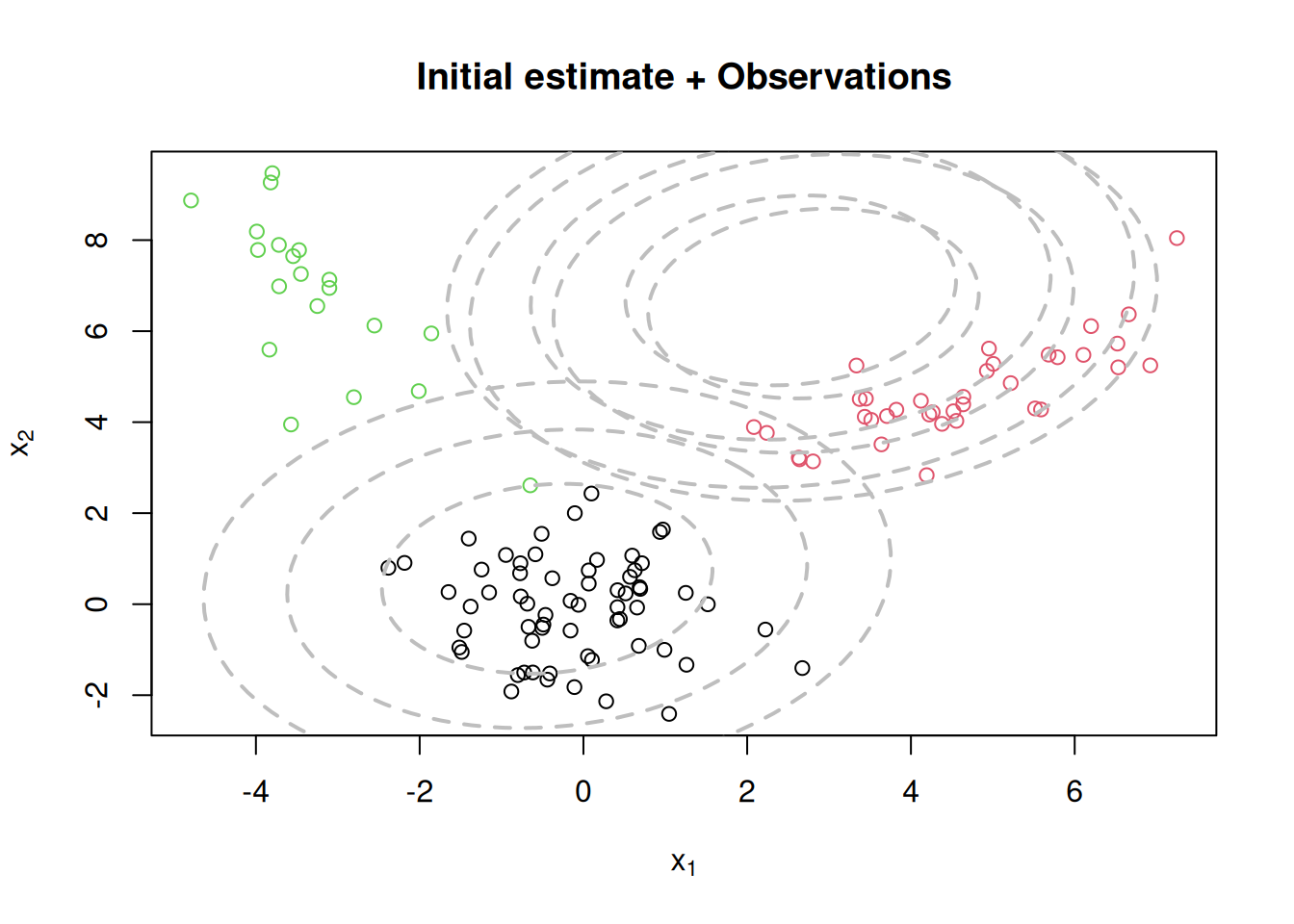
while(!sw){
  ## E step
  v = array(0, dim=c(n,KK))
  for(k in 1:KK){
    v[,k] = log(w[k]) + dmvnorm(x, mu[k,], Sigma[k,,],log=TRUE)  #Compute the log of the weights
  }
  for(i in 1:n){
    v[i,] = exp(v[i,] - max(v[i,]))/sum(exp(v[i,] - max(v[i,])))  #Go from logs to actual weights in a numerically stable manner
  }

  ## M step
  w     = apply(v,2,mean)
  mu    = array(0, dim=c(KK, p))
  for(k in 1:KK){
    for(i in 1:n){
      mu[k,]    = mu[k,] + v[i,k]*x[i,]
    }
    mu[k,] = mu[k,]/sum(v[,k])
  }
  Sigma = array(0, dim=c(KK, p, p))
  for(k in 1:KK){
    for(i in 1:n){
      Sigma[k,,] = Sigma[k,,] + v[i,k]*(x[i,] - mu[k,])%*%t(x[i,] - mu[k,])
    }
    Sigma[k,,] = Sigma[k,,]/sum(v[,k])
  }

  ## Check convergence
  QQn = 0
  for(i in 1:n){
    for(k in 1:KK){
      QQn = QQn + v[i,k]*(log(w[k]) + dmvnorm(x[i,],mu[k,],Sigma[k,,],log=TRUE))
    }
  }
  if(abs(QQn-QQ)/abs(QQn)<epsilon){
    sw=TRUE
  }
  QQ = QQn
  QQ.out = c(QQ.out, QQ)
  s = s + 1
  #print(paste(s, QQn))

  plot_components(QQ.out, s, x, cc, KK, Sigma, mu, c(-200, -100), png_dir = "em_mvn_frames")

}library(magick)Linking to ImageMagick 6.9.11.60
Enabled features: fontconfig, freetype, fftw, heic, lcms, pango, webp, x11
Disabled features: cairo, ghostscript, raw, rsvgUsing 16 threadsmake_em_gif <- function(
frames_dir = ".",
pattern = "frame_*.png",
out_file = "em.gif",
duration_sec = 60
) {
stopifnot(requireNamespace("magick", quietly = TRUE))
files <- sort(Sys.glob(file.path(frames_dir, pattern)))
if (length(files) == 0) stop("No frames found. Check frames_dir/pattern.")
target_fps <- length(files) / duration_sec
allowed <- c(1, 2, 4, 5, 10, 20, 25, 50, 100)
fps <- allowed[which.min(abs(allowed - target_fps))]
img <- magick::image_read(files)
img <- magick::image_animate(img, fps = fps)
magick::image_write(img, path = out_file)
message(sprintf("Wrote %s (%d frames at %d fps ≈ %.1f sec)",
out_file, length(files), fps, length(files)/fps))
invisible(out_file)
}
make_em_gif("em_mvn_frames", out_file = "em.gif", duration_sec = 60)Wrote em.gif (12 frames at 1 fps ≈ 12.0 sec)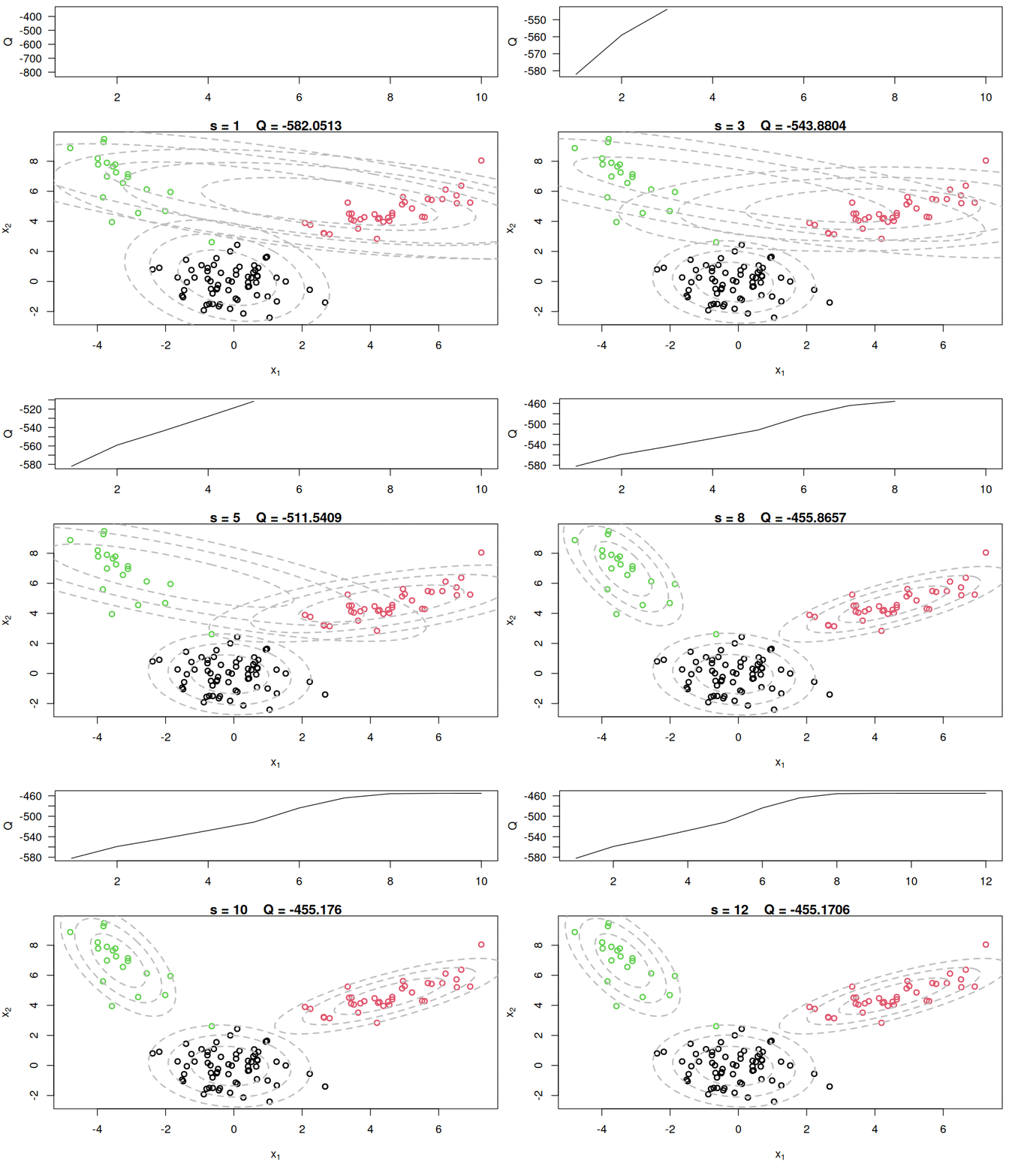
# Plot current components over data
layout(matrix(c(1,2),2,1), widths=c(1,1), heights=c(1.3,3))
par(mar=c(3.1,4.1,0.5,0.5))
plot(QQ.out[1:s],type="l", xlim=c(1,max(10,s)), las=1, ylab="Q", lwd=2)

par(mar=c(5,4,1,0.5))
plot(x[,1], x[,2], col=cc, main=paste("s =",s,"   Q =", round(QQ.out[s],4)), xlab=expression(x[1]), ylab=expression(x[2]))
for(k in 1:KK){
  lines(ellipse(x=Sigma[k,,], centre=mu[k,], level=0.50), col="grey", lty=2, lwd=2)
  lines(ellipse(x=Sigma[k,,], centre=mu[k,], level=0.82), col="grey", lty=2, lwd=2)
  lines(ellipse(x=Sigma[k,,], centre=mu[k,], level=0.95), col="grey", lty=2, lwd=2)
}
If your data had support on the positive real numbers rather than the whole real line, how could you use the EM algorithm you just learned to instead fit a mixture of log-Gaussian distributions?
Would you need to recode your algorithm?
Updating the algorithm is nontrivial - it requires derivatives for each parameter. Depending on the distribution, we may need to add custom code to update each. We also need to update the distribution if these are changed.
So while the algorithm does not change, the code may change quite a bit.
Data on the lifetime (in years) of fuses produced by the ACME Corporation is available in the file fuses.csv:
Provide the EM algorithm to fit the mixture model